

Artificial Intelligence (AI) is transforming the way people create audio content. From YouTube videos and podcasts to audiobooks, e-learning courses, customer support, and business presentations, AI voice generators make it possible to produce natural-sounding speech without recording your own voice.
Modern AI voice generators use advanced deep learning models to convert written text into realistic, expressive speech in multiple languages and accents. Many platforms also support voice cloning, allowing users to create a digital voice model with appropriate permission.
Whether you are a content creator, blogger, educator, marketer, software developer, or business owner, AI voice generators can save time, reduce production costs, and improve content quality.
In this guide, you’ll learn:
- What AI voice generators are
- How AI text-to-speech works
- The technologies behind AI speech synthesis
- Benefits and limitations
- Real-world applications
- The best AI voice generator tools
- Step-by-step tutorials
- Voice cloning basics
- Best practices
- Frequently asked questions
Table of Contents
What Are AI Voice Generators?
AI voice generators are software applications that convert written text into spoken audio using artificial intelligence.
Instead of recording narration manually, you simply enter text, select a voice, and the AI generates speech within seconds.
Many modern tools can produce voices that sound remarkably natural by incorporating pauses, emphasis, pacing, and emotional expression.
How AI Voice Generators Work
Most AI voice generators follow a similar workflow.
Step 1 – Enter Text
The user provides:
- A sentence
- A paragraph
- A blog article
- A presentation script
- A book chapter
- Video narration
- Podcast script
Example:
“Artificial Intelligence is changing the future of technology.”
Step 2 – AI Understands the Text
The AI analyzes:
- Grammar
- Sentence structure
- Pronunciation
- Punctuation
- Context
- Numbers
- Dates
- Abbreviations
This helps produce speech that sounds more natural and easier to understand.
Step 3 – Voice Synthesis
The platform converts text into speech using neural text-to-speech technology.
Many tools let you choose:
- Male or female voices
- Different accents
- Speaking speed
- Emotional tone
- Language
- Voice style
Step 4 – Audio Export
After generation, you can usually export the audio in common formats such as MP3 or WAV, depending on the platform.
Technologies Behind AI Voice Generation
Modern AI voice generators combine several technologies.
Neural Text-to-Speech (Neural TTS)
Neural TTS uses deep learning to create more natural-sounding speech than traditional text-to-speech systems.
Natural Language Processing (NLP)
NLP helps the AI understand punctuation, grammar, sentence flow, and context.
Deep Learning
Deep learning models are trained on large collections of speech data to learn pronunciation, rhythm, and intonation.
Speech Synthesis
Speech synthesis converts processed text into audio that resembles human speech.
Types of AI Voice Generation
Text-to-Speech (TTS)
Converts written text into spoken audio.
Examples:
- Reading blog articles
- Audiobooks
- E-learning lessons
- Video narration
Voice Cloning
Voice cloning creates a synthetic version of a person’s voice from recorded samples.
This technology should only be used with the speaker’s permission and in accordance with applicable laws and platform policies.
AI Dubbing
AI dubbing translates spoken content into another language while preserving timing and natural delivery.
Common use cases include:
- Educational videos
- Product demonstrations
- Marketing campaigns
- International content
AI Voice Changers
Voice changers modify an existing recording rather than generating speech from text.
They are often used in:
- Gaming
- Entertainment
- Podcasts
- Creative media
Benefits of AI Voice Generators
Save Time
Generate professional narration in minutes instead of spending hours recording and editing.
Reduce Costs
Lower the need for studio equipment, microphones, or professional voice actors for many routine projects.
Improve Productivity
Create voiceovers for multiple videos, courses, or presentations quickly.
Support Multiple Languages
Many platforms offer dozens or even hundreds of voices across many languages.
Easy to Update
Need to change one sentence? Simply edit the text and regenerate the audio instead of re-recording the entire script.
Real-World Use Cases
AI voice generators are widely used for:
- YouTube videos
- Podcasts
- Audiobooks
- E-learning courses
- Business presentations
- Marketing videos
- Product demonstrations
- Customer support systems
- IVR phone menus
- Accessibility tools
- News narration
- Virtual assistants
Who Should Use AI Voice Generators?
These tools are useful for:
- Bloggers
- YouTubers
- Podcasters
- Teachers
- Students
- Small businesses
- Marketing teams
- Software developers
- Authors
- Freelancers
- E-learning creators
- Customer support teams
Choosing the Right AI Voice Generator
When comparing AI voice platforms, consider:
- Voice quality
- Language support
- Voice customization
- Voice cloning capabilities
- Commercial licensing
- Pricing
- Export formats
- API availability
- Ease of use
- Integration with your workflow
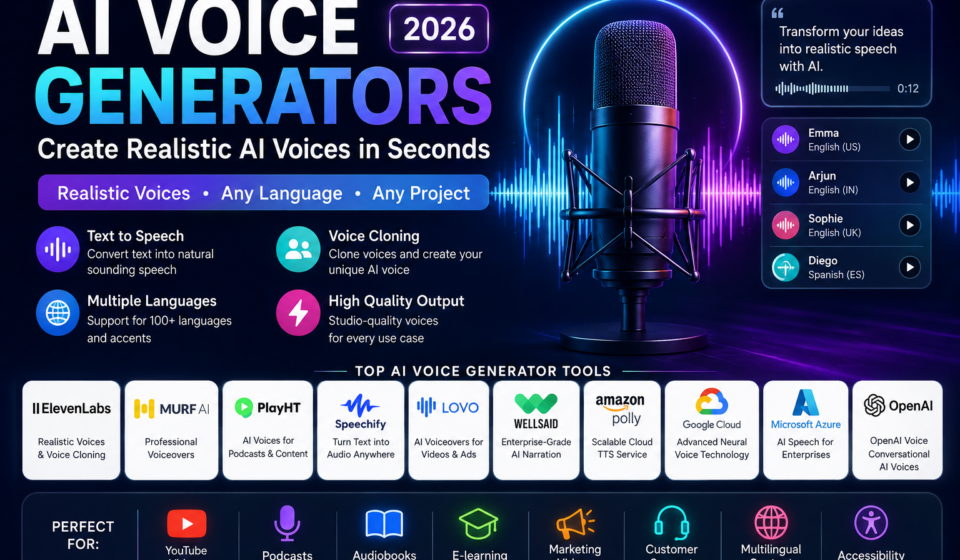
Best AI Voice Generator Tools (2026)
Choosing the right AI voice generator depends on your requirements. Some platforms focus on realistic voice cloning, while others specialize in multilingual narration, podcast production, customer support, or developer APIs.
Below are some of the best AI voice generators available in 2026.
ElevenLabs
Official Website: https://elevenlabs.io
ElevenLabs is one of the most advanced AI voice generation platforms available today. It is known for producing highly realistic voices with natural emotion, excellent pronunciation, and industry-leading voice cloning capabilities.
Best For
- Voice Cloning
- Audiobooks
- YouTube Narration
- Podcasts
- Storytelling
Key Features
- Human-like AI voices
- Voice cloning
- Text-to-speech
- Speech-to-speech
- Multiple languages
- AI dubbing
- API access
Pros
- Outstanding voice quality
- Natural emotional expression
- Easy-to-use interface
Cons
- Limited free usage
- Advanced features require a paid plan
Murf AI
Official Website: https://murf.ai
Murf AI is a professional AI voice generator designed for business presentations, marketing videos, corporate training, and e-learning content.
Best For
- Business Presentations
- E-learning
- Marketing Videos
- Explainer Videos
- Corporate Training
Key Features
- 200+ AI voices
- Multiple languages
- Voice customization
- Team collaboration
- Voiceover editing
Pros
- Professional-quality narration
- Excellent for business use
- Beginner-friendly interface
Cons
- Premium voices require a subscription
PlayHT
Official Website: https://play.ht
PlayHT provides realistic AI voice generation and voice cloning with support for hundreds of voices across many languages. It is popular among podcasters and developers.
Best For
- Podcasts
- AI Voice APIs
- Articles
- Blog Narration
- Customer Support
Key Features
- Text-to-speech
- Voice cloning
- AI podcasts
- Multiple accents
- API integration
Pros
- Natural speech
- Large voice library
- Fast generation
Cons
- Free plan has usage limits
Speechify
Official Website: https://speechify.com
Speechify converts documents, PDFs, webpages, and articles into natural-sounding audio, making it an excellent accessibility and productivity tool.
Best For
- Students
- Professionals
- Reading Articles
- PDFs
- Accessibility
Key Features
- OCR support
- AI reading
- Mobile apps
- Multiple languages
- Speed control
Pros
- Easy to use
- Excellent mobile experience
- Natural narration
Cons
- Some premium voices require payment
Lovo AI
Official Website: https://lovo.ai
Lovo AI is an AI-powered voice generation platform offering expressive voices for videos, advertisements, YouTube content, and e-learning.
Best For
- YouTube Videos
- Marketing
- Training Videos
- Advertising
- Podcasts
Key Features
- AI voiceovers
- Voice cloning
- AI script writing
- Video editor
- Multilingual support
Pros
- High-quality voices
- Integrated video editing
- Beginner friendly
Cons
- Advanced features available on higher-tier plans
WellSaid Labs
Official Website: https://wellsaidlabs.com
WellSaid Labs specializes in premium AI narration for enterprise customers, training content, educational materials, and commercial projects.
Best For
- Enterprise
- Corporate Training
- Professional Narration
- E-learning
Key Features
- Studio-quality voices
- Team collaboration
- Enterprise security
- Commercial licensing
Pros
- Extremely professional voices
- Reliable enterprise platform
Cons
- Higher pricing than many competitors
Amazon Polly
Official Website: https://aws.amazon.com/polly/
Amazon Polly is Amazon Web Services’ cloud-based text-to-speech service for developers and businesses.
Best For
- Developers
- Mobile Apps
- Websites
- Cloud Applications
- IVR Systems
Key Features
- Neural voices
- API integration
- Multiple languages
- SSML support
- Scalable cloud infrastructure
Pros
- Reliable cloud service
- Strong developer ecosystem
- Flexible API
Cons
- Requires AWS knowledge for advanced integration
Google Cloud Text-to-Speech
Official Website: https://cloud.google.com/text-to-speech
Google Cloud Text-to-Speech provides high-quality neural voices and integrates with Google Cloud services.
Best For
- Developers
- Enterprise Applications
- Cloud Solutions
- AI Projects
Key Features
- Neural voices
- WaveNet technology
- API support
- 50+ languages
- SSML support
Pros
- Excellent voice quality
- Reliable cloud platform
- Extensive language support
Cons
- Usage-based pricing
Microsoft Azure AI Speech
Official Website: https://azure.microsoft.com/products/ai-services/ai-speech
Microsoft Azure AI Speech offers advanced text-to-speech, speech recognition, translation, and custom voice capabilities.
Best For
- Enterprise
- Developers
- AI Applications
- Business Automation
Key Features
- Neural text-to-speech
- Custom voice creation
- Speech translation
- Speech recognition
- Azure integration
Pros
- Enterprise-grade security
- Powerful APIs
- High scalability
Cons
- Can be complex for beginners
OpenAI Voice
Official Website: https://chatgpt.com
OpenAI Voice provides natural conversational speech integrated into ChatGPT. It is designed for interactive AI conversations, multilingual communication, and voice-based assistance.
Best For
- Conversational AI
- Productivity
- Language Learning
- Interactive Assistants
Key Features
- Natural conversations
- Multiple voices
- Fast responses
- Multilingual support
- AI assistant integration
Pros
- Realistic conversational voices
- Easy to use
- Excellent multilingual capabilities
Cons
- Some advanced features depend on your plan
AI Voice Generator Comparison
| Tool | Free Plan | Best For |
|---|---|---|
| ElevenLabs | ✅ | Voice Cloning |
| Murf AI | ✅ | Business Voiceovers |
| PlayHT | ✅ | Podcasts |
| Speechify | ✅ | Reading Documents |
| Lovo AI | ✅ | YouTube Videos |
| WellSaid Labs | Trial | Enterprise |
| Amazon Polly | Free Tier | Developers |
| Google Cloud TTS | Free Tier | APIs |
| Azure AI Speech | Free Tier | Enterprise |
| OpenAI Voice | Limited | Conversational AI |
Common Limitations
While AI voice technology has improved significantly, keep these points in mind:
- Some free plans include usage limits.
- Premium voices may require a subscription.
- Voice cloning should only be performed with appropriate permission.
- AI pronunciation may occasionally need manual adjustments for uncommon names or technical terms.
Conclusion
AI voice generators have become valuable tools for content creators, educators, businesses, and developers. They simplify the process of producing high-quality narration while reducing both time and production costs.
Choosing the right platform depends on your goals, whether you need realistic narration, multilingual support, podcast production, educational content, or developer APIs.
In the next part of this guide, we’ll compare the best AI voice generator tools—including ElevenLabs, Murf AI, PlayHT, Lovo AI, Speechify, WellSaid Labs, Amazon Polly, Google Cloud Text-to-Speech, Microsoft Azure AI Speech, and OpenAI Voice—with tutorials, official resources, pricing, strengths, and limitations.