

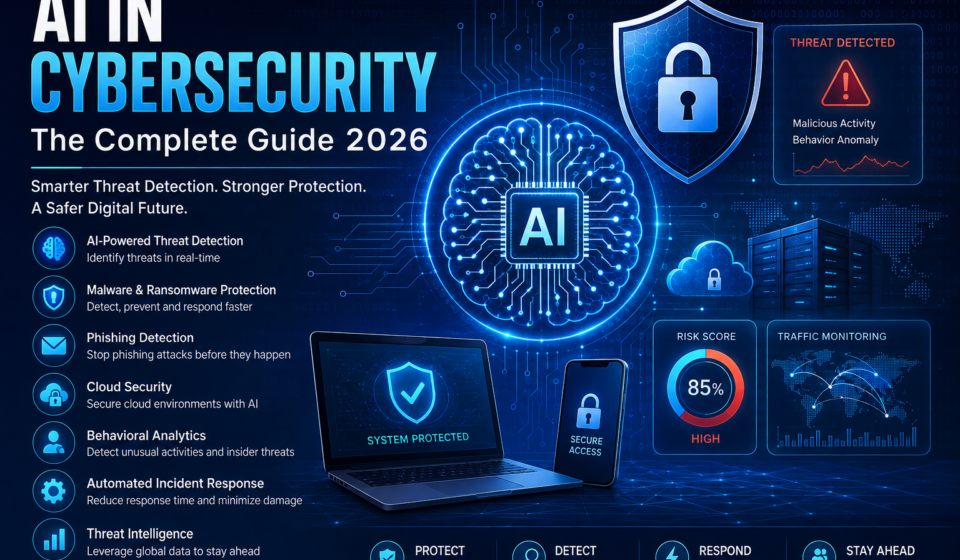

Cyberattacks have become more sophisticated than ever before. Traditional security systems that rely solely on predefined rules and human monitoring often struggle to keep pace with rapidly evolving threats. Organizations now face ransomware, phishing campaigns, zero-day exploits, insider threats, and AI-powered attacks that can spread across networks within minutes.
Artificial Intelligence (AI) is transforming cybersecurity by enabling systems to detect threats, analyze suspicious behavior, automate responses, and continuously learn from new attack patterns. Instead of waiting for human analysts to identify malicious activity, AI can monitor millions of events every second, identify anomalies, and respond in real time.
Whether you’re an IT professional, student, cybersecurity enthusiast, or business owner, understanding how AI is reshaping digital security is essential. This guide explains AI in cybersecurity from the ground up, covering how it works, where it’s used, its benefits, challenges, and what the future holds.
Table of Contents
What is AI in Cybersecurity?
Artificial Intelligence in cybersecurity refers to the use of intelligent computer systems that can analyze data, recognize attack patterns, detect suspicious behavior, predict threats, and automatically respond to cyber incidents without requiring constant human intervention.
Unlike traditional security software that depends on manually written rules and known malware signatures, AI continuously learns from large amounts of security data. This enables it to identify previously unknown threats, making it highly effective against modern cyberattacks.
AI-powered cybersecurity systems can:
- Detect malware
- Identify phishing attacks
- Analyze network traffic
- Monitor user behavior
- Prevent account takeovers
- Detect insider threats
- Stop ransomware
- Automate incident response
- Predict future attacks
- Reduce false alarms
Why AI is Becoming Essential in Cybersecurity
The digital world is growing rapidly. Every day, organizations generate enormous amounts of data across cloud platforms, mobile devices, IoT systems, and enterprise networks. Human security teams cannot manually analyze every login attempt, email, file transfer, or network connection.
Several factors have accelerated the adoption of AI in cybersecurity:
Increasing Cyberattacks
Cybercriminals use automation, AI, and advanced malware to launch attacks at unprecedented speed. Traditional security systems often detect threats only after damage has occurred.
Massive Data Volumes
Modern enterprises generate billions of security events every day. AI can process this data in real time and highlight meaningful threats.
Shortage of Cybersecurity Professionals
The global demand for cybersecurity experts exceeds the available workforce. AI helps bridge this gap by automating repetitive tasks and assisting analysts.
Faster Threat Detection
AI significantly reduces the time required to identify and respond to security incidents, minimizing financial and operational damage.
How AI Improves Cybersecurity
AI enhances nearly every stage of the cybersecurity lifecycle.
1. Threat Detection
AI continuously monitors:
- Network traffic
- User activity
- Email communications
- Device behavior
- Cloud infrastructure
- Application logs
Instead of looking only for known attack signatures, AI identifies unusual patterns that may indicate an attack.
Example:
If an employee who normally logs in from India suddenly accesses sensitive systems from another country at 3:00 AM and downloads large amounts of data, AI can immediately flag or block the activity.
2. Malware Detection
Traditional antivirus software depends heavily on malware signatures. New malware variants can evade signature-based detection until updates are released.
AI identifies malware by analyzing:
- File behavior
- Code characteristics
- Execution patterns
- Memory usage
- Process relationships
This behavioral analysis enables AI to detect previously unseen malware families.
3. Phishing Detection
Phishing remains one of the most common cyber threats.
AI examines:
- Email content
- Writing style
- Sender reputation
- URL structure
- Domain age
- Attachments
- Embedded links
It can identify sophisticated phishing emails that appear legitimate but contain subtle indicators of fraud.
4. Network Monitoring
Modern networks contain thousands of devices.
AI continuously monitors:
- Traffic flow
- Connection patterns
- Data transfers
- Login attempts
- Device communication
- DNS requests
Suspicious activity is detected immediately, enabling rapid investigation.
5. User Behavior Analytics (UBA)
AI learns what “normal” behavior looks like for each user.
It monitors:
- Login times
- Access locations
- Applications used
- File access patterns
- Device usage
- Typing behavior (in advanced systems)
When behavior deviates significantly from the norm, AI generates an alert or triggers automated protective actions.
AI vs Traditional Cybersecurity
| Feature | Traditional Security | AI-Powered Security |
|---|---|---|
| Detection Method | Rules and signatures | Behavioral analysis + learning |
| Unknown Threat Detection | Limited | Excellent |
| Speed | Slower | Real-time |
| Learning Ability | Manual updates | Continuous learning |
| Scalability | Limited | Very high |
| False Positives | Higher | Lower with training |
| Automation | Low | High |
| Adaptability | Limited | Dynamic |
Core Technologies Behind AI Security
Several AI technologies work together to strengthen cybersecurity.
Machine Learning (ML)
Machine Learning enables systems to learn from historical attack data and recognize similar threats in the future.
Applications include:
- Spam filtering
- Fraud detection
- Malware classification
- Threat prediction
Deep Learning
Deep Learning uses neural networks to analyze complex security data.
It excels at:
- Image-based CAPTCHA analysis
- Advanced malware detection
- Network anomaly detection
- Complex attack identification
Natural Language Processing (NLP)
NLP helps AI understand human language.
Cybersecurity applications include:
- Email analysis
- Phishing detection
- Threat intelligence analysis
- Dark web monitoring
- Security report summarization
Behavioral Analytics
Behavioral analytics focuses on identifying unusual actions rather than known attack signatures.
Examples:
- Unusual employee activity
- Insider threats
- Credential theft
- Account compromise
Benefits of AI in Cybersecurity
Faster Threat Detection
AI identifies attacks within seconds instead of hours or days.
Reduced Response Time
Automated systems isolate infected devices and block malicious activity immediately.
Better Accuracy
AI reduces false positives by learning which activities are normal and which are suspicious.
Continuous Monitoring
Unlike humans, AI systems operate 24/7 without fatigue.
Improved Incident Response
AI automatically:
- Blocks IP addresses
- Quarantines files
- Disables compromised accounts
- Isolates infected endpoints
- Generates incident reports
Cost Savings
Automation reduces manual workloads, allowing security teams to focus on high-priority investigations.
Industries Using AI in Cybersecurity
AI security is widely adopted across sectors:
Banking
- Fraud detection
- Payment protection
- Identity verification
Healthcare
- Patient data protection
- Medical device security
- Ransomware prevention
Government
- National security
- Critical infrastructure defense
- Threat intelligence
E-commerce
- Payment fraud prevention
- Customer account protection
- Bot detection
Education
- Student data security
- Cloud application protection
- Network monitoring
Manufacturing
- Industrial IoT security
- Operational technology protection
- Supply chain monitoring
Current Cybersecurity Landscape
Organizations today face increasingly complex threats, including:
- AI-generated phishing emails
- Ransomware-as-a-Service (RaaS)
- Supply chain attacks
- Cloud misconfigurations
- Insider threats
- Credential theft
- Deepfake-based social engineering
- IoT attacks
- API attacks
AI provides organizations with the ability to detect these evolving threats more quickly and accurately than traditional approaches.
The Future of AI in Cybersecurity
The future of cybersecurity will rely heavily on AI-driven technologies capable of predicting, preventing, and responding to threats autonomously.
Emerging trends include:
- Autonomous Security Operations Centers (SOCs)
- Predictive threat intelligence
- AI-powered Zero Trust architectures
- Self-healing networks
- AI-driven vulnerability management
- Quantum-resistant security solutions
- Explainable AI (XAI) for security decisions
As cyber threats continue to evolve, AI will become a foundational component of modern cybersecurity strategies.
How Does AI Work in Cybersecurity?
Artificial Intelligence (AI) in cybersecurity works by collecting massive amounts of security data, analyzing it using intelligent algorithms, identifying suspicious patterns, predicting potential threats, and automatically responding to cyberattacks.
Unlike traditional security tools that rely only on predefined rules or malware signatures, AI continuously learns from new data. This enables it to detect previously unseen threats, reduce false positives, and improve its accuracy over time.
The typical AI-powered cybersecurity workflow includes:
- Data Collection
- Data Processing
- Feature Extraction
- Machine Learning Model Training
- Threat Detection
- Risk Scoring
- Automated Response
- Continuous Learning
AI Cybersecurity Architecture
The following architecture illustrates how AI protects an organization from cyber threats.
                 Users / Devices / Servers / Cloud
                           │
                           ▼
                Security Data Collection Layer
────────────────────────────────────────────────
• Network Traffic
• Login Activities
• Email Logs
• Firewall Logs
• Endpoint Data
• Cloud Logs
• IoT Devices
────────────────────────────────────────────────
                           │
                           ▼
              Data Processing & Normalization
────────────────────────────────────────────────
• Remove duplicate data
• Clean corrupted records
• Standardize formats
• Organize security events
────────────────────────────────────────────────
                           │
                           ▼
             Machine Learning & AI Engine
────────────────────────────────────────────────
• Pattern Recognition
• Behavioral Analysis
• Threat Prediction
• Malware Classification
• User Behavior Analytics
• Risk Scoring
────────────────────────────────────────────────
                           │
                           ▼
              Threat Detection Engine
────────────────────────────────────────────────
• Malware
• Phishing
• Insider Threats
• Ransomware
• Bot Activity
• Credential Theft
────────────────────────────────────────────────
                           │
                           ▼
              Automated Security Response
────────────────────────────────────────────────
• Block IP
• Quarantine File
• Disable User
• Isolate Device
• Notify SOC
• Generate Alert
────────────────────────────────────────────────
                           │
                           ▼
                 Continuous Learning
Step 1: Data Collection
AI systems begin by collecting information from multiple sources across the IT environment.
Common Data Sources
- Firewalls
- Antivirus software
- Endpoint Detection and Response (EDR)
- Cloud platforms
- Identity management systems
- Web applications
- Email servers
- DNS servers
- VPN gateways
- Network switches
- Routers
- IoT devices
- Security Information and Event Management (SIEM) platforms
Example
An organization with 5,000 employees may generate millions of security events every day, including:
- User logins
- File downloads
- Email attachments
- Network requests
- USB device activity
- API calls
- Cloud access logs
AI can process all of these events simultaneously, something that would be impractical for human analysts alone.
Step 2: Data Processing
Raw security data often contains duplicate entries, inconsistent formats, and irrelevant information.
Before analysis, AI systems perform preprocessing tasks such as:
- Removing duplicate events
- Filtering noise
- Correcting formatting issues
- Synchronizing timestamps
- Aggregating related events
- Enriching logs with contextual information (e.g., asset criticality or threat intelligence)
This results in structured, high-quality data suitable for machine learning.
Step 3: Feature Extraction
AI does not analyze raw data directly. Instead, it extracts meaningful characteristics (features) that help distinguish normal behavior from malicious activity.
Example Features
For a login event:
- Login time
- Geographic location
- Device type
- Browser
- Operating system
- IP reputation
- Number of failed attempts
- Multi-factor authentication status
For network traffic:
- Packet size
- Protocol
- Connection frequency
- Destination country
- Data transfer volume
- Session duration
These features become the inputs for AI models.
Step 4: Machine Learning in Cybersecurity
Machine Learning (ML) is the core technology that allows AI systems to recognize patterns and make predictions based on historical data.
Supervised Learning
The model is trained using labeled datasets where the outcome is already known.
Example:
| File | Label |
|---|---|
| File A | Malware |
| File B | Safe |
| File C | Malware |
| File D | Safe |
The model learns to classify future files as malicious or benign.
Common use cases:
- Malware detection
- Spam filtering
- Fraud detection
- Phishing classification
Unsupervised Learning
In this approach, the AI receives unlabeled data and identifies patterns or anomalies on its own.
This is particularly useful for detecting:
- Insider threats
- Zero-day attacks
- Unknown malware
- Network anomalies
Example:
If one employee suddenly downloads 100 GB of confidential data at midnight—far outside their normal behavior—the AI flags it as suspicious, even if no prior rule exists.
Reinforcement Learning
Reinforcement Learning enables AI to improve through feedback. It receives rewards for correct decisions and penalties for incorrect ones, gradually optimizing its actions.
Potential cybersecurity applications include:
- Adaptive firewall policies
- Automated incident response
- Dynamic access control
- Network defense optimization
Deep Learning in Cybersecurity
Deep Learning uses artificial neural networks with multiple layers to detect highly complex patterns that traditional algorithms may miss.
Common Applications
- Advanced malware detection
- Deepfake identification
- Email phishing analysis
- Image-based CAPTCHA recognition
- Threat intelligence analysis
Why It Matters
Modern malware often changes its code to evade signature-based detection. Deep learning models focus on behavior and underlying patterns rather than exact code matches, making them more resilient.
Neural Networks
Neural networks are inspired by the way the human brain processes information.
A simplified flow:
Input Layer
      │
      ▼
Hidden Layer 1
      │
      ▼
Hidden Layer 2
      │
      ▼
Output Layer
For cybersecurity, inputs might include:
- File size
- Network behavior
- API usage
- Process activity
- Memory access patterns
The output could be:
- Safe
- Suspicious
- Malware
- High Risk
Behavioral Analytics
Behavioral Analytics focuses on how users, devices, and applications normally behave.
Instead of relying solely on signatures, AI builds a baseline of expected activity and detects deviations.
Example
Normal behavior:
- Login: 9:00 AM
- Location: New Delhi
- Device: Office Laptop
- Files accessed: HR documents
Suspicious behavior:
- Login: 2:45 AM
- Location: Another country
- Device: Unknown laptop
- Files accessed: Financial records and source code
The AI assigns a high-risk score and can trigger additional verification or block the session.
Threat Detection Workflow
Security Event
      │
      ▼
Data Collection
      │
      ▼
Machine Learning Analysis
      │
      ▼
Behavior Comparison
      │
      ▼
Risk Score Generation
      │
      ▼
Threat Classification
      │
      ▼
Security Response
This pipeline allows organizations to detect and respond to threats in seconds.
Risk Scoring
AI assigns a numerical risk score to each event based on factors such as:
- User identity
- Asset sensitivity
- Device trust level
- Threat intelligence
- Behavioral anomalies
- Historical activity
Example
| Event | Risk Score | Action |
|---|---|---|
| Employee login from office | 5 | Allow |
| Login from trusted home device | 20 | Allow |
| Multiple failed logins | 55 | Challenge with MFA |
| Unknown device downloading sensitive files | 85 | Alert security team |
| Confirmed ransomware behavior | 100 | Isolate endpoint immediately |
Risk scoring helps prioritize investigations and reduce alert fatigue.
Automated Incident Response
Once AI identifies a credible threat, it can execute predefined actions automatically.
Examples include:
- Blocking malicious IP addresses
- Quarantining infected files
- Disabling compromised user accounts
- Isolating endpoints from the network
- Terminating malicious processes
- Triggering Multi-Factor Authentication (MFA)
- Notifying the Security Operations Center (SOC)
- Opening a ticket in an incident management system
Automation significantly reduces the time between detection and containment.
AI and Threat Intelligence
AI also enhances threat intelligence by aggregating information from:
- Public vulnerability databases
- Malware repositories
- Dark web monitoring
- Security advisories
- Industry threat feeds
It correlates this external intelligence with internal events, enabling faster identification of emerging attack campaigns.
Key Takeaways
- AI processes vast amounts of security data far faster than humans.
- Machine Learning identifies known and unknown threats through pattern recognition.
- Deep Learning improves detection of sophisticated attacks such as polymorphic malware and advanced phishing.
- Behavioral Analytics detects suspicious activities by learning what “normal” looks like.
- Risk scoring helps prioritize the most critical security incidents.
- Automated response reduces the time needed to contain attacks and minimizes potential damage.
Real-World Applications of AI in Cybersecurity
Artificial Intelligence is no longer an experimental technology in cybersecurity. It is now a core component of enterprise security strategies, helping organizations detect, prevent, and respond to cyber threats faster than traditional methods.
AI is used across every layer of modern IT infrastructure—from endpoints and networks to cloud platforms, email systems, identity management, and Security Operations Centers (SOCs).
Let’s explore the most important real-world applications of AI in cybersecurity.
1. AI for Malware Detection
Traditional antivirus software identifies malware using known signatures. While effective against previously identified threats, it may struggle with new or modified malware variants.
AI enhances malware detection by analyzing behavior rather than relying solely on signatures.
How AI Detects Malware
AI evaluates characteristics such as:
- File behavior
- Process execution
- Memory usage
- Registry changes
- Network communication
- API calls
- Encryption activity
If a program begins encrypting thousands of files unexpectedly, AI can identify ransomware-like behavior and stop it before significant damage occurs.
Example
A newly discovered ransomware sample has no known signature.
Traditional antivirus:
- May not detect it immediately.
AI-powered security:
- Recognizes suspicious encryption behavior.
- Stops the process.
- Isolates the infected device.
- Alerts the security team.
2. AI for Phishing Detection
Phishing attacks continue to evolve, using convincing language, fake login pages, QR codes, and even AI-generated content.
AI improves email security by examining multiple indicators simultaneously.
AI Analyzes
- Sender reputation
- Domain age
- URL structure
- Writing style
- Attachment behavior
- Embedded scripts
- Historical communication patterns
Example
An email appears to come from the finance department requesting an urgent payment.
AI notices:
- The sender domain differs by one character.
- The domain was registered recently.
- The writing style is inconsistent with previous messages.
The email is automatically quarantined before reaching employees.
3. AI for Ransomware Protection
Ransomware encrypts files and demands payment for their recovery.
AI detects ransomware by monitoring system behavior instead of waiting for malware signatures.
Warning Signs Detected by AI
- Rapid file encryption
- Unusual file renaming
- Mass deletion of backups
- Suspicious PowerShell commands
- High disk activity
- Unauthorized privilege escalation
Automatic Response
- Stop malicious processes
- Disconnect the affected endpoint
- Protect shared drives
- Notify administrators
- Preserve forensic evidence
This rapid response can prevent ransomware from spreading across the organization.
4. AI for Network Security
Enterprise networks generate millions of connections every day.
AI continuously analyzes network traffic to identify unusual activity.
AI Detects
- Port scanning
- Distributed Denial-of-Service (DDoS) attacks
- Command-and-control communication
- Lateral movement
- Data exfiltration
- Suspicious DNS requests
Example
A workstation suddenly begins communicating with servers in multiple countries and transfers unusually large amounts of encrypted data.
AI flags the behavior as abnormal and blocks the communication until it is investigated.
5. AI in Endpoint Detection and Response (EDR)
Endpoints such as laptops, desktops, and servers are common attack targets.
AI-powered EDR solutions monitor endpoint activity in real time.
AI Monitors
- Running processes
- Installed applications
- USB device activity
- Registry modifications
- File creation
- Command execution
- User behavior
Benefits
- Early attack detection
- Automated isolation of infected devices
- Detailed attack timelines
- Faster incident investigations
6. AI in Extended Detection and Response (XDR)
XDR expands visibility beyond endpoints by correlating data across multiple security layers.
XDR Collects Data From
- Endpoints
- Email systems
- Firewalls
- Cloud platforms
- Identity providers
- Network devices
- Security Information and Event Management (SIEM) systems
AI analyzes these data sources together to identify complex attack chains that might appear harmless when viewed individually.
7. AI in Security Operations Centers (SOC)
Modern Security Operations Centers receive thousands of alerts every day.
Many alerts are duplicates or false positives, making it difficult for analysts to focus on genuine threats.
AI helps SOC teams by:
- Prioritizing alerts
- Grouping related incidents
- Suggesting investigation paths
- Automating repetitive tasks
- Recommending response actions
Example Workflow
Security Alert
      │
      ▼
AI Correlation Engine
      │
      ▼
Risk Analysis
      │
      ▼
Priority Assignment
      │
      ▼
SOC Analyst Review
      │
      ▼
Automated Response (if approved)
This reduces alert fatigue and improves operational efficiency.
8. AI in Identity and Access Management (IAM)
Compromised credentials remain one of the leading causes of data breaches.
AI strengthens Identity and Access Management by continuously evaluating login behavior.
AI Evaluates
- Login location
- Device trust
- User role
- Time of access
- Historical behavior
- Network reputation
Example
An employee typically logs in from Mumbai during office hours.
A login attempt occurs at 3:00 AM from another country using an unknown device.
AI immediately:
- Increases the risk score.
- Requires Multi-Factor Authentication (MFA).
- Blocks access if verification fails.
9. AI in Cloud Security
Cloud environments are dynamic, making manual monitoring difficult.
AI continuously protects cloud infrastructure by identifying:
- Misconfigured storage buckets
- Excessive permissions
- Unauthorized access
- Suspicious API activity
- Data leaks
- Vulnerable workloads
Example
A cloud storage bucket containing sensitive customer data is accidentally made public.
AI detects the configuration change, generates an alert, and can automatically recommend or apply corrective actions based on policy.
10. AI in Zero Trust Security
Zero Trust follows the principle:
“Never Trust, Always Verify.”
AI makes Zero Trust more effective by continuously assessing risk instead of relying on one-time authentication.
AI Evaluates
- User identity
- Device health
- Location
- Application sensitivity
- User behavior
- Network context
If risk increases during a session, AI can:
- Request re-authentication.
- Restrict access.
- End the session.
- Notify security teams.
11. AI for Insider Threat Detection
Not all cybersecurity threats originate outside the organization.
Employees, contractors, or compromised internal accounts may intentionally or unintentionally expose sensitive information.
AI identifies insider threats through behavioral analytics.
Indicators
- Unusual file downloads
- Accessing unfamiliar systems
- Excessive printing
- Data uploads to personal cloud storage
- Repeated failed login attempts
- Privilege abuse
By learning normal behavior patterns, AI can detect suspicious internal activity early.
12. AI for Fraud Detection
Banks, financial institutions, and e-commerce platforms rely heavily on AI to detect fraud.
AI Monitors
- Transaction value
- Purchase location
- Device fingerprint
- Spending habits
- Login behavior
- Payment method
Example
A customer usually shops within one city.
Within minutes:
- A purchase is attempted from another continent.
- The amount is significantly higher than normal.
- A new device is used.
AI blocks the transaction until additional verification is completed.
Industry Use Cases
| Industry | AI Cybersecurity Applications |
|---|---|
| Banking | Fraud detection, payment security, account protection |
| Healthcare | Patient data protection, ransomware defense, medical device monitoring |
| Government | Critical infrastructure protection, threat intelligence, identity verification |
| Retail & E-commerce | Payment fraud detection, bot mitigation, account security |
| Manufacturing | Industrial IoT security, operational technology monitoring |
| Education | Student data protection, cloud security, phishing prevention |
| Telecommunications | Network monitoring, DDoS detection, service availability |
AI in Incident Response
When AI confirms a threat, it can perform multiple actions automatically.
Automated Actions
- Block malicious IP addresses
- Disable compromised user accounts
- Quarantine infected files
- Isolate affected endpoints
- Terminate malicious processes
- Force password resets
- Trigger Multi-Factor Authentication
- Notify security teams
- Generate incident reports
Automating these actions significantly reduces the time required to contain attacks.
Benefits of AI Applications in Cybersecurity
- Detects threats in real time
- Identifies unknown attack patterns
- Reduces false positives
- Automates repetitive security tasks
- Improves analyst productivity
- Enhances cloud security
- Strengthens identity protection
- Supports Zero Trust strategies
- Accelerates incident response
- Protects critical business assets
Key Takeaways
- AI is integrated into nearly every aspect of modern cybersecurity.
- It protects endpoints, networks, cloud platforms, email systems, identities, and enterprise applications.
- Behavioral analysis enables AI to detect previously unknown threats.
- AI-powered automation reduces response times from hours to seconds.
- Organizations across banking, healthcare, government, retail, and manufacturing increasingly rely on AI to improve cyber resilience.
External Resources (Authoritative)
For additional learning and to strengthen your article’s authority, consider linking to:
- National Institute of Standards and Technology (NIST) – AI Risk Management Framework and Cybersecurity Framework.
- MITRE ATT&CK – Knowledge base of adversary tactics and techniques.
- Open Worldwide Application Security Project (OWASP) – Web application security resources.
- Cybersecurity and Infrastructure Security Agency (CISA) – Guidance on emerging cyber threats.
- European Union Agency for Cybersecurity (ENISA) – Reports on AI and cybersecurity.
These trusted sources can improve user trust and complement your content without linking to competitors.
Advantages of AI in Cybersecurity
Artificial Intelligence has become one of the most valuable technologies in modern cybersecurity because it can process massive volumes of security data, recognize complex attack patterns, and respond to threats faster than human analysts alone.
Below are the major advantages of AI-powered cybersecurity.
1. Real-Time Threat Detection
Traditional security systems may require minutes or even hours to detect an attack.
AI continuously monitors:
- Network traffic
- Endpoints
- Cloud environments
- Email systems
- User activity
- Identity services
This enables threats to be identified within seconds.
Example
If ransomware starts encrypting files, AI can detect abnormal file activity almost immediately and isolate the affected device before the malware spreads.
2. Detection of Unknown Threats
Signature-based security solutions can only identify threats that are already known.
AI uses behavioral analysis to identify:
- Zero-day attacks
- Unknown malware
- Insider threats
- Advanced Persistent Threats (APTs)
- New phishing campaigns
This significantly improves protection against emerging cyber threats.
3. Reduced False Positives
Security teams often spend valuable time investigating alerts that turn out to be harmless.
AI improves alert quality by:
- Learning normal behavior
- Correlating multiple data sources
- Assigning contextual risk scores
- Continuously refining detection models
As a result, analysts can focus on genuine threats.
4. Faster Incident Response
AI reduces the time between threat detection and containment.
Instead of waiting for manual intervention, AI can automatically:
- Block malicious IP addresses
- Disable compromised accounts
- Isolate infected endpoints
- Quarantine suspicious files
- Trigger Multi-Factor Authentication (MFA)
- Notify security teams
5. Continuous Monitoring
Cyberattacks can occur at any time.
Unlike human analysts, AI systems operate 24 hours a day, 7 days a week without fatigue.
Continuous monitoring increases the likelihood of detecting attacks before significant damage occurs.
6. Improved Threat Intelligence
AI collects and analyzes information from:
- Security logs
- Threat intelligence feeds
- Vulnerability databases
- Malware repositories
- Dark web monitoring
- Security advisories
By correlating these sources, AI provides a broader understanding of the evolving threat landscape.
7. Enhanced Productivity
Security professionals often spend time on repetitive tasks.
AI automates:
- Log analysis
- Alert prioritization
- Malware classification
- Incident reporting
- Routine investigations
This allows cybersecurity teams to concentrate on strategic and complex security challenges.
Challenges of AI in Cybersecurity
Although AI offers many advantages, it is not a complete replacement for human expertise.
Organizations must understand its limitations before deployment.
1. High Implementation Costs
Developing and deploying AI security solutions requires investment in:
- Computing infrastructure
- Skilled personnel
- Security platforms
- High-quality datasets
- Continuous model maintenance
Large enterprises may adopt AI more easily than smaller organizations with limited budgets.
2. Data Quality Requirements
AI depends on accurate and representative data.
Poor-quality data can lead to:
- Incorrect predictions
- Missed threats
- Increased false positives
- Biased decision-making
Maintaining clean, well-labeled, and current datasets is essential.
3. Skilled Workforce Requirements
AI systems require professionals with expertise in:
- Cybersecurity
- Machine Learning
- Data Science
- Cloud Computing
- Security Operations
Organizations may face challenges in recruiting and retaining these specialists.
4. Adversarial AI Attacks
Cybercriminals are increasingly attempting to manipulate AI systems.
Examples include:
- Poisoning training datasets
- Crafting adversarial inputs
- Evading machine learning models
- Manipulating AI-generated risk scores
Protecting AI models is becoming an important area of cybersecurity research.
5. Model Drift
Threats evolve continuously.
AI models trained on outdated data may gradually lose effectiveness, a phenomenon known as model drift.
Organizations should regularly:
- Retrain models
- Validate performance
- Update threat intelligence
- Monitor detection accuracy
Risks of AI in Cybersecurity
Like any technology, AI introduces new risks alongside its benefits.
Over-Reliance on Automation
Organizations should avoid assuming AI will always make correct decisions.
Human oversight remains essential for:
- High-impact decisions
- Regulatory compliance
- Incident investigations
- Strategic planning
Privacy Concerns
AI often analyzes large amounts of personal and organizational data.
This raises questions about:
- Data collection
- User consent
- Data retention
- Regulatory compliance
- Responsible AI governance
Organizations should align AI deployments with applicable privacy regulations and internal policies.
Explainability
Some advanced AI models operate as “black boxes,” making it difficult to understand why a particular decision was made.
This can create challenges when:
- Investigating incidents
- Explaining automated actions
- Demonstrating regulatory compliance
- Building user trust
To address this, many organizations are adopting Explainable AI (XAI) techniques that provide more transparent reasoning.
Ethical Considerations
Responsible AI adoption requires balancing security effectiveness with fairness and accountability.
Important ethical principles include:
- Transparency
- Accountability
- Fairness
- Human oversight
- Privacy protection
- Secure data handling
Organizations should document how AI systems make decisions and establish processes for reviewing automated actions.
AI Used by Cybercriminals
Artificial Intelligence is also being used to improve offensive cyber capabilities.
Potential malicious uses include:
- AI-generated phishing emails
- Deepfake voice and video scams
- Automated vulnerability discovery
- Password guessing optimization
- Malware capable of adapting its behavior
- Social engineering at scale
These developments highlight why defenders must continue improving AI-powered security capabilities.
AI vs Human Cybersecurity Analysts
| Feature | AI | Human Analyst |
|---|---|---|
| Speed | Excellent | Moderate |
| Continuous Monitoring | 24/7 | Limited by shifts |
| Pattern Recognition | Excellent | Good |
| Strategic Decision-Making | Limited | Excellent |
| Creativity | Limited | High |
| Contextual Judgment | Limited | Excellent |
| Experience-Based Reasoning | Limited | Excellent |
| Learning from Data | Excellent | Good |
Best Practice
The strongest cybersecurity programs combine AI with skilled human analysts. AI excels at scale and speed, while humans provide context, judgment, and strategic decision-making.
Generative AI in Cybersecurity
Generative AI is transforming how security teams work.
Common applications include:
- Threat report summarization
- Security documentation
- Code analysis
- Malware explanation
- Security awareness training
- Log interpretation
- Threat hunting assistance
However, organizations should validate AI-generated outputs before relying on them in production environments.
Explainable AI (XAI)
Explainable AI helps security professionals understand why an AI system produced a specific decision.
For example, instead of simply flagging a login as “high risk,” an explainable system might identify contributing factors such as:
- New geographic location
- Unrecognized device
- Unusual login time
- Multiple failed authentication attempts
Greater transparency improves trust and supports incident investigations.
Top AI Cybersecurity Tools
Several leading cybersecurity platforms incorporate AI capabilities to improve detection and response.
| Tool | Primary Focus |
|---|---|
| Microsoft Defender XDR | Endpoint, identity, email, and cloud protection |
| CrowdStrike Falcon | Endpoint Detection and Response (EDR) |
| Palo Alto Networks Cortex XDR | Extended Detection and Response |
| Google Security Operations | Security analytics and threat detection |
| SentinelOne Singularity | Autonomous endpoint protection |
| Darktrace | Network detection and response using AI |
| Splunk Enterprise Security | SIEM with AI-assisted analytics |
| IBM QRadar Suite | Threat detection and incident response |
| Cisco XDR | Multi-domain threat detection |
| Trend Micro Vision One | Extended Detection and Response |
Note: The best choice depends on an organization’s size, existing infrastructure, compliance requirements, and security objectives.
Future Trends in AI and Cybersecurity (2026–2035)
The next decade is expected to bring major advancements in AI-driven security.
1. Autonomous Security Operations Centers (SOC)
AI will automate more routine investigations, allowing analysts to focus on advanced threats and strategic planning.
2. Predictive Threat Intelligence
AI will increasingly identify attack indicators before incidents occur by correlating global threat intelligence with local security events.
3. AI-Powered Zero Trust
Continuous risk evaluation will make Zero Trust architectures more adaptive and responsive.
4. Self-Healing Systems
Future systems may automatically detect, isolate, recover from, and verify remediation of certain security incidents with minimal human intervention.
5. Quantum-Resistant Security
As quantum computing evolves, AI may assist organizations in identifying cryptographic risks and planning migrations to quantum-resistant algorithms.
6. AI-Assisted Vulnerability Management
AI will help prioritize vulnerabilities by considering exploitability, asset importance, and current threat activity rather than relying solely on severity scores.
Best Practices for Organizations
To maximize the benefits of AI in cybersecurity:
- Combine AI with experienced security professionals.
- Regularly update and retrain AI models.
- Monitor AI performance for drift and bias.
- Validate automated decisions for high-impact actions.
- Protect AI models against adversarial attacks.
- Integrate AI with existing security platforms.
- Implement Zero Trust principles.
- Conduct regular security awareness training.
- Maintain high-quality data for AI systems.
- Develop incident response plans that include AI-assisted workflows.
Key Takeaways
- AI significantly improves threat detection, incident response, and operational efficiency.
- Human expertise remains essential for strategic decisions, investigations, and governance.
- Organizations must address challenges such as data quality, explainability, privacy, and adversarial attacks.
- Generative AI is becoming an important tool for security teams but should be used responsibly.
- The future of cybersecurity will likely involve closer collaboration between AI systems and human analysts.
How to Implement AI in Cybersecurity
Implementing AI successfully requires careful planning rather than simply installing an AI-powered security tool. Organizations should adopt AI in stages, ensuring it integrates with existing infrastructure, processes, and governance.
Step 1: Assess Your Security Environment
Begin by evaluating your current cybersecurity posture.
Questions to Consider
- What are your most valuable digital assets?
- Which cyber threats are most relevant to your industry?
- Where are your biggest security gaps?
- Which security tools are already deployed?
- Are your security logs centralized?
A clear understanding of the existing environment helps determine where AI can deliver the greatest value.
Step 2: Define Security Objectives
Examples of objectives include:
- Reduce phishing attacks
- Improve ransomware detection
- Automate incident response
- Strengthen cloud security
- Improve threat hunting
- Reduce false positives
- Accelerate Security Operations Center (SOC) workflows
Define measurable Key Performance Indicators (KPIs), such as reducing incident response time or increasing detection rates.
Step 3: Build a Strong Data Foundation
AI relies on quality data.
Collect logs from:
- Firewalls
- Endpoint Detection and Response (EDR)
- Identity providers
- Email gateways
- Cloud platforms
- Servers
- Applications
- Network devices
- Security Information and Event Management (SIEM) platforms
Ensure data is:
- Accurate
- Complete
- Current
- Properly labeled
- Securely stored
Step 4: Select the Right AI Security Solution
When evaluating AI cybersecurity platforms, consider:
- Detection accuracy
- Automation capabilities
- Integration with existing tools
- Cloud compatibility
- Compliance support
- Reporting features
- Vendor reputation
- Scalability
- Cost of ownership
Choose solutions that align with your organization’s size and security requirements.
Step 5: Pilot Before Full Deployment
Start with a limited deployment in a controlled environment.
Monitor:
- Detection quality
- False positives
- Performance impact
- User experience
- Response effectiveness
Use the pilot phase to refine policies before expanding organization-wide.
Step 6: Train Security Teams
AI enhances human analysts—it does not replace them.
Provide training on:
- AI-generated alerts
- Risk scoring
- Automated workflows
- Threat hunting
- AI governance
- Incident validation
Well-trained teams make better use of AI insights.
Step 7: Monitor and Improve Continuously
Cyber threats evolve rapidly.
Organizations should:
- Retrain AI models
- Update threat intelligence
- Review detection rules
- Conduct security assessments
- Validate AI decisions
- Monitor model performance
Continuous improvement keeps AI effective against emerging threats.
AI Cybersecurity Maturity Model
Organizations often progress through several stages of AI adoption.
| Level | Description |
|---|---|
| Level 1 | Manual monitoring with limited automation |
| Level 2 | AI-assisted threat detection |
| Level 3 | AI-driven alert prioritization |
| Level 4 | Automated incident response |
| Level 5 | Predictive and adaptive cybersecurity with continuous optimization |
Most organizations begin at Levels 2–3 and gradually adopt more advanced capabilities.
AI Cybersecurity Best Practices
- Combine AI with experienced security professionals.
- Implement Multi-Factor Authentication (MFA).
- Adopt Zero Trust principles.
- Keep software and firmware updated.
- Regularly patch known vulnerabilities.
- Encrypt sensitive data.
- Perform continuous vulnerability assessments.
- Back up critical systems securely.
- Monitor AI model performance for drift.
- Conduct regular security awareness training.
- Review automated actions to ensure accountability.
- Document AI governance policies.
Common Mistakes to Avoid
- Assuming AI can replace human analysts.
- Using poor-quality or incomplete data.
- Ignoring AI model maintenance.
- Deploying AI without clear security objectives.
- Over-automating high-risk decisions.
- Failing to test AI systems before production.
- Neglecting privacy and compliance requirements.
Avoiding these pitfalls improves long-term success.
Frequently Asked Questions (SEO FAQs)
1. What is AI in cybersecurity?
AI in cybersecurity uses technologies such as machine learning and behavioral analytics to detect, prevent, and respond to cyber threats more efficiently than traditional rule-based systems.
2. How does AI detect cyber threats?
AI analyzes large volumes of security data, identifies unusual patterns, assigns risk scores, and can automatically respond to suspicious activities.
3. Can AI stop ransomware?
AI can detect ransomware behavior, isolate affected systems, block malicious processes, and alert security teams before widespread damage occurs.
4. Is AI better than traditional antivirus?
AI complements traditional antivirus by detecting unknown and behavior-based threats that signature-based tools may miss.
5. Does AI replace cybersecurity professionals?
No. AI automates repetitive tasks and improves detection, while human experts provide investigation, strategic decisions, and oversight.
6. What industries use AI in cybersecurity?
Banking, healthcare, government, education, retail, manufacturing, telecommunications, and cloud service providers all use AI to improve security.
7. What is behavioral analytics?
Behavioral analytics uses AI to learn normal user and device behavior and identify unusual activities that may indicate a cyberattack.
8. What is Explainable AI (XAI)?
Explainable AI provides transparent explanations for AI decisions, making security investigations and compliance easier.
9. Can AI detect phishing emails?
Yes. AI evaluates sender reputation, writing style, URLs, attachments, and historical communication patterns to identify phishing attempts.
10. Is AI secure against attackers?
AI improves cybersecurity, but attackers may also attempt adversarial attacks against AI models. Organizations should secure AI systems through governance, monitoring, and regular validation.
Final Conclusion
Artificial Intelligence is reshaping cybersecurity by enabling organizations to detect threats faster, automate routine tasks, and respond to incidents with greater speed and accuracy. From phishing prevention and malware detection to cloud security and Zero Trust architectures, AI has become an essential component of modern cyber defense.
However, AI is most effective when combined with skilled security professionals, robust governance, and continuous improvement. Organizations that invest in high-quality data, regular model updates, and responsible AI practices will be better prepared to defend against today’s threats and tomorrow’s evolving attack techniques.
As cyber threats continue to grow in sophistication, AI will remain a critical enabler of proactive, resilient, and adaptive cybersecurity strategies.
Internal Linking Suggestions
Link this article to related content on your website, such as:
- AI Agents vs AI Chatbots
- AI Website Builders
- AI Detectors Explained
- Cloud Computing Guide
- Web Hosting Guide
- DNS Explained
- VPN Explained
- What Is Zero Trust Security?
- What Is Machine Learning?
- Best AI Tools for Developers
This strengthens topical authority and improves user navigation.
References & Further Reading
For readers who want to explore AI and cybersecurity in greater depth, the following official resources provide industry standards, frameworks, and best practices.
1. National Institute of Standards and Technology (NIST)
NIST develops globally recognized cybersecurity standards and AI governance frameworks.
- AI Risk Management Framework (AI RMF): https://www.nist.gov/itl/ai-risk-management-framework
- NIST Cybersecurity Framework (CSF 2.0): https://www.nist.gov/cyberframework
2. MITRE ATT&CK
MITRE ATT&CK is a globally recognized knowledge base of real-world cyber adversary tactics, techniques, and procedures (TTPs). It is widely used by security professionals for threat detection, incident response, and security assessments.
- MITRE ATT&CK Framework: https://attack.mitre.org/
3. Cybersecurity and Infrastructure Security Agency (CISA)
CISA provides official cybersecurity guidance, threat alerts, best practices, and security resources for organizations and individuals.
- CISA Official Website: https://www.cisa.gov/
- Cybersecurity Resources: https://www.cisa.gov/topics/cybersecurity
4. Open Worldwide Application Security Project (OWASP)
OWASP is a nonprofit organization dedicated to improving software and web application security through open-source resources and industry best practices.
Useful resources include:
- OWASP Official Website: https://owasp.org/
- OWASP Top 10: https://owasp.org/www-project-top-ten/
- OWASP Web Security Testing Guide: https://owasp.org/www-project-web-security-testing-guide/
5. European Union Agency for Cybersecurity (ENISA)
ENISA publishes research, cybersecurity reports, threat landscape analyses, and guidance for governments, businesses, and security professionals.
- ENISA Official Website: https://www.enisa.europa.eu/
- ENISA Threat Landscape Reports: https://www.enisa.europa.eu/topics/cyber-threats/threat-landscape