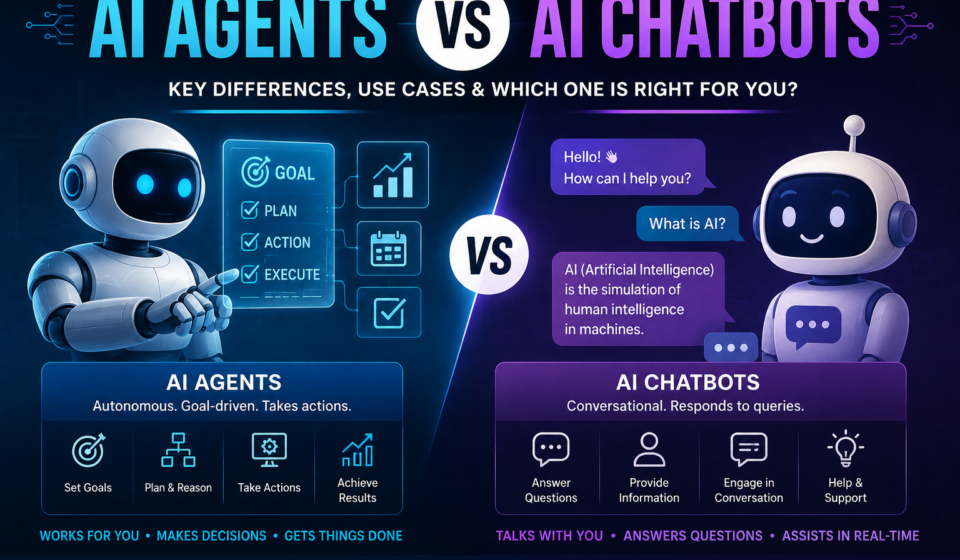
AI Agents vs AI Chatbots: What’s the Difference? A Complete Beginner’s Guide (2026)

AI AGENTS VS AI CHATBOTS
Artificial Intelligence (AI) has rapidly transformed the way people interact with technology. Whether you’re chatting with a customer support bot, asking an AI assistant to summarize a document, or using an intelligent system to automate repetitive tasks, AI has become an integral part of everyday life.
Among the most popular AI-powered technologies today are AI Chatbots and AI Agents. Although these terms are often used interchangeably, they represent different levels of intelligence, autonomy, and capability.
At first glance, both can answer questions, provide recommendations, and assist users. However, the similarities largely end there. AI chatbots are primarily designed for conversation, while AI agents can understand goals, make decisions, plan multiple steps, interact with external tools, and complete complex tasks with minimal human intervention.
As businesses increasingly adopt AI, understanding the distinction between these two technologies is essential. Choosing the wrong solution can result in higher costs, poor customer experiences, and inefficient workflows.
AI AGENTS VS AI CHATBOTS

In this comprehensive guide, you’ll learn:
- What AI chatbots are
- What AI agents are
- How each technology works
- Their strengths and limitations
- Real-world examples
- Industry applications
- Future trends
- Which solution is right for your needs
By the end of this article, you’ll clearly understand why AI agents are considered the next evolution of conversational AI.
Table of Contents
What Is Artificial Intelligence (AI)?
Artificial Intelligence (AI) refers to computer systems that perform tasks typically requiring human intelligence. These tasks include:
- Understanding natural language
- Learning from data
- Recognizing images and speech
- Solving problems
- Making decisions
- Predicting outcomes
- Automating repetitive processes
Instead of following only predefined instructions, modern AI systems use machine learning, deep learning, and large language models (LLMs) to improve their performance over time.
Today, AI powers:
- Virtual assistants
- Search engines
- Recommendation systems
- Self-driving technology
- Fraud detection
- Medical diagnostics
- Smart home devices
- Customer service platforms
- Content creation tools
The rapid advancement of AI has also led to the development of intelligent systems capable of acting independently—known as AI agents.
What Is an AI Chatbot?
An AI chatbot is a software application designed to communicate with users using natural language through text or voice. Its primary role is to answer questions, provide information, assist with common tasks, and simulate human-like conversations.
Unlike traditional rule-based bots that rely on predefined scripts, modern AI chatbots use Natural Language Processing (NLP) and Large Language Models (LLMs) to understand user intent and generate context-aware responses.
How AI Chatbots Work
A typical AI chatbot follows these steps:
- Receives a user query.
- Interprets the user’s intent using NLP.
- Searches its knowledge base or generates a response using an AI model.
- Returns a relevant answer to the user.
The interaction usually ends after the response unless the user continues the conversation.
Common Features of AI Chatbots
- Conversational interface
- Question answering
- Language translation
- Content generation
- Customer support
- FAQ automation
- Appointment booking
- Product recommendations
- Basic troubleshooting
Popular AI Chatbot Examples
- ChatGPT
- Google Gemini
- Claude
- Microsoft Copilot
- Meta AI
- Perplexity AI
These chatbots excel at interacting with users but generally require users to initiate each step.
What Is an AI Agent?
An AI agent is an advanced AI system designed not only to communicate but also to reason, plan, make decisions, use external tools, and accomplish goals autonomously.
Instead of simply responding to prompts, AI agents can:
- Break large objectives into smaller tasks
- Retrieve information from multiple sources
- Access APIs and software tools
- Execute workflows
- Monitor progress
- Adapt based on results
- Continue until the objective is completed
This makes AI agents significantly more capable than traditional chatbots.
Simple Example
AI Chatbot
User:
“Book me a flight.”
Bot:
“Please visit this airline website.”
AI Agent
User:
“Book the cheapest flight to Delhi next Friday.”
Agent:
- Searches multiple airline websites
- Compares prices
- Applies your preferences
- Selects the best option
- Requests confirmation
- Completes the booking
This ability to take action rather than only provide information is what distinguishes AI agents.
AI Agents vs AI Chatbots: Quick Overview
| Feature | AI Chatbot | AI Agent |
|---|---|---|
| Primary Purpose | Conversation | Goal Completion |
| Autonomy | Low | High |
| Multi-Step Planning | No | Yes |
| Tool Usage | Limited | Extensive |
| Memory | Limited | Long-term possible |
| Workflow Automation | Minimal | Advanced |
| Decision Making | Basic | Intelligent |
| API Integration | Limited | Extensive |
| Task Execution | Usually No | Yes |
| Learning Capability | Moderate | Advanced |
Why This Comparison Matters
Organizations worldwide are investing billions of dollars in AI technologies to improve productivity, customer experience, and operational efficiency. However, selecting the right AI solution depends on understanding the capabilities and limitations of each approach.
For example:
- A customer support website may only need an AI chatbot to answer frequently asked questions.
- A software development company may benefit from AI agents that can generate code, run tests, fix bugs, and deploy applications.
- An e-commerce business might use chatbots for customer inquiries while employing AI agents to manage inventory, optimize pricing, and automate marketing campaigns.
Choosing the appropriate technology ensures better user experiences, lower operational costs, and higher return on investment (ROI).
Evolution of AI Chatbots
The journey of AI chatbots began with simple rule-based systems like ELIZA in the 1960s, which relied on predefined scripts and keyword matching. Over time, advancements in machine learning, natural language processing (NLP), and large language models (LLMs) transformed chatbots into intelligent conversational assistants capable of understanding context and generating human-like responses.
Today’s AI chatbots can:
- Answer complex questions
- Summarize documents
- Translate languages
- Write emails
- Generate content
- Assist in education and customer support
However, most still depend on user prompts and do not independently execute complex workflows.
Evolution of AI Agents
AI agents represent the next stage in AI evolution. Instead of waiting for instructions after every interaction, they can work toward achieving a defined objective by planning, reasoning, using external tools, and adapting their actions based on results.
Modern AI agents are increasingly used for:
- Research automation
- Software development
- Business process automation
- Personal productivity
- Data analysis
- Cybersecurity monitoring
- Customer service orchestration
Their ability to combine reasoning, memory, and tool usage makes them far more capable than traditional chatbots.
Key Components of Modern AI Systems
Whether it’s an AI chatbot or an AI agent, most modern AI systems are built using these foundational components:
- Large Language Model (LLM): Understands and generates natural language.
- Natural Language Processing (NLP): Interprets user intent and context.
- Memory: Stores conversation history or long-term preferences.
- Knowledge Base: Provides factual information and organizational data.
- Tools & APIs: Enable interaction with external applications and services.
- Decision Engine: Helps AI agents plan and choose actions.
- Feedback Loop: Improves future responses based on outcomes.
The sophistication of these components largely determines whether the system behaves like a chatbot or a true AI agent.
Conclusion
AI chatbots and AI agents share a common foundation in artificial intelligence, but they are designed for different purposes. Chatbots excel at conversations and answering questions, while AI agents are built to understand goals, make decisions, and complete complex tasks autonomously