
Meta Description:
Learn what Digital Twins are, how they work, their benefits, applications, challenges, and how this technology is shaping the future of smart industries and smart cities.
🌐 Digital Twins: A Virtual Copy of the Real World
Imagine having a virtual version of a machine, building, vehicle, or even an entire city that behaves exactly like its real-world counterpart. This is the concept behind Digital Twins.
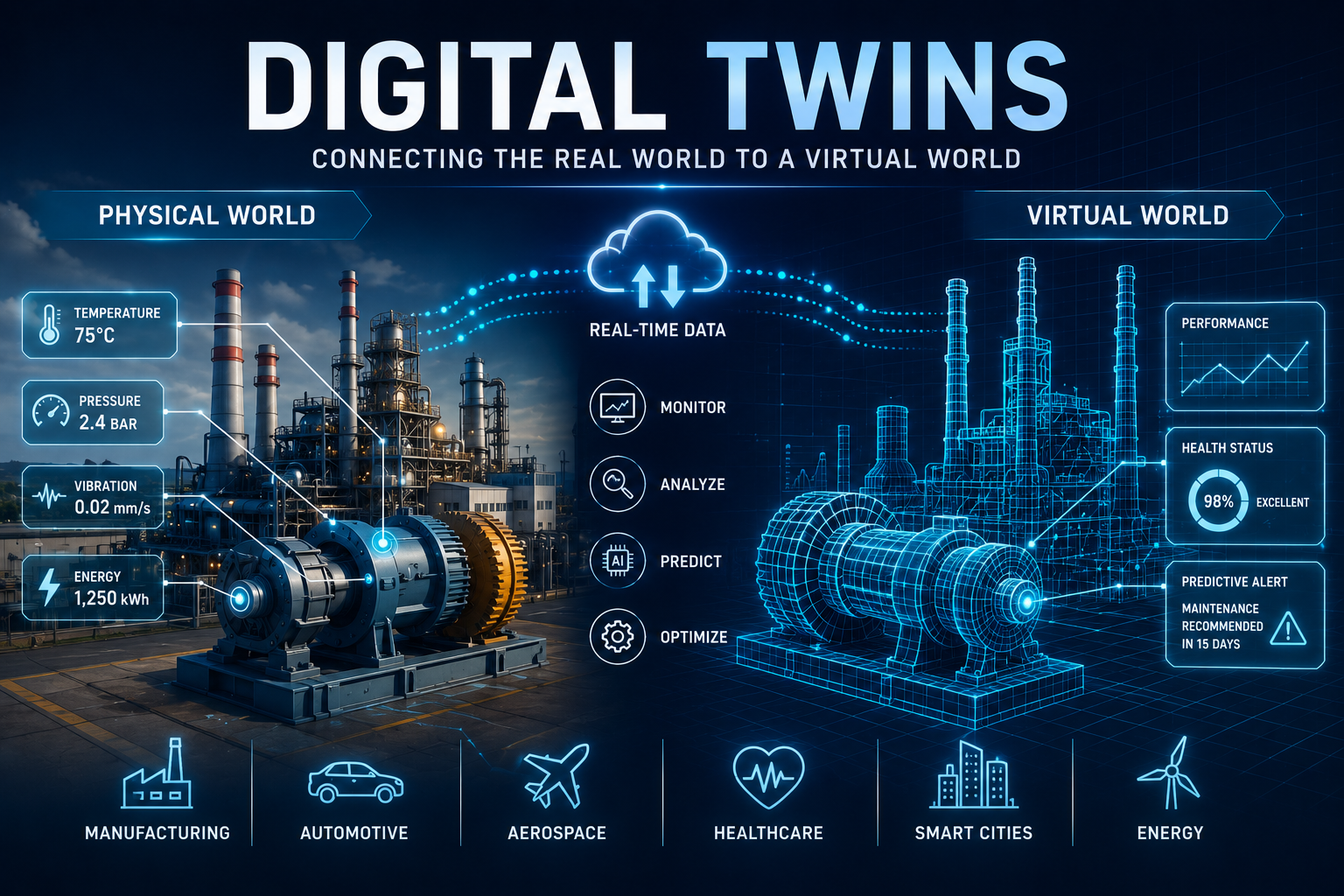
A Digital Twin is a digital replica of a physical object, system, process, or environment. It continuously receives real-time data from sensors and connected devices, allowing organizations to monitor, analyze, predict, and optimize performance.
Digital Twins are becoming a key technology in the era of Artificial Intelligence (AI), Internet of Things (IoT), Cloud Computing, and Industry 4.0.
What is a Digital Twin?
A Digital Twin is a virtual model that mirrors a real-world object or system.
The physical asset sends data through sensors to its digital counterpart, which helps organizations understand performance, predict failures, and improve efficiency.
Simple Definition
Digital Twin = Physical Object + Real-Time Data + Virtual Model
Simple Diagram
     Physical Asset
    (Machine/Vehicle)
             │
             ▼
      IoT Sensors
             │
             ▼
      Real-Time Data
             │
             ▼
       Cloud Platform
             │
             ▼
       Digital Twin
     (Virtual Model)
             │
      ┌──────┼──────┐
      ▼      ▼      ▼
 Monitoring Analysis Prediction
             │
             ▼
      Better Decisions
How Do Digital Twins Work?
Digital Twins combine several technologies to create an accurate virtual representation of a physical object.
1. Data Collection
Sensors attached to physical assets collect information such as:
- Temperature
- Pressure
- Speed
- Energy consumption
- Location
- Performance metrics
2. Data Transmission
The collected data is sent through:
- IoT Networks
- Wi-Fi
- 5G/6G Networks
- Cloud Platforms
3. Virtual Modeling
A digital model of the physical asset is created using:
- CAD Models
- Simulation Software
- AI Algorithms
4. Analysis
The digital twin analyzes incoming data to:
- Detect anomalies
- Monitor performance
- Simulate future scenarios
- Predict failures
5. Optimization
Organizations use insights from the digital twin to:
- Improve efficiency
- Reduce downtime
- Save costs
- Increase productivity
Types of Digital Twins
Product Digital Twins
Virtual representations of products during design and development.
Examples:
- Smartphones
- Automobiles
- Aircraft
Asset Digital Twins
Focus on individual physical assets.
Examples:
- Engines
- Turbines
- Manufacturing machines
System Digital Twins
Represent interconnected systems.
Examples:
- Factory production lines
- Power grids
- Transportation systems
Process Digital Twins
Simulate business and operational processes.
Examples:
- Supply chains
- Manufacturing workflows
- Logistics operations
Applications of Digital Twins
🏭 Manufacturing
Manufacturers use digital twins to:
- Monitor equipment
- Predict maintenance needs
- Improve production efficiency
- Reduce downtime
🚗 Automotive Industry
Digital twins help:
- Test vehicle designs
- Monitor vehicle performance
- Improve safety systems
- Support autonomous driving development
✈️ Aerospace
Aircraft manufacturers use digital twins for:
- Engine monitoring
- Flight simulations
- Predictive maintenance
- Safety improvements
🏥 Healthcare
Healthcare applications include:
- Patient monitoring
- Medical equipment management
- Personalized treatment planning
🏙️ Smart Cities
Digital twins can model:
- Traffic systems
- Energy grids
- Water supply networks
- Public transportation
This helps city planners make better decisions.
⚡ Energy Sector
Utilities use digital twins to monitor:
- Power plants
- Wind turbines
- Solar farms
- Electrical grids
Benefits of Digital Twins
✅ Real-time monitoring
✅ Predictive maintenance
✅ Reduced operational costs
✅ Improved efficiency
✅ Better decision-making
✅ Increased productivity
✅ Enhanced product quality
✅ Reduced downtime
✅ Faster innovation
✅ Improved sustainability
Challenges
- High implementation costs
- Data privacy concerns
- Cybersecurity risks
- Complex integration with existing systems
- Large data storage requirements
- Need for skilled professionals
Digital Twins and AI
Artificial Intelligence makes Digital Twins even more powerful.
AI helps digital twins:
- Predict equipment failures
- Optimize performance
- Automate decisions
- Detect unusual patterns
- Improve forecasting accuracy
Together, AI and Digital Twins create intelligent systems capable of self-optimization.
Future of Digital Twins
The future of Digital Twins is extremely promising. As IoT, AI, cloud computing, and high-speed connectivity continue to evolve, digital twins will become more sophisticated and widely adopted.
Future developments may include:
- Entire digital twin cities
- Smart factories with autonomous operations
- Advanced healthcare simulations
- Real-time climate and environmental monitoring
- Integration with augmented reality (AR) and virtual reality (VR)
- AI-driven autonomous optimization
- Digital twins for personal health management
Experts predict that Digital Twins will become a foundational technology for Industry 4.0 and smart infrastructure.
Conclusion
Digital Twins are transforming how organizations design, monitor, and manage physical assets. By creating a real-time virtual replica of the real world, businesses can gain deeper insights, reduce costs, improve efficiency, and make smarter decisions.
As AI, IoT, and cloud technologies continue to advance, Digital Twins will play a crucial role in building smarter industries, smarter cities, and a more connected future.
Frequently Asked Questions (FAQs)
What is a Digital Twin?
A Digital Twin is a virtual representation of a physical object, system, or process that uses real-time data to mirror and analyze its real-world counterpart.
How does a Digital Twin work?
It collects data from sensors, sends the data to a virtual model, and uses analytics and AI to monitor, simulate, and optimize performance.
What industries use Digital Twins?
Manufacturing, automotive, aerospace, healthcare, energy, construction, logistics, and smart city management.
What are the benefits of Digital Twins?
Benefits include predictive maintenance, improved efficiency, cost reduction, real-time monitoring, and better decision-making.
What is the future of Digital Twins?
Future Digital Twins will be powered by AI, IoT, AR/VR, and advanced connectivity to create intelligent, self-optimizing systems.