

Meta Description:
Learn what Brain-Computer Interfaces (BCIs) are, how they work, their applications, benefits, challenges, and the future of this revolutionary technology.
What is a Brain-Computer Interface (BCI)?
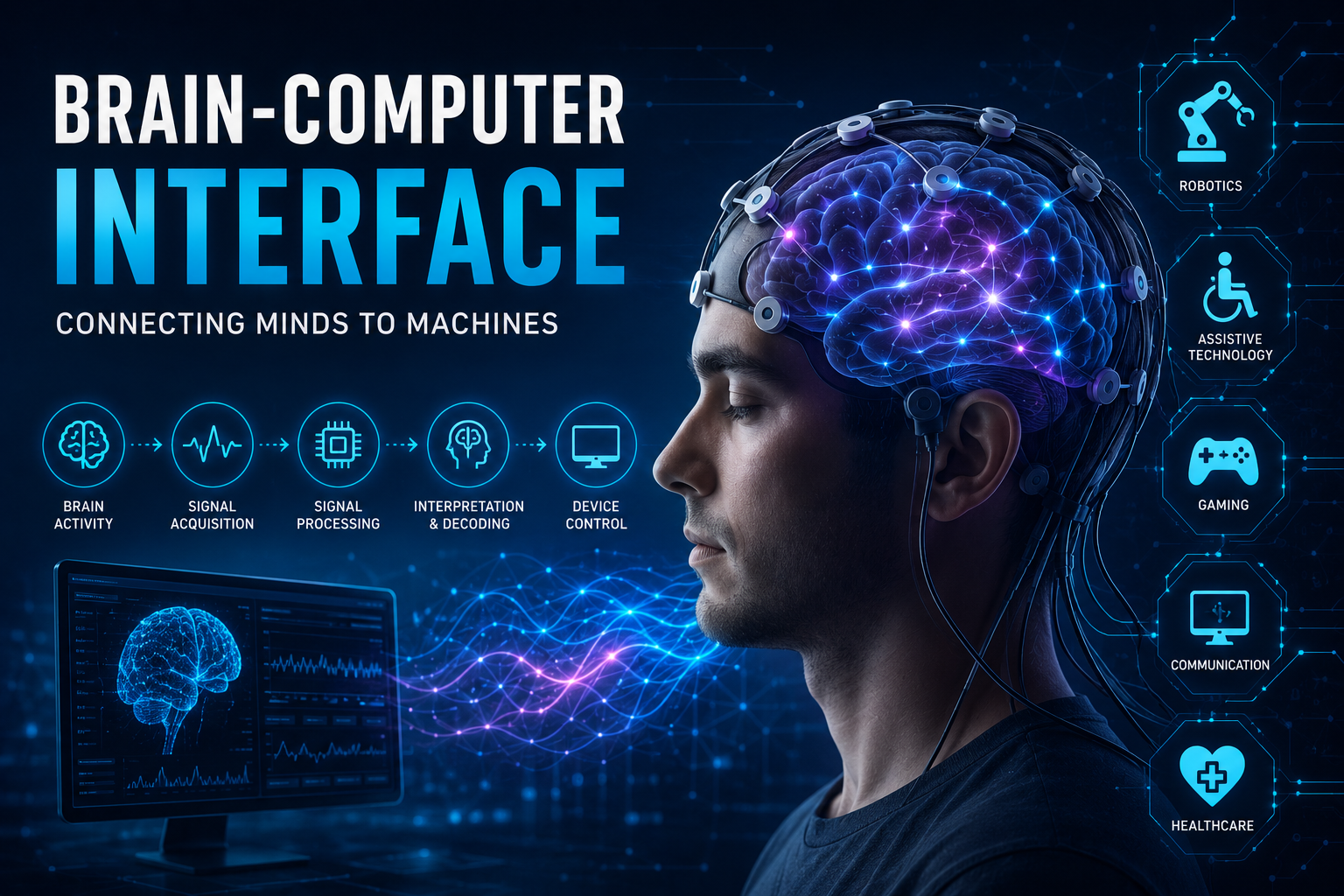
A Brain-Computer Interface (BCI) is a technology that creates a direct communication pathway between the human brain and an external device, such as a computer, robot, prosthetic limb, or wheelchair.
Instead of using a keyboard, mouse, or touchscreen, a BCI allows a person to control devices using brain signals.
In simple terms:
Brain → Computer → Action
BCIs are transforming healthcare, communication, gaming, robotics, and human-computer interaction.
Simple Diagram
        🧠 Human Brain
              │
   Electrical Brain Signals
              │
      EEG / Brain Sensors
              │
      Signal Processing
              │
      Artificial Intelligence
              │
     Computer Interpretation
              │
      ┌───────┼────────┐
      │       │        │
      ▼       ▼        ▼
   💻 PC   🦾 Robot   🦽 Wheelchair
How Does a BCI Work?
A Brain-Computer Interface follows several steps:
1. Brain Activity
The brain produces electrical signals whenever we think, move, or imagine movement.
2. Signal Collection
Special devices capture brain signals using sensors.
Common technologies include:
- EEG (Electroencephalography)
- ECoG (Electrocorticography)
- Brain implants
- MEG (Magnetoencephalography)
3. Signal Processing
Software removes noise and extracts useful brain patterns.
4. Artificial Intelligence
AI and machine learning recognize what the user intends to do.
For example:
- Move left
- Select an object
- Type a letter
- Move a robotic arm
5. Device Control
The decoded command is sent to a connected device.
Examples:
- Computer cursor
- Robot
- Wheelchair
- Prosthetic hand
- Smart home device
Types of Brain-Computer Interfaces
1. Non-Invasive BCI
- Sensors placed on the scalp
- No surgery required
- Safer and more affordable
- Commonly uses EEG
Examples:
- Gaming
- Education
- Research
2. Invasive BCI
- Electrodes implanted directly into the brain
- Higher signal quality
- Requires surgery
- Mainly used in medical research and advanced clinical applications
3. Semi-Invasive BCI
- Electrodes placed beneath the skull but outside brain tissue
- Better accuracy than non-invasive systems
- Lower risk than fully invasive implants
Applications of Brain-Computer Interfaces
🏥 Healthcare
BCIs help patients:
- Control prosthetic limbs
- Regain communication abilities
- Operate wheelchairs
- Assist stroke rehabilitation
- Support paralysis recovery
🤖 Robotics
Brain signals can control:
- Robotic arms
- Industrial robots
- Humanoid robots
- Surgical robots
🎮 Gaming
Players can:
- Control characters using thoughts
- Improve immersive VR experiences
- Create hands-free gameplay
🎓 Education
BCIs can:
- Measure attention levels
- Support adaptive learning
- Improve accessibility for students with disabilities
🚗 Smart Vehicles
Future BCIs may allow drivers to:
- Control vehicle functions
- Improve road safety
- Assist autonomous driving systems
🏠 Smart Homes
Users could control:
- Lights
- Fans
- Television
- Doors
- Security systems
Using only brain activity.
Advantages of BCI
- Helps people with paralysis
- Restores communication for patients with severe disabilities
- Enables hands-free control
- Improves prosthetic technology
- Faster human-computer interaction
- Supports rehabilitation
- Enhances accessibility
- Opens new possibilities for AI-driven applications
Challenges
- High development cost
- Privacy and security concerns for brain data
- Ethical questions
- Accuracy limitations
- Training required for users
- Surgical risks for invasive BCIs
- Signal interference and noise
Future of Brain-Computer Interfaces
Brain-Computer Interfaces are expected to become more advanced with improvements in AI, neuroscience, and wearable technology. Future developments may include:
- Wireless BCIs with higher accuracy
- AI-powered thought recognition
- Better prosthetic control
- Faster communication for people with disabilities
- Integration with augmented and virtual reality
- Smart home and IoT control through thought
- Enhanced gaming and entertainment experiences
- Medical breakthroughs in treating neurological disorders
As research continues, BCIs could fundamentally change how humans interact with technology.
Conclusion
Brain-Computer Interfaces represent one of the most exciting frontiers in technology. By enabling direct communication between the brain and machines, BCIs have the potential to improve healthcare, empower people with disabilities, and create entirely new ways of interacting with computers.
Although technical, ethical, and privacy challenges remain, continued innovation in AI and neuroscience is bringing this technology closer to everyday use.
Frequently Asked Questions (FAQs)
What is a Brain-Computer Interface (BCI)?
A Brain-Computer Interface is a system that enables direct communication between the human brain and an external device using brain signals.
How does a BCI work?
A BCI captures brain signals, processes them with software and AI, and converts them into commands that control a computer or other device.
What are BCIs used for?
They are used in healthcare, assistive technology, robotics, gaming, education, research, and smart home control.
Are Brain-Computer Interfaces safe?
Non-invasive BCIs, such as EEG headsets, are generally considered safe. Invasive BCIs require surgery and carry associated medical risks.
What is the future of BCIs?
Future BCIs are expected to become more accurate, wireless, AI-powered, and integrated into healthcare, communication, and consumer technologies.