
Meta Description:
Discover what Edge AI is, how it works, its architecture, benefits, real-world applications, challenges, and why it is becoming one of the most important technologies for the future of AI and IoT.
🚀 Edge AI: The Future of Real-Time Artificial Intelligence
Artificial Intelligence (AI) has transformed the way computers analyze data and make decisions. Traditionally, AI applications relied on cloud computing, where data is sent to remote servers for processing. While this approach is powerful, it can introduce delays, increase bandwidth usage, and raise privacy concerns.
Edge AI solves these challenges by running AI models directly on devices such as smartphones, cameras, drones, robots, industrial machines, and IoT sensors. Instead of sending all data to the cloud, Edge AI enables devices to process information locally, making decisions almost instantly.
As industries demand faster, smarter, and more secure systems, Edge AI is becoming a cornerstone of modern technologies such as autonomous vehicles, smart cities, healthcare, manufacturing, and consumer electronics.
What is Edge AI?
Edge AI refers to the deployment of Artificial Intelligence algorithms directly on edge devices—devices located close to where data is generated.
Unlike cloud-based AI, Edge AI performs computation locally, reducing the need to transmit large volumes of data over the internet.
Simple Definition
Edge AI = Artificial Intelligence + Local Data Processing + Real-Time Decision Making
How Edge AI Works
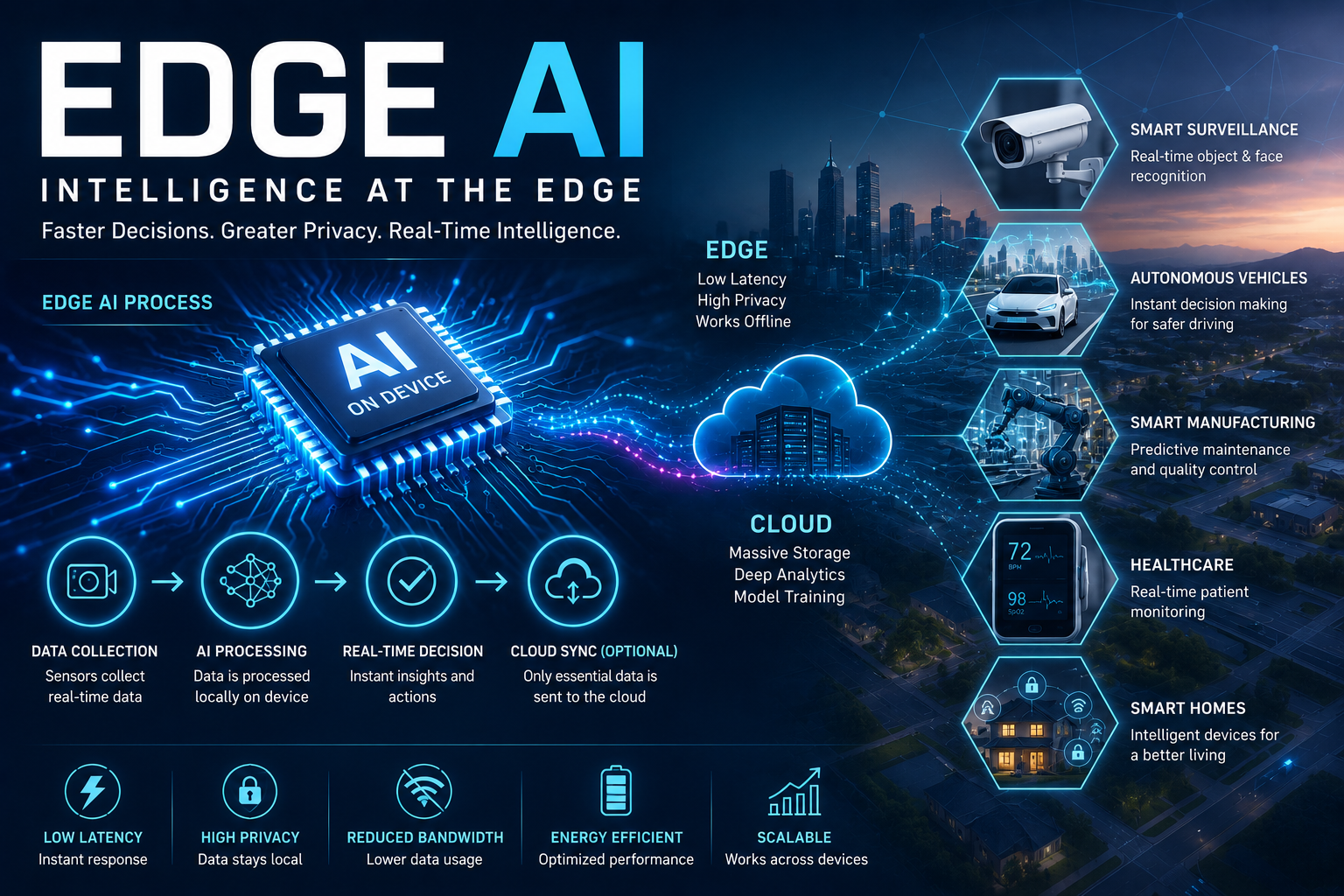
- Data Collection: Sensors, cameras, microphones, or IoT devices collect data.
- Local Processing: An AI model running on the device analyzes the data immediately.
- Decision Making: The device takes action based on the analysis.
- Cloud Synchronization (Optional): Selected data may be sent to the cloud for storage, updates, or additional analytics.
This architecture minimizes latency and improves privacy because sensitive data often remains on the device.
Simple Diagram (HTML)
        Camera / Sensor
               │
               ▼
        Edge AI Device
      (AI Chip + Processor)
               │
       AI Model Inference
               │
      ┌────────┼─────────┐
      ▼        ▼         ▼
 Detect    Analyze    Decide
               │
               ▼
     Immediate Action
               │
       Optional Cloud Sync
Key Components of Edge AI
1. Edge Devices
Devices where AI runs locally.
Examples:
- Smartphones
- Security cameras
- Drones
- Smart speakers
- Robots
- Industrial controllers
- Medical devices
- Autonomous vehicles
2. AI Models
Machine learning or deep learning models trained to recognize patterns and make predictions.
Examples:
- Object detection
- Face recognition
- Voice recognition
- Defect detection
- Predictive maintenance
3. AI Accelerators
Specialized hardware improves AI performance.
Examples:
- Neural Processing Units (NPUs)
- GPUs
- TPUs
- AI inference chips
4. Sensors
Sensors provide real-time input.
Examples:
- Cameras
- Temperature sensors
- LiDAR
- Radar
- GPS
- Microphones
- Motion sensors
5. Edge Software
Software frameworks optimize AI models for efficient execution on devices with limited resources.
Edge AI vs Cloud AI
| Feature | Edge AI | Cloud AI |
|---|---|---|
| Processing Location | On the device | Remote cloud servers |
| Internet Requirement | Often not required | Usually required |
| Latency | Very low | Higher |
| Privacy | High | Moderate |
| Bandwidth Usage | Low | High |
| Real-Time Response | Excellent | Good |
| Offline Operation | Yes | Limited |
Benefits of Edge AI
⚡ Faster Response
Processes data in milliseconds, enabling real-time decision-making.
🔒 Enhanced Privacy
Sensitive information stays on the device, reducing exposure to external networks.
🌐 Reduced Internet Dependency
Many Edge AI applications work even without a stable internet connection.
💰 Lower Bandwidth Costs
Only essential data is transmitted to the cloud.
🔋 Better Efficiency
Optimized AI models consume less power and reduce operational costs.
📈 Improved Reliability
Devices continue functioning even during network outages.
Real-World Applications
🚗 Autonomous Vehicles
Edge AI enables vehicles to:
- Detect pedestrians
- Recognize traffic signs
- Avoid obstacles
- Assist with autonomous driving
🏭 Smart Manufacturing
Factories use Edge AI to:
- Detect product defects
- Monitor equipment
- Predict machine failures
- Improve production efficiency
🏥 Healthcare
Applications include:
- Wearable health monitors
- Smart diagnostic devices
- Patient monitoring
- Medical imaging analysis
📹 Smart Surveillance
AI-powered cameras can:
- Detect intrusions
- Recognize faces
- Identify suspicious activities
- Reduce false alarms
🏠 Smart Homes
Edge AI powers:
- Voice assistants
- Smart thermostats
- Security systems
- Energy management
- Intelligent appliances
🌾 Agriculture
Farmers use Edge AI for:
- Crop health monitoring
- Soil analysis
- Pest detection
- Precision irrigation
🛍️ Retail
Retailers deploy Edge AI for:
- Automated checkout
- Customer analytics
- Inventory management
- Shelf monitoring
🤖 Robotics
Robots use Edge AI for:
- Navigation
- Object recognition
- Human interaction
- Industrial automation
Industries Using Edge AI
- Manufacturing
- Healthcare
- Retail
- Transportation
- Agriculture
- Telecommunications
- Banking
- Logistics
- Energy
- Smart Cities
- Defense
- Consumer Electronics
Challenges of Edge AI
Although Edge AI offers many advantages, it also presents several challenges:
- Limited processing power on small devices
- Memory and storage constraints
- Battery life limitations
- Cybersecurity risks
- Model optimization complexity
- Device management at scale
- Hardware compatibility issues
Future of Edge AI
Edge AI is expected to become one of the fastest-growing areas of artificial intelligence. Future developments include:
- AI-powered smartphones
- Intelligent robots
- Fully autonomous vehicles
- AI-enabled factories
- Smart healthcare devices
- 6G-powered Edge AI applications
- AI-driven drones
- Edge AI in smart cities
- Advanced AI chips with lower power consumption
- Federated learning for privacy-preserving AI
As AI chips become more powerful and efficient, Edge AI will enable billions of connected devices to make intelligent decisions independently.
Edge AI and the Internet of Things (IoT)
Edge AI and IoT work together to create intelligent systems.
- IoT devices collect data from the physical world.
- Edge AI analyzes the data locally.
- Cloud platforms provide long-term storage, analytics, and model updates.
This combination powers applications such as smart factories, connected vehicles, precision agriculture, and intelligent energy management.
Popular Edge AI Platforms
- NVIDIA Jetson
- Google Coral
- Intel OpenVINO
- Qualcomm AI Engine
- Apple Neural Engine
- AWS IoT Greengrass
- Azure IoT Edge
Why Edge AI Matters
Edge AI represents a shift from centralized intelligence to distributed intelligence. Instead of relying solely on cloud servers, intelligent devices can process information where it is generated. This leads to:
- Faster decisions
- Lower latency
- Better privacy
- Greater reliability
- Reduced operational costs
- Enhanced user experiences
As connected devices continue to grow, Edge AI will play a critical role in enabling real-time intelligence across industries.
Conclusion
Edge AI is transforming the future of artificial intelligence by bringing computation closer to the source of data. Whether it’s a self-driving car reacting to road conditions, a smart camera detecting security threats, or a wearable device monitoring health, Edge AI enables faster, more secure, and more efficient decision-making.
With advancements in AI hardware, IoT, and high-speed networks, Edge AI is expected to become a foundational technology for next-generation digital ecosystems.
Frequently Asked Questions (FAQs)
What is Edge AI?
Edge AI is the deployment of AI models on local devices, allowing data to be processed near its source instead of relying entirely on cloud servers.
How is Edge AI different from Cloud AI?
Edge AI performs processing on the device for faster responses and improved privacy, while Cloud AI relies on remote servers for computation.
What are the advantages of Edge AI?
Key benefits include low latency, enhanced privacy, reduced bandwidth usage, offline functionality, and real-time decision-making.
Where is Edge AI used?
It is widely used in autonomous vehicles, healthcare, manufacturing, smart homes, surveillance, retail, agriculture, and robotics.
What is the future of Edge AI?
Edge AI will become increasingly integrated with IoT, 6G, AI accelerators, and smart devices, enabling intelligent systems to operate efficiently and independently.