

Introduction
Solid-State Batteries (SSBs) are considered one of the most promising advancements in battery technology. As industries move toward electric vehicles (EVs), renewable energy storage, and portable electronics, the demand for safer, more powerful, and longer-lasting batteries continues to grow.
Unlike traditional lithium-ion batteries, which use a liquid electrolyte, solid-state batteries replace the liquid with a solid electrolyte. This simple but significant change improves safety, increases energy density, reduces charging time, and extends battery life.
Many of the world’s leading automotive and technology companies are investing billions of dollars in solid-state battery research, expecting the technology to play a major role in the future of transportation and energy storage.

Table of Contents
What is a Solid-State Battery?
A Solid-State Battery (SSB) is a rechargeable battery that uses a solid electrolyte instead of the liquid or gel electrolyte found in conventional lithium-ion batteries.
The solid electrolyte transfers lithium ions between the battery’s anode and cathode while improving stability and reducing the risk of leakage or thermal runaway.
How Does a Solid-State Battery Work?
A solid-state battery operates on the same basic electrochemical principles as a lithium-ion battery, but with a different electrolyte material.
Working Process
- The battery is charged using an external power source.
- Lithium ions move through the solid electrolyte from the cathode to the anode.
- During discharge, lithium ions travel back to the cathode.
- Electrons flow through the external circuit, providing power to the connected device.
- The process repeats during every charge and discharge cycle.
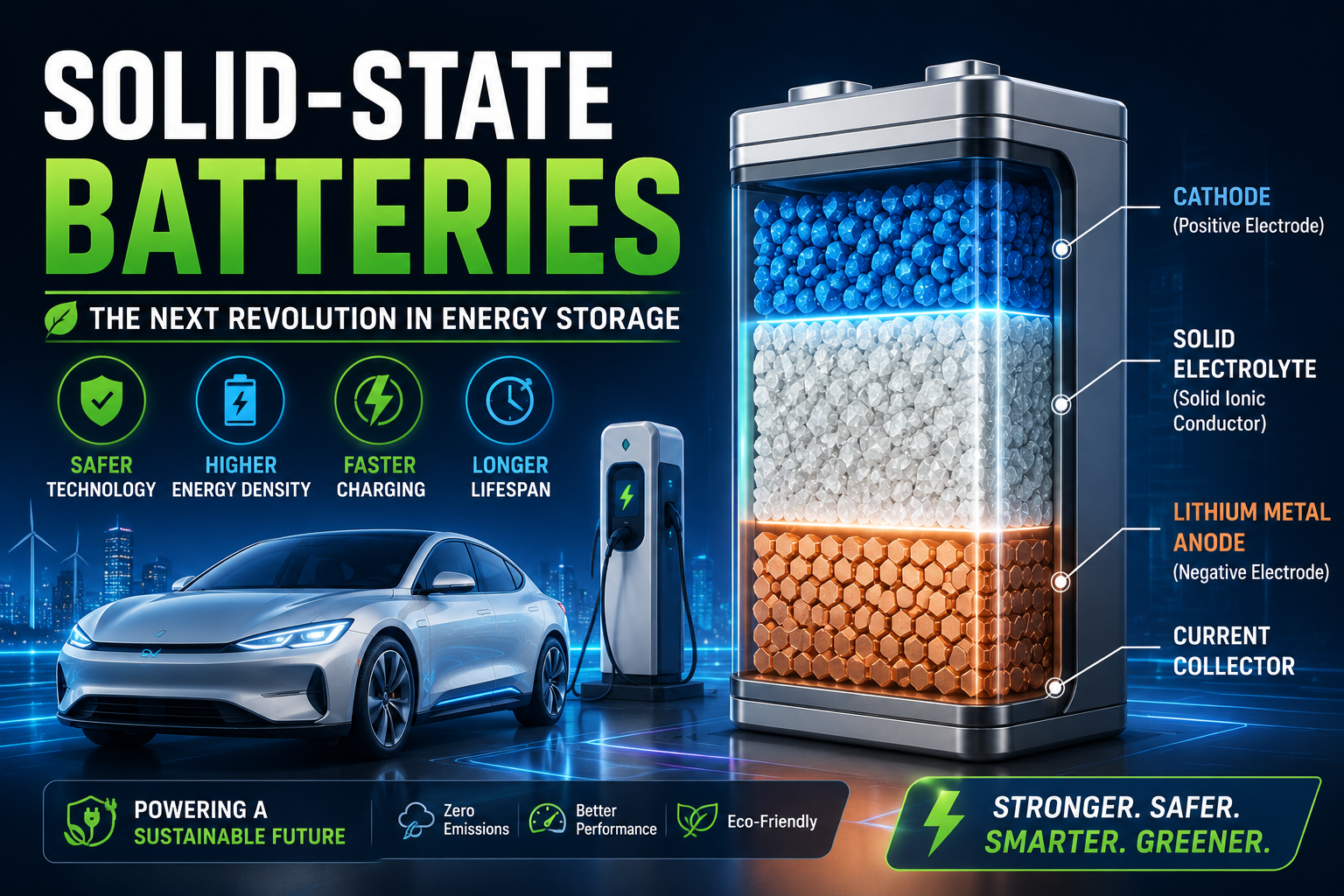
Main Components of a Solid-State Battery
1. Solid Electrolyte
The defining component of the battery.
Common materials include:
- Ceramic electrolytes
- Sulfide-based electrolytes
- Oxide electrolytes
- Polymer electrolytes
2. Anode
Often uses:
- Lithium metal
- Silicon
- Graphite (in some designs)
Lithium-metal anodes can significantly increase energy density.
3. Cathode
Typically contains lithium compounds such as:
- Lithium Nickel Manganese Cobalt Oxide (NMC)
- Lithium Iron Phosphate (LFP)
- Other advanced cathode chemistries
4. Current Collectors
Metal foils that transfer electrons between the battery and the external circuit.
Advantages of Solid-State Batteries
Higher Energy Density
Solid-state batteries can store more energy in the same physical space compared with many current lithium-ion batteries.
Benefits include:
- Longer EV driving range
- Smaller battery packs
- Lighter vehicles
Faster Charging
Solid electrolytes have the potential to enable significantly faster charging while minimizing heat generation, depending on the battery design.
Improved Safety
Unlike liquid electrolytes:
- No leakage
- Lower fire risk
- Reduced risk of thermal runaway
- Better resistance to overheating
Longer Lifespan
Solid-state batteries are expected to withstand more charge-discharge cycles before significant capacity loss.
Better Temperature Performance
Many solid-state battery designs aim to operate more effectively across a wider temperature range than conventional lithium-ion batteries.
Disadvantages of Solid-State Batteries
High Manufacturing Cost
Production remains expensive because:
- New manufacturing processes are required.
- Specialized materials increase costs.
- Large-scale production is still developing.
Manufacturing Challenges
Scaling production while maintaining quality and performance is one of the biggest technical hurdles.
Limited Commercial Availability
Although several companies have demonstrated prototypes and pilot production, mass-market adoption is still in its early stages.
Solid-State Batteries vs Lithium-Ion Batteries
| Feature | Solid-State Battery | Lithium-Ion Battery |
|---|---|---|
| Electrolyte | Solid | Liquid |
| Safety | Higher | Good, but susceptible to thermal runaway |
| Energy Density | Higher potential | High |
| Charging Speed | Potentially faster | Fast |
| Lifespan | Potentially longer | Good |
| Fire Risk | Lower | Higher |
| Manufacturing Cost | Higher | Lower |
| Commercial Availability | Emerging | Widely available |
Applications of Solid-State Batteries
Electric Vehicles (EVs)
Potential benefits include:
- Longer driving range
- Faster charging
- Reduced battery weight
- Enhanced safety
Consumer Electronics
Solid-state batteries could improve:
- Smartphones
- Laptops
- Tablets
- Smartwatches
Aerospace
Applications include:
- Satellites
- Electric aircraft
- Drones
Medical Devices
Used in:
- Pacemakers
- Wearable health devices
- Implantable medical equipment
Renewable Energy Storage
They may support more efficient storage of electricity generated from:
- Solar power
- Wind energy
- Smart grids
How Solid-State Batteries Improve Electric Vehicles
Future EVs equipped with solid-state batteries could offer:
- Longer driving ranges
- Faster charging times
- Increased battery life
- Improved crash safety
- Reduced battery weight
- Better performance in diverse climates
Challenges Facing Solid-State Battery Technology
Despite their promise, several challenges remain:
- High production costs
- Complex manufacturing
- Material durability
- Large-scale commercialization
- Supply chain development
Researchers and manufacturers continue working to overcome these issues.
Major Companies Developing Solid-State Batteries
Several organizations are actively investing in solid-state battery technology, including:
- Toyota
- Samsung SDI
- QuantumScape
- Solid Power
- Panasonic
- Nissan
- BMW
- Mercedes-Benz
- Honda
- Hyundai
Future of Solid-State Batteries
Solid-state batteries are expected to play a major role in the next generation of electric vehicles, portable electronics, and renewable energy systems. As manufacturing improves and costs decline, adoption is likely to expand across multiple industries. Continued advances in materials science, production techniques, and battery design could make solid-state batteries a key technology for cleaner and more efficient energy storage.
Frequently Asked Questions (FAQs)
1. What is a Solid-State Battery?
A rechargeable battery that uses a solid electrolyte instead of a liquid electrolyte.
2. Are Solid-State Batteries safer?
Yes. They generally offer improved safety due to the absence of flammable liquid electrolytes, reducing the risk of leakage and thermal runaway.
3. Why are Solid-State Batteries important for EVs?
They have the potential to provide longer driving range, faster charging, improved safety, and longer battery life.
4. Are Solid-State Batteries commercially available?
Some products and pilot deployments exist, but large-scale commercial adoption is still emerging.
5. Will Solid-State Batteries replace lithium-ion batteries?
They are expected to complement and, in some applications, gradually replace conventional lithium-ion batteries as the technology matures. However, lithium-ion batteries are likely to remain widely used for many years.
Conclusion
Solid-state batteries represent one of the most significant innovations in modern energy storage. Their potential for higher energy density, faster charging, enhanced safety, and longer service life makes them an attractive option for electric vehicles, consumer electronics, medical devices, and renewable energy storage. While challenges such as manufacturing cost and scalability remain, ongoing research and investment are steadily bringing this technology closer to widespread adoption.