

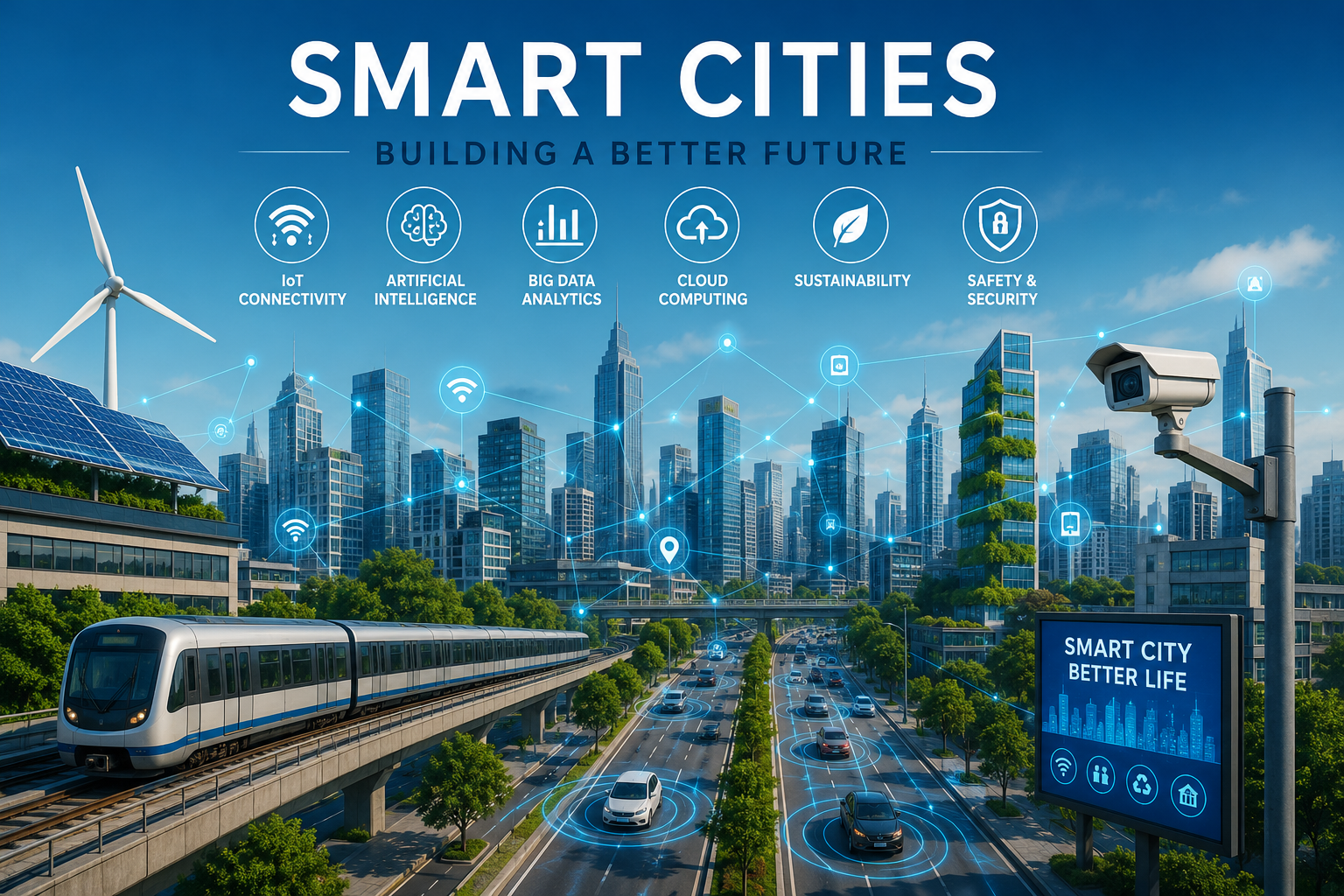

As urban populations continue to grow, cities face increasing challenges such as traffic congestion, pollution, energy consumption, waste management, and public safety. To address these issues, governments and technology companies are transforming traditional cities into Smart Cities.
A Smart City uses advanced technologies like the Internet of Things (IoT), Artificial Intelligence (AI), Big Data, Cloud Computing, and 5G networks to improve the quality of life for citizens while making urban services more efficient, sustainable, and secure.
In this comprehensive guide, you’ll learn what Smart Cities are, how they work, their key technologies, advantages, challenges, and what the future holds.
What is a Smart City?
A Smart City is an urban area that uses digital technologies and connected devices to collect data, analyze it, and improve public services such as transportation, energy, healthcare, waste management, water supply, and public safety.
The primary goal of a Smart City is to make urban life:
- More efficient
- More sustainable
- Safer
- Environmentally friendly
- Economically productive
- Citizen-focused
Simple Definition
A Smart City is a city that uses technology and real-time data to improve infrastructure, public services, and the daily lives of its residents.
Why Do We Need Smart Cities?
Modern cities face several challenges:
- Rapid population growth
- Traffic congestion
- Air pollution
- Water shortages
- Rising energy demand
- Waste management problems
- Public safety concerns
- Climate change
Smart technologies help governments solve these problems more effectively.
Key Technologies Behind Smart Cities
1. Internet of Things (IoT)
IoT devices collect real-time data from across the city.
Examples include:
- Smart traffic lights
- Air quality sensors
- Smart parking systems
- Water level sensors
- Smart streetlights
2. Artificial Intelligence (AI)
AI analyzes city data and automates decision-making.
Applications include:
- Traffic prediction
- Crime detection
- Energy optimization
- Public transportation scheduling
- Emergency response
3. Big Data Analytics
Millions of sensors generate enormous amounts of data every second.
Big Data helps governments:
- Predict traffic
- Reduce pollution
- Improve healthcare
- Manage disasters
- Optimize public transport
4. Cloud Computing
Cloud platforms store and process city data securely.
Benefits include:
- Centralized management
- Faster data processing
- Easy scalability
- Cost savings
5. 5G Networks
High-speed connectivity enables:
- Connected vehicles
- Smart surveillance
- Remote healthcare
- Autonomous transportation
- Real-time monitoring
6. Geographic Information System (GIS)
GIS provides digital maps for:
- Urban planning
- Disaster management
- Infrastructure monitoring
- Land management
Features of a Smart City
A modern Smart City typically includes:
Smart Transportation
- Intelligent traffic signals
- Smart parking
- Electric buses
- Metro integration
- Real-time traffic updates
Smart Energy
- Smart electricity grids
- Renewable energy
- Solar power
- Smart meters
- Energy-efficient buildings
Smart Water Management
- Leak detection
- Water quality monitoring
- Smart irrigation
- Water conservation systems
Smart Waste Management
- Sensor-enabled dustbins
- Automated garbage collection
- Waste recycling
- Route optimization
Smart Healthcare
- Telemedicine
- Digital hospitals
- Health monitoring devices
- Emergency response systems
Smart Education
- Digital classrooms
- Online learning
- Smart libraries
- AI-powered education platforms
Smart Governance
Governments provide services digitally.
Examples:
- Online tax payments
- Digital identity
- E-governance portals
- Online complaint systems
Smart Security
- AI surveillance cameras
- Facial recognition
- Emergency alert systems
- Smart policing
- Disaster monitoring
Applications of Smart Cities
Transportation
Smart traffic systems reduce congestion and fuel consumption.
Examples include:
- GPS traffic monitoring
- Smart parking
- Intelligent traffic lights
- Electric vehicle charging stations
Healthcare
Technology improves healthcare through:
- Remote patient monitoring
- AI diagnosis
- Emergency ambulance tracking
- Electronic medical records
Environment
Smart Cities reduce pollution using:
- Air quality monitoring
- Noise sensors
- Green energy
- Smart irrigation
Public Safety
Governments improve safety through:
- Smart CCTV
- Crime prediction
- Fire detection
- Flood monitoring
- Earthquake warning systems
Utilities
Digital monitoring improves:
- Electricity supply
- Water distribution
- Gas networks
- Sewer systems
Benefits of Smart Cities
Better Quality of Life
Citizens enjoy cleaner, safer, and more convenient living conditions.
Reduced Traffic
AI traffic systems minimize congestion and travel time.
Energy Savings
Smart grids reduce electricity waste.
Cleaner Environment
Lower emissions improve air quality and support sustainability.
Improved Public Safety
Real-time monitoring helps emergency services respond faster.
Efficient Government Services
Digital platforms simplify access to public services.
Economic Growth
Smart infrastructure attracts businesses, startups, and investors.
Challenges of Smart Cities
Although Smart Cities offer many advantages, they also face challenges.
High Development Cost
Building smart infrastructure requires significant investment.
Cybersecurity Risks
Connected systems may become targets for cyberattacks.
Data Privacy
Large-scale data collection raises privacy concerns.
Digital Divide
Not everyone has equal access to digital technology.
Infrastructure Maintenance
Smart devices and networks require ongoing maintenance and upgrades.
Real-World Examples of Smart Cities
Singapore
Singapore uses AI, IoT, and smart transportation systems to improve urban living and is widely recognized for its integrated digital services.
Barcelona (Spain)
Known for:
- Smart lighting
- Smart parking
- Waste management
- Public Wi-Fi
Dubai (UAE)
Features include:
- Paperless government services
- AI-powered public services
- Smart police stations
- Autonomous transportation initiatives
Seoul (South Korea)
Uses:
- Intelligent transportation
- Smart healthcare
- High-speed internet
- Digital governance
India’s Smart Cities Mission
India launched the Smart Cities Mission to improve urban infrastructure and quality of life through technology-driven development. Cities participating in the mission focus on areas such as integrated command and control centers, smart mobility, digital governance, efficient utilities, and sustainable urban planning.
Future of Smart Cities
The next generation of Smart Cities will include:
- Autonomous vehicles
- AI-powered governance
- Smart drones
- Digital twins of cities
- Green buildings
- Zero-carbon transportation
- Smart energy grids
- Advanced robotics
- Edge computing
- 6G connectivity (as it becomes available)
As technologies mature, Smart Cities are expected to become more resilient, sustainable, and citizen-centric.
Smart City vs Traditional City
| Feature | Traditional City | Smart City |
|---|---|---|
| Traffic | Manual control | AI-powered management |
| Electricity | Standard grid | Smart grid |
| Water | Manual monitoring | Sensor-based monitoring |
| Governance | Paper-based | Digital services |
| Waste Collection | Fixed schedule | Sensor-driven collection |
| Public Safety | Conventional surveillance | AI-assisted monitoring |
| Parking | Manual search | Smart parking guidance |
| Energy | Higher consumption | Optimized energy use |
Frequently Asked Questions (FAQs)
What is a Smart City?
A Smart City uses digital technologies, sensors, and data analytics to improve public services, infrastructure, and quality of life.
Which technologies are used in Smart Cities?
Common technologies include:
- Internet of Things (IoT)
- Artificial Intelligence (AI)
- Big Data Analytics
- Cloud Computing
- 5G Networks
- Geographic Information Systems (GIS)
Why are Smart Cities important?
They help reduce pollution, improve transportation, conserve energy, enhance public safety, and make government services more efficient.
What are the biggest challenges?
The major challenges include cybersecurity, data privacy, high implementation costs, infrastructure maintenance, and ensuring equal access to digital services.
Conclusion
Smart Cities represent the future of urban development by combining technology, sustainability, and citizen-focused planning. Through the use of IoT, AI, Big Data, cloud computing, and advanced connectivity, cities can become cleaner, safer, more efficient, and more resilient.
While challenges such as cybersecurity and investment remain, the long-term benefits of smarter infrastructure and improved public services make Smart Cities a key component of sustainable urban growth in the 21st century.
Recommended External References
- Smart Cities Mission (India)
- UN-Habitat
- IEEE Smart Cities