
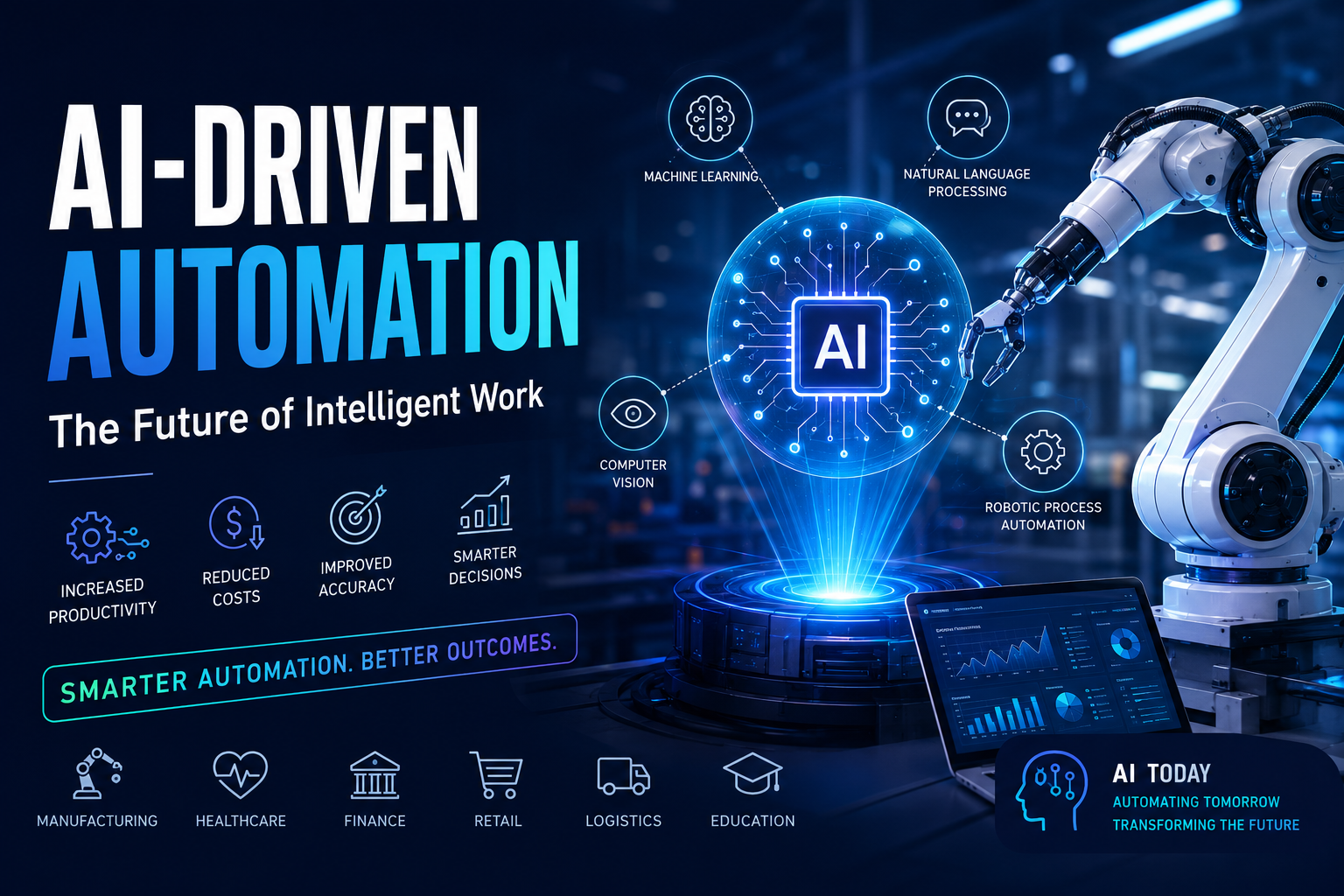

Artificial Intelligence (AI) has evolved from a futuristic concept into one of the most transformative technologies of the modern era. Among its many applications, AI-driven automation has become a game changer for businesses, governments, healthcare providers, manufacturers, and individuals. Unlike traditional automation, which follows predefined rules, AI-driven automation uses machine learning, deep learning, natural language processing (NLP), and computer vision to make intelligent decisions, learn from data, and continuously improve over time.
In 2026, organizations are adopting AI-driven automation not only to reduce costs but also to improve efficiency, customer satisfaction, and innovation. From intelligent chatbots and self-driving vehicles to predictive maintenance and smart factories, AI-powered automation is reshaping the global economy.

Table of Contents
What is AI-Driven Automation?
AI-driven automation is the integration of Artificial Intelligence technologies with automation systems to perform tasks that traditionally required human intelligence.
Unlike conventional automation, AI can:
- Learn from historical data
- Identify patterns
- Make predictions
- Understand language
- Recognize images
- Adapt to changing situations
- Improve its performance over time
This enables machines to perform complex cognitive tasks instead of simply following fixed instructions.
Traditional Automation vs AI-Driven Automation
| Traditional Automation | AI-Driven Automation |
|---|---|
| Rule-based | Data-driven |
| Fixed workflows | Adaptive workflows |
| No learning capability | Continuously learns |
| Requires manual updates | Self-improving models |
| Limited decision-making | Intelligent decision-making |
| Best for repetitive tasks | Handles complex scenarios |
How AI-Driven Automation Works
AI-driven automation combines several advanced technologies into one intelligent system.
1. Data Collection
AI gathers data from:
- IoT devices
- Sensors
- Databases
- Cameras
- Customer interactions
- Websites
- ERP and CRM systems
2. Data Processing
The collected data is cleaned, organized, and prepared for analysis.
3. Machine Learning
Algorithms analyze historical data to identify patterns and make predictions.
Examples:
- Fraud detection
- Demand forecasting
- Customer behavior prediction
4. Decision Making
The AI system determines the most suitable action based on its analysis.
Examples:
- Approving a loan
- Routing customer support tickets
- Scheduling deliveries
5. Automation Execution
The AI system automatically performs the required task.
Examples:
- Sending emails
- Updating databases
- Processing invoices
- Controlling robots
6. Continuous Learning
The system receives feedback and improves its accuracy over time.
Core Technologies Behind AI-Driven Automation
Machine Learning (ML)
Learns from data without explicit programming.
Applications:
- Product recommendations
- Fraud detection
- Predictive maintenance
Deep Learning
Uses neural networks for highly complex tasks.
Examples:
- Speech recognition
- Image recognition
- Medical diagnosis
Natural Language Processing (NLP)
Allows computers to understand human language.
Examples:
- Chatbots
- AI assistants
- Language translation
Computer Vision
Enables machines to interpret images and videos.
Applications:
- Face recognition
- Quality inspection
- Autonomous vehicles
Robotic Process Automation (RPA)
Automates repetitive digital tasks.
Examples:
- Invoice processing
- Payroll
- Data migration
Generative AI
Creates new content including:
- Text
- Images
- Videos
- Software code
- Music
Benefits of AI-Driven Automation
Increased Productivity
AI works 24/7 without fatigue, significantly increasing operational efficiency.
Reduced Costs
Organizations save money by automating repetitive manual processes.
Improved Accuracy
AI minimizes human errors and delivers consistent results.
Faster Decision-Making
AI analyzes massive datasets within seconds.
Better Customer Experience
AI-powered chatbots provide instant support around the clock.
Predictive Capabilities
AI predicts:
- Equipment failures
- Customer demand
- Market trends
- Financial risks
Scalability
AI systems can handle increasing workloads without proportional increases in staffing.
Real-World Applications
Healthcare
AI automates:
- Medical imaging analysis
- Disease prediction
- Drug discovery
- Hospital management
- Patient monitoring
Manufacturing
Smart factories use AI for:
- Predictive maintenance
- Quality inspection
- Robotic assembly
- Inventory optimization
Banking & Finance
Applications include:
- Fraud detection
- Credit scoring
- Automated trading
- Customer service chatbots
- Risk analysis
Retail & E-Commerce
AI powers:
- Personalized recommendations
- Dynamic pricing
- Inventory management
- Customer support
- Demand forecasting
Education
AI supports:
- Personalized learning
- Automated grading
- Virtual tutors
- Student performance analytics
Transportation
AI enables:
- Self-driving vehicles
- Traffic optimization
- Fleet management
- Route planning
- Logistics automation
Agriculture
Smart farming uses AI for:
- Crop monitoring
- Irrigation control
- Pest detection
- Yield prediction
- Autonomous farming equipment
Government
Governments leverage AI for:
- Digital public services
- Smart city management
- Traffic monitoring
- Document processing
- Cybersecurity
Popular AI Automation Tools
- Microsoft Copilot
- OpenAI ChatGPT
- Google Gemini
- UiPath
- Automation Anywhere
- Blue Prism
- Zapier AI
- Make (formerly Integromat)
- IBM watsonx
- Salesforce Einstein
- ServiceNow AI
- Notion AI
Industries Being Transformed
- Healthcare
- Manufacturing
- Finance
- Education
- Retail
- Logistics
- Agriculture
- Government
- Telecommunications
- Energy
- Hospitality
- Real Estate
- Insurance
- Automotive
- Media
Challenges of AI-Driven Automation
High Initial Investment
Developing AI systems requires significant investment in infrastructure and talent.
Data Privacy
AI depends on large datasets, making data protection and compliance critical.
Cybersecurity Risks
Automated systems can become targets for cyberattacks.
Workforce Transformation
Automation changes job roles, requiring continuous reskilling and upskilling.
Ethical Concerns
Organizations must address issues such as bias, transparency, and accountability in AI systems.
Future Trends (2026–2035)
The next decade is expected to see rapid advancements, including:
- Autonomous AI agents capable of completing multi-step business tasks
- AI-powered digital twins for real-time simulation and optimization
- Hyperautomation combining AI, RPA, and analytics
- Edge AI processing data directly on devices for faster decisions
- AI-driven cybersecurity with automated threat detection and response
- Collaborative robots (cobots) working safely alongside humans
- Fully autonomous smart factories
- Personalized AI assistants for work and daily life
- Sustainable AI solutions that reduce energy consumption
- Explainable AI (XAI) to improve transparency and trust
Best Practices for Implementing AI-Driven Automation
- Identify repetitive and high-impact processes.
- Ensure access to high-quality, well-governed data.
- Start with small pilot projects before scaling.
- Combine AI with human oversight for critical decisions.
- Train employees to work effectively with AI tools.
- Monitor performance using clear KPIs and continuously refine models.
- Establish strong governance for privacy, security, and ethical AI use.
Frequently Asked Questions (FAQs)
What is AI-driven automation?
AI-driven automation uses artificial intelligence to automate tasks that require learning, decision-making, and adaptation, going beyond simple rule-based automation.
How is AI-driven automation different from traditional automation?
Traditional automation follows predefined rules, while AI-driven automation can learn from data, recognize patterns, and improve its performance over time.
Which industries benefit the most?
Healthcare, manufacturing, finance, retail, education, logistics, agriculture, government, and customer service are among the sectors seeing the greatest benefits.
Does AI-driven automation replace human jobs?
AI automates repetitive tasks, but it also creates new roles in AI development, data science, system management, and human-AI collaboration. Many jobs are evolving rather than disappearing.
Is AI-driven automation suitable for small businesses?
Yes. Cloud-based AI services and no-code automation platforms make AI-driven automation increasingly affordable and accessible for small and medium-sized businesses.
Conclusion
AI-driven automation is transforming how organizations operate by combining intelligence with automation. It enables businesses to streamline operations, improve accuracy, enhance customer experiences, and make faster, data-driven decisions. As AI technologies continue to mature, organizations that invest in responsible adoption, workforce development, and robust governance will be best positioned to thrive in an increasingly automated world.
Whether you are a business leader, developer, student, or technology enthusiast, understanding AI-driven automation is essential for navigating the future of work and innovation.
Further Reading & Official Resources
Learn more about AI-driven automation from these trusted resources:
- OpenAI – Explore AI models, APIs, and enterprise AI solutions.
https://openai.com/ - Google AI – Discover Google’s latest AI research, products, and technologies.
https://ai.google/ - Google Cloud AI – Learn about AI and machine learning services for businesses.
https://cloud.google.com/ai - Microsoft AI – Explore Microsoft’s AI platform, Copilot, and enterprise AI solutions.
https://www.microsoft.com/ai - Microsoft Azure AI – Build, deploy, and manage AI-powered applications.
https://azure.microsoft.com/products/ai-services - Amazon Web Services (AWS) AI & Machine Learning – AI and automation tools for cloud applications.
https://aws.amazon.com/machine-learning/ - IBM Watsonx – Enterprise AI, automation, and machine learning platform.
https://www.ibm.com/watsonx - NVIDIA AI – AI computing, deep learning, and GPU-accelerated automation technologies.
https://www.nvidia.com/ai - TensorFlow – Open-source machine learning framework developed by Google.
https://www.tensorflow.org/ - PyTorch – Open-source deep learning framework for AI development.
https://pytorch.org/ - Hugging Face – Open-source AI models, datasets, and machine learning tools.
https://huggingface.co/ - Scikit-learn – Machine learning library for predictive analytics and automation.
https://scikit-learn.org/ - MIT Computer Science and Artificial Intelligence Laboratory (CSAIL) – Research in AI, robotics, and intelligent automation.
https://www.csail.mit.edu/ - NIST AI Risk Management Framework (AI RMF) – Best practices for trustworthy and responsible AI systems.
https://www.nist.gov/itl/ai-risk-management-framework - ISO – International standards related to artificial intelligence and automation.
https://www.iso.org/artificial-intelligence.html
📖 Related Articles