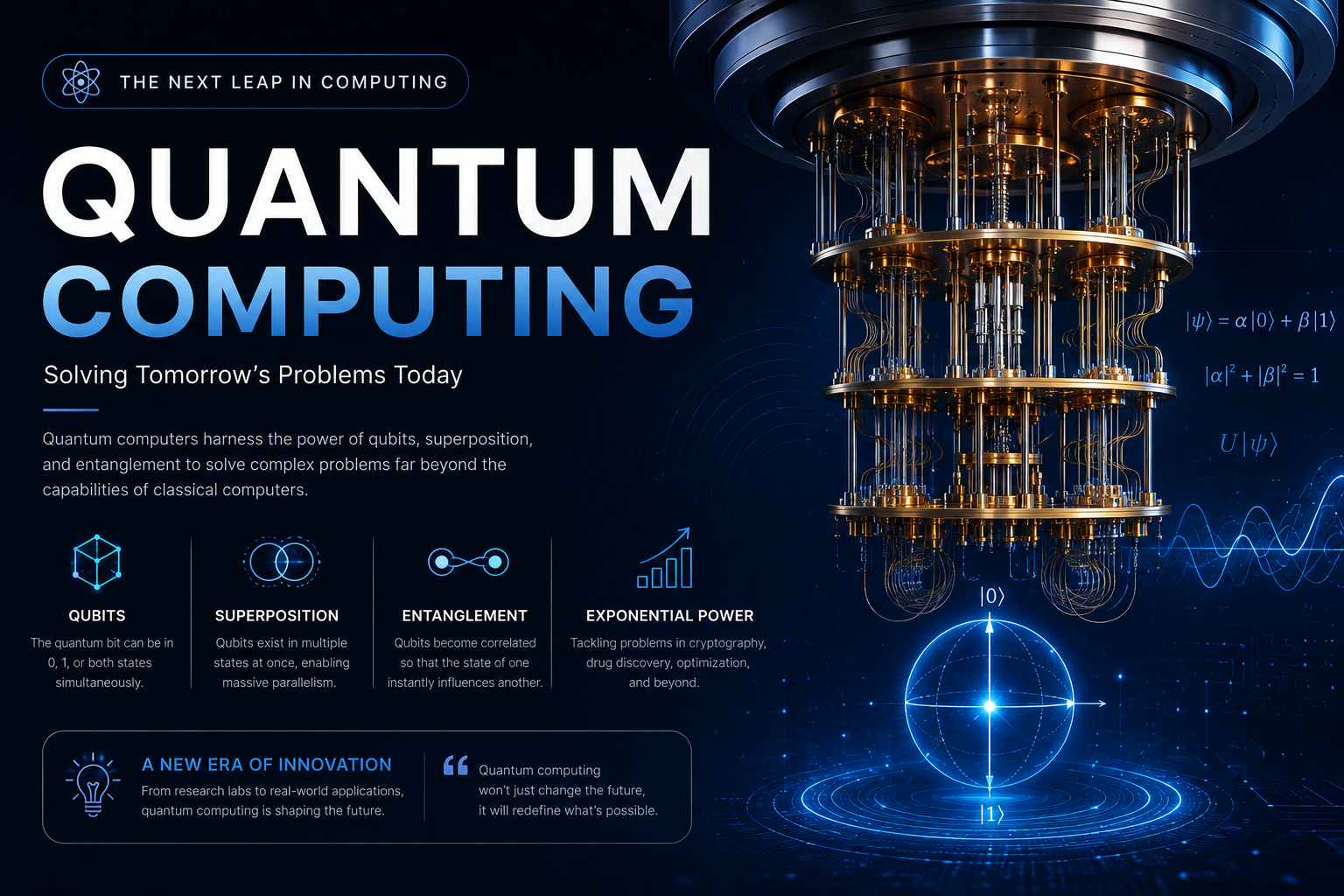
Quantum computing leverages the principles of quantum physics to solve complex problems that are effectively impossible for classical computers. While traditional devices process binary bits (0s and 1s), quantum computers use quantum bits (qubits) that can exist as both 0 and 1 simultaneously. While still in development, quantum technology will soon be able to solve complex problems that classical supercomputers can’t solve (or can’t solve fast enough).
Father of Quantum Computer:
British physicist David Deutsch is widely recognized as the “father of quantum computing”. In 1985, he published a seminal paper establishing the theoretical foundation for the field by describing the first universal quantum computer and formulating the concept of a quantum Turing machine
How it Works
The massive leap in processing power and speed comes from two primary properties of quantum mechanics:
Superposition: Unlike a standard bit, a qubit can exist as a 0, a 1, or any quantum proportion of both at the same time. This allows a quantum computer to evaluate millions of possibilities concurrently rather than one by one.
Entanglement: Qubits can become interconnected, meaning the state of one qubit directly affects the state of another. This allows computing power to scale exponentially as more qubits are added.
Common Applications
Quantum computing is not designed to replace your smartphone or laptop. Instead, it is meant to accelerate hyper-specific, computationally heavy tasks across various fields:
Healthcare & Pharmaceuticals: Simulating molecular interactions to discover new drugs and understand diseases.
Finance: Running complex simulations for portfolio optimization and risk analysis.
Logistics: Instantly calculating the most efficient routes for global supply chains and traffic management.
Cybersecurity: Developing advanced cryptographic systems and breaking traditional encryption formats.