
Post-Quantum Cryptography (PQC): The Complete 2026 Guide to Quantum-Safe Encryption, Algorithms, Migration & Future

Post-Quantum Cryptography (PQC): The Complete Guide to Quantum-Safe Encryption (2026)
The rapid advancement of quantum computing is transforming the future of technology. While quantum computers promise incredible breakthroughs in medicine, artificial intelligence, scientific research, and optimization, they also pose a serious threat to today’s encryption systems.
This is where Post-Quantum Cryptography (PQC) comes into play. PQC refers to cryptographic algorithms specifically designed to remain secure even against attacks from powerful quantum computers.
In this comprehensive guide, you’ll learn what PQC is, why it’s important, how it works, the latest NIST standards, migration strategies, real-world applications, challenges, and the future of quantum-safe cybersecurity.
Table of Contents

What is Post-Quantum Cryptography (PQC)?
Post-Quantum Cryptography (PQC) is a new generation of cryptographic algorithms designed to protect digital information from attacks by both classical and quantum computers.
Unlike traditional encryption systems such as RSA or ECC, PQC algorithms rely on mathematical problems that are believed to be difficult for quantum computers to solve.
The goal is to ensure secure communication for decades, even after practical quantum computers become available.
Why Do We Need Post-Quantum Cryptography?
Today’s internet security depends on mathematical problems that classical computers cannot solve efficiently.
These include:
- RSA
- Elliptic Curve Cryptography (ECC)
- Diffie-Hellman Key Exchange
Unfortunately, quantum computers can solve these problems much faster using specialized algorithms.
Without quantum-safe encryption:
- Banking systems become vulnerable.
- Government communications may be exposed.
- Medical records could be stolen.
- Digital signatures may become forgeable.
- Blockchain systems may require upgrades.
- Military communications could be compromised.
Understanding the Quantum Threat
Current encryption relies on problems like:
- Integer factorization
- Discrete logarithms
- Elliptic curve mathematics
Quantum computers use qubits instead of bits.
Using Shor’s Algorithm, a quantum computer could efficiently solve these mathematical problems that are practically impossible for classical computers.
This creates a significant cybersecurity challenge for organizations worldwide.
How Current Encryption Works
Today’s encryption typically follows this process:
- Generate a public key.
- Share the public key openly.
- Keep the private key secret.
- Encrypt data using the public key.
- Decrypt data using the private key.
This model has secured the internet for decades.
Why Quantum Computers Are Different
Classical computers process one value at a time.
Quantum computers use:
- Superposition
- Entanglement
- Quantum interference
This allows them to perform certain calculations exponentially faster than classical computers.
As a result, many existing public-key cryptographic systems become insecure.
What Makes PQC Different?
Post-Quantum Cryptography is based on mathematical problems believed to remain difficult even for quantum computers.
Examples include:
- Lattice mathematics
- Error-correcting codes
- Hash functions
- Multivariate polynomial equations
- Isogeny-based mathematics (research area)
These problems currently have no known efficient quantum solutions.
Types of Post-Quantum Cryptographic Algorithms
1. Lattice-Based Cryptography
The most promising PQC approach.
Used in:
- Key exchange
- Encryption
- Digital signatures
Examples:
- CRYSTALS-Kyber (ML-KEM)
- CRYSTALS-Dilithium (ML-DSA)
2. Hash-Based Cryptography
Uses cryptographic hash functions.
Mainly used for:
- Digital signatures
- Software authentication
- Firmware validation
Examples:
- SPHINCS+
3. Code-Based Cryptography
Relies on decoding random linear codes.
Highly secure but often requires larger key sizes.
Example:
- Classic McEliece
4. Multivariate Cryptography
Uses systems of multivariable polynomial equations.
Still an active research area.
NIST Standardization Process
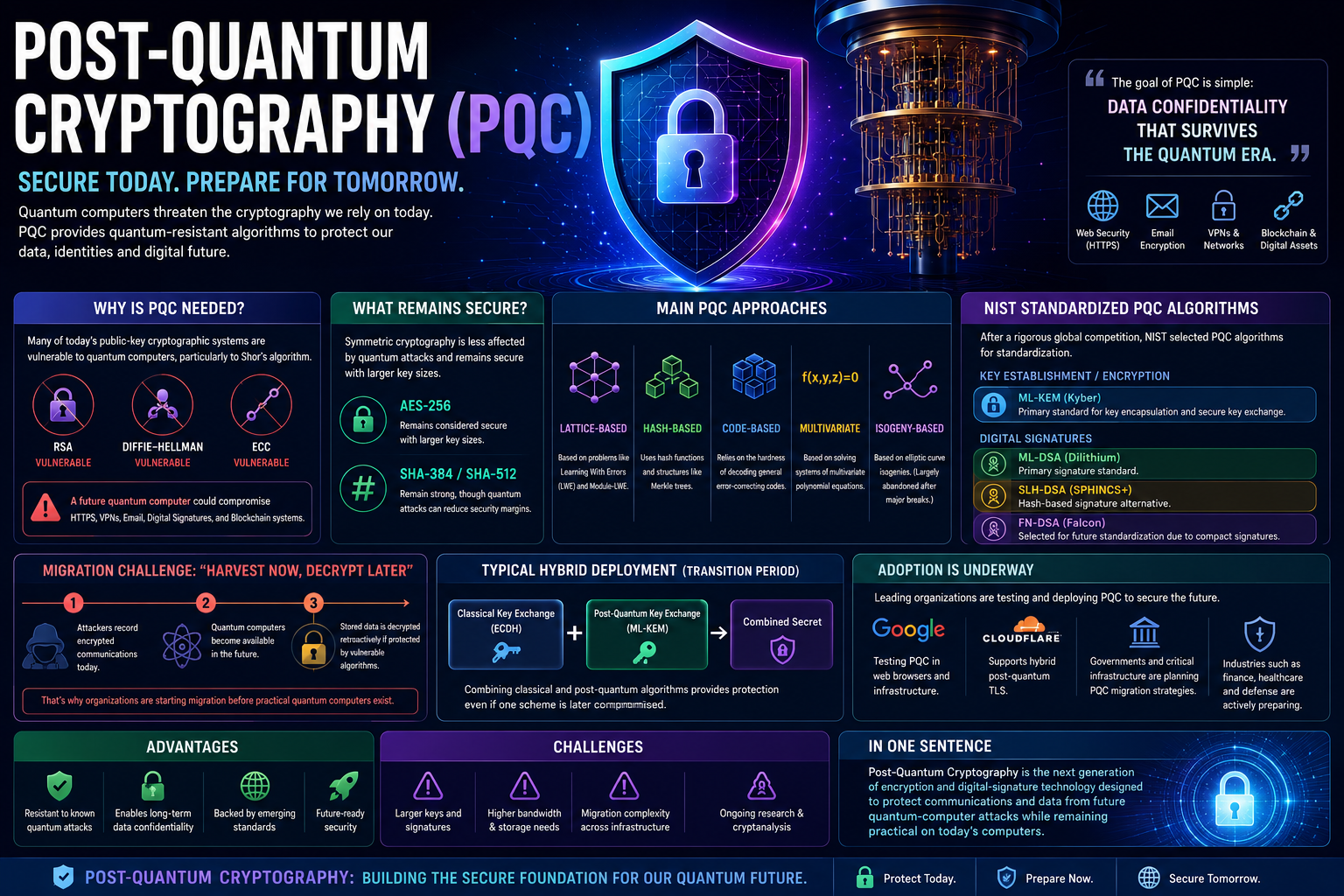
The U.S. National Institute of Standards and Technology (NIST) launched the PQC standardization project to identify secure algorithms for future internet security.
Selected standards include:
| Standard | Purpose |
|---|---|
| ML-KEM (formerly CRYSTALS-Kyber) | Key Establishment |
| ML-DSA (formerly CRYSTALS-Dilithium) | Digital Signatures |
| SLH-DSA (SPHINCS+) | Stateless Hash-Based Signatures |
These standards are expected to become the foundation of next-generation secure communications.
Popular PQC Algorithms
| Algorithm | Category | Purpose |
|---|---|---|
| ML-KEM (Kyber) | Lattice-Based | Encryption |
| ML-DSA (Dilithium) | Lattice-Based | Digital Signature |
| SLH-DSA (SPHINCS+) | Hash-Based | Signature |
| Classic McEliece | Code-Based | Encryption |
How Post-Quantum Cryptography Works
The PQC process generally includes:
Step 1
Generate quantum-resistant public and private keys.
Step 2
Share the public key securely.
Step 3
Encrypt data using quantum-safe algorithms.
Step 4
Transmit encrypted information.
Step 5
Decrypt using the private key.
Even if a quantum computer intercepts the communication, the underlying mathematical problems are designed to remain computationally infeasible.
Real-World Applications of PQC
Banking
Protects financial transactions and payment systems.
Government
Secures classified information and national infrastructure.
Cloud Computing
Provides quantum-safe encryption for cloud storage and services.
Healthcare
Safeguards patient records and medical databases.
Blockchain
Helps secure digital signatures and cryptocurrency systems against future quantum attacks.
Internet of Things (IoT)
Protects billions of connected smart devices.
Artificial Intelligence
Secures AI models, datasets, and communications.
Defense
Ensures secure military communications.
Benefits of Post-Quantum Cryptography
- Resistant to quantum computer attacks
- Compatible with existing internet infrastructure
- Protects long-term confidential data
- Enhances digital signatures
- Supports secure cloud computing
- Future-proofs cybersecurity
- Improves trust in digital services
- Enables secure communication for decades
Challenges of PQC
Despite its advantages, PQC faces several challenges:
- Larger public keys
- Increased signature sizes
- Higher computational requirements
- Migration complexity
- Compatibility with legacy systems
- Need for global standard adoption
PQC vs Traditional Cryptography
| Feature | Traditional Cryptography | Post-Quantum Cryptography |
|---|---|---|
| Quantum Resistant | ❌ No | ✅ Yes |
| Uses RSA/ECC | ✅ Yes | ❌ No |
| Future Ready | ❌ Limited | ✅ Excellent |
| NIST Standardized | Existing Standards | New PQC Standards |
| Security Against Quantum Computers | Weak | Strong |
How Organizations Can Migrate to PQC
A successful migration strategy includes:
- Identify cryptographic assets.
- Inventory all certificates and encryption systems.
- Evaluate quantum risk.
- Test hybrid cryptographic solutions.
- Upgrade software and hardware.
- Replace vulnerable algorithms.
- Train cybersecurity teams.
- Continuously monitor emerging standards.
Industries That Need PQC
- Financial Services
- Government Agencies
- Healthcare
- Defense
- Telecommunications
- Cloud Providers
- Automotive
- Aerospace
- Manufacturing
- Education
- Cryptocurrency Platforms
- E-commerce
Future of Post-Quantum Cryptography
As quantum computing matures, PQC will become the default security standard across digital ecosystems.
Future developments may include:
- Quantum-safe VPNs
- Quantum-resistant TLS protocols
- Secure 6G communications
- Quantum-safe blockchain networks
- Next-generation IoT security
- AI-driven cryptographic management
- Hybrid classical and quantum-safe encryption
Organizations that begin adopting PQC today will be better prepared for tomorrow’s cybersecurity landscape.
Frequently Asked Questions (FAQ)
What is Post-Quantum Cryptography?
It is a set of cryptographic algorithms designed to remain secure against attacks from both classical and quantum computers.
Is RSA quantum-safe?
No. RSA can be broken by sufficiently powerful quantum computers using Shor’s algorithm.
Does PQC require a quantum computer?
No. PQC algorithms run on today’s classical computers while protecting against future quantum threats.
What is the most widely adopted PQC algorithm?
ML-KEM (formerly CRYSTALS-Kyber) is widely expected to be used for quantum-resistant key establishment.
Is PQC already available?
Yes. Many organizations are testing and deploying standardized PQC algorithms as part of their long-term security strategies.
Conclusion
Post-Quantum Cryptography (PQC) is a critical advancement in cybersecurity, preparing organizations for the era of quantum computing. As traditional encryption methods become increasingly vulnerable to quantum attacks, adopting quantum-resistant algorithms is essential for safeguarding sensitive data, digital identities, financial transactions, and national infrastructure.
By understanding PQC, following emerging standards, and planning early migration strategies, businesses and governments can build resilient, future-ready security systems that remain trustworthy in the quantum age.