Multimodal AI: The Complete Guide to AI That Understands Text, Images, Audio, Video, and More (2026)

Table of Contents
Multimodal AI: The Future of Artificial Intelligence
Artificial Intelligence (AI) has evolved rapidly over the past decade. Traditional AI systems were designed to process only one type of data, such as text, images, or speech. Today, a new generation of AI known as Multimodal AI is transforming industries by understanding and combining multiple forms of information simultaneously.
Imagine asking an AI assistant to analyze a medical image while reading a doctor’s notes and listening to a patient’s voice. Instead of treating these as separate tasks, Multimodal AI combines all available information to produce more accurate and intelligent responses.
This capability is making AI more human-like than ever before.
What is Multimodal AI?
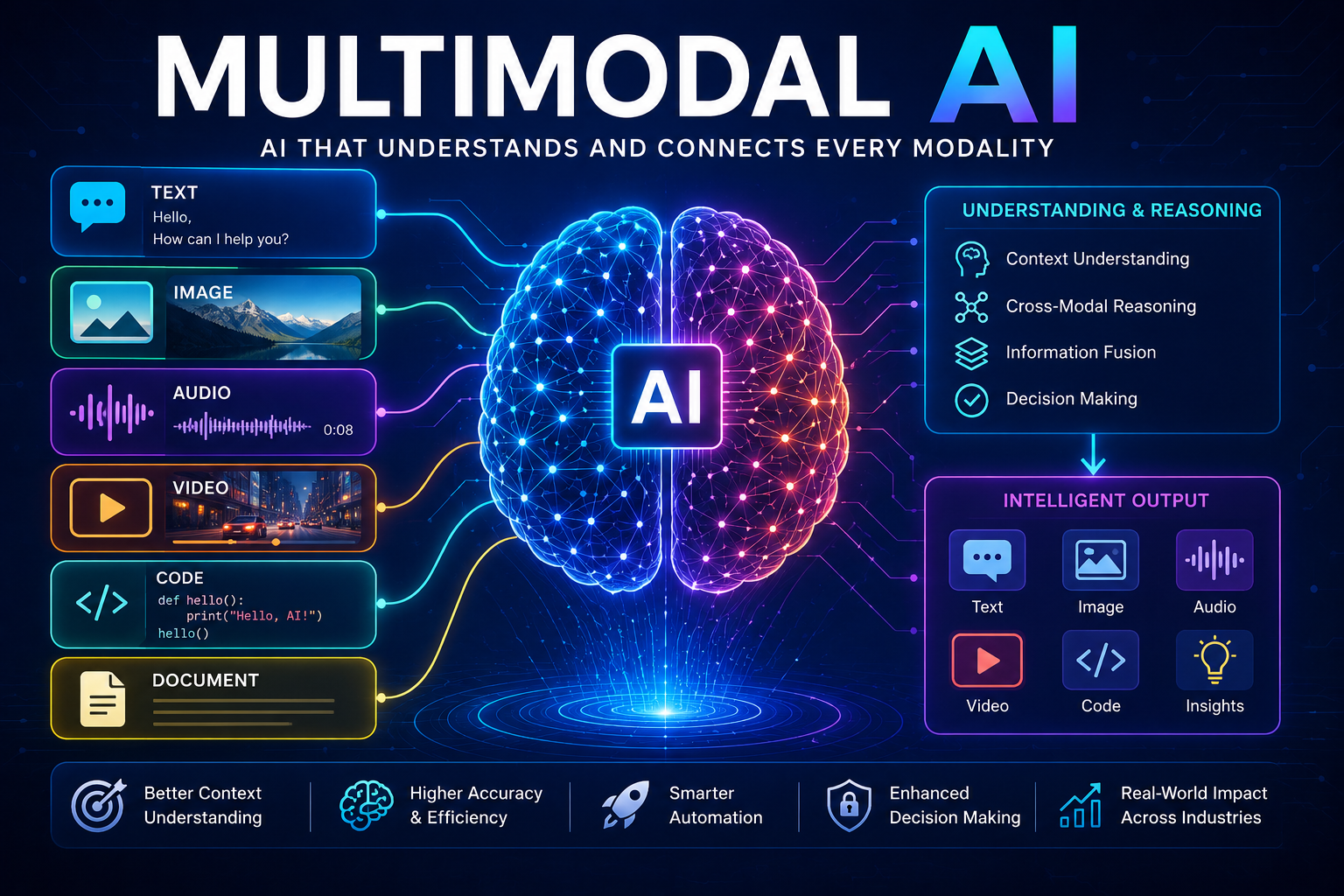
Multimodal AI is an advanced branch of Artificial Intelligence that can process, understand, and generate information from multiple data types (called modalities) at the same time.
These modalities include:
- Text
- Images
- Audio
- Video
- Documents
- Handwriting
- Code
- Sensor Data
- 3D Models
Unlike traditional AI, which works with only one data type, Multimodal AI combines different inputs to improve reasoning and decision-making.
Why is Multimodal AI Important?
Humans naturally understand information from multiple senses.
For example:
A person can:
- Read a document
- View an image
- Listen to speech
- Observe facial expressions
- Understand context
Multimodal AI attempts to replicate this ability.
Instead of understanding only text, it understands the entire context.
Simple Example
Imagine uploading a picture of a broken laptop and asking:
“What is wrong with this laptop and how can I repair it?”
A Multimodal AI system can:
- Analyze the image
- Detect physical damage
- Read any visible error messages
- Understand your written question
- Suggest possible repairs
- Recommend replacement parts
- Estimate repair cost
Traditional AI cannot perform all these tasks together.
Types of Modalities
| Modality | Example |
|---|---|
| Text | Articles, emails, PDFs |
| Image | Photos, X-rays, screenshots |
| Audio | Voice recordings, music |
| Video | CCTV footage, lectures |
| Code | Python, Java, C++, SQL |
| Documents | Contracts, invoices |
| Sensor Data | IoT devices, GPS |
| 3D Data | CAD models, digital twins |
How Multimodal AI Works
A Multimodal AI model typically follows several stages.
1. Data Collection
The system receives multiple types of input.
Example:
- User uploads an image
- Writes a question
- Speaks through a microphone
2. Encoding
Each type of data is converted into mathematical vectors.
Examples:
- Text → Language embeddings
- Images → Vision embeddings
- Audio → Audio embeddings
These embeddings help AI understand relationships.
3. Feature Fusion
The AI combines information from different modalities into a unified representation.
This allows the model to understand context much better.
4. Cross-Modal Attention
The AI learns which information is most important.
Example:
If an image contains a warning sign and the text asks about safety, the AI focuses on both together.
5. Reasoning
Large neural networks analyze the combined information.
The AI:
- Understands
- Compares
- Predicts
- Explains
6. Response Generation
Finally, the AI generates:
- Text
- Images
- Speech
- Code
- Charts
- Videos
depending on the task.
Architecture of Multimodal AI
A simplified architecture includes:
          User Input
        /     |      \
     Text   Image   Audio
        \     |      /
      Individual Encoders
             ↓
     Feature Fusion Layer
             ↓
     Transformer Model
             ↓
     AI Reasoning Engine
             ↓
      Intelligent Response
Key Technologies Behind Multimodal AI
Transformers
Modern Multimodal AI is powered by Transformer architectures that understand long-range relationships between different data types.
Vision Transformers (ViT)
Used for understanding images and visual information.
Applications include:
- Object detection
- Image recognition
- Medical imaging
Large Language Models (LLMs)
These models process language.
Examples include conversational assistants and document summarization systems.
Contrastive Learning
The AI learns relationships between images and text.
Example:
Learning that a picture of a dog corresponds to the word “dog.”
Cross-Attention Networks
These networks allow text to influence image understanding and vice versa.
Popular Multimodal AI Models
Some of the most advanced Multimodal AI systems include:
- GPT-4o
- Gemini
- Claude
- Llama Vision
- Qwen-VL
- DeepSeek Vision
- Pixtral
- Kosmos
- Florence
- BLIP
Each model combines language understanding with visual or multimodal reasoning.
Real-World Applications
Healthcare
Doctors use Multimodal AI to combine:
- MRI scans
- Patient history
- Laboratory reports
- Medical images
This improves diagnosis accuracy.
Education
Students can:
- Upload homework
- Ask questions
- Learn through diagrams
- Generate notes
- Translate languages
Customer Support
Businesses use AI chatbots capable of:
- Reading screenshots
- Understanding customer messages
- Processing invoices
- Analyzing uploaded files
Manufacturing
Factories use Multimodal AI for:
- Defect detection
- Quality inspection
- Predictive maintenance
- Industrial automation
Autonomous Vehicles
Self-driving cars combine:
- Cameras
- Radar
- LiDAR
- GPS
- Traffic information
to make driving decisions.
Finance
Banks analyze:
- Documents
- Customer conversations
- Identity cards
- Transaction history
to detect fraud.
Retail
AI can:
- Recommend products
- Analyze customer behavior
- Search using images
- Improve shopping experiences
Content Creation
Creators generate:
- Blog posts
- Images
- Videos
- Music
- Marketing campaigns
- Social media content
using a single AI assistant.
Benefits of Multimodal AI
- Better understanding of context
- Higher accuracy
- Faster decision-making
- Improved customer experience
- Enhanced automation
- Better accessibility
- Supports natural conversations
- Reduced manual work
- Smarter recommendations
- Increased productivity
Challenges
Despite its advantages, Multimodal AI faces several challenges.
Large Computing Requirements
Training requires powerful GPUs and TPUs.
High Cost
Building large multimodal models is expensive.
Data Quality
Poor-quality datasets reduce performance.
Privacy Issues
Sensitive information must be protected.
Bias
Training data may introduce unfair or inaccurate outputs.
Hallucinations
AI can occasionally generate incorrect information with high confidence.
Multimodal AI vs Traditional AI
| Feature | Traditional AI | Multimodal AI |
|---|---|---|
| Text | ✔ | ✔ |
| Images | Separate model | ✔ |
| Audio | Separate model | ✔ |
| Video | Separate model | ✔ |
| Combined reasoning | ✘ | ✔ |
| Better context | Limited | Excellent |
| Human-like understanding | Low | High |
Future of Multimodal AI
Over the next decade, Multimodal AI is expected to become a core technology in healthcare, education, robotics, finance, manufacturing, and scientific research. Future systems will better understand emotions, collaborate with robots, interact through augmented reality, process information in real time, and support more natural conversations across languages and media.
Frequently Asked Questions (FAQ)
What is Multimodal AI?
Multimodal AI is an artificial intelligence system that processes and understands multiple types of data—such as text, images, audio, and video—at the same time.
How is Multimodal AI different from Generative AI?
Generative AI focuses on creating new content, while Multimodal AI focuses on understanding and combining different data formats. Many modern AI systems combine both capabilities.
What are examples of Multimodal AI?
Examples include AI assistants that analyze images while answering text questions, medical diagnostic systems combining scans with reports, and autonomous vehicles using cameras, radar, and sensors.
Is Multimodal AI the future?
Yes. It is considered one of the most significant advancements in AI because it enables more accurate, context-aware, and human-like interactions.
Conclusion
Multimodal AI represents the next major leap in artificial intelligence. By integrating text, images, audio, video, documents, and other data types into a unified understanding, it enables smarter decision-making and more natural human-computer interactions. As research advances and computing power grows, Multimodal AI will play a central role in transforming industries, improving productivity, and powering the intelligent applications of the future.