Generative AI: Complete Guide (2026) – How It Works, Features, Examples, Applications & Future

Table of Contents
What is Generative AI?
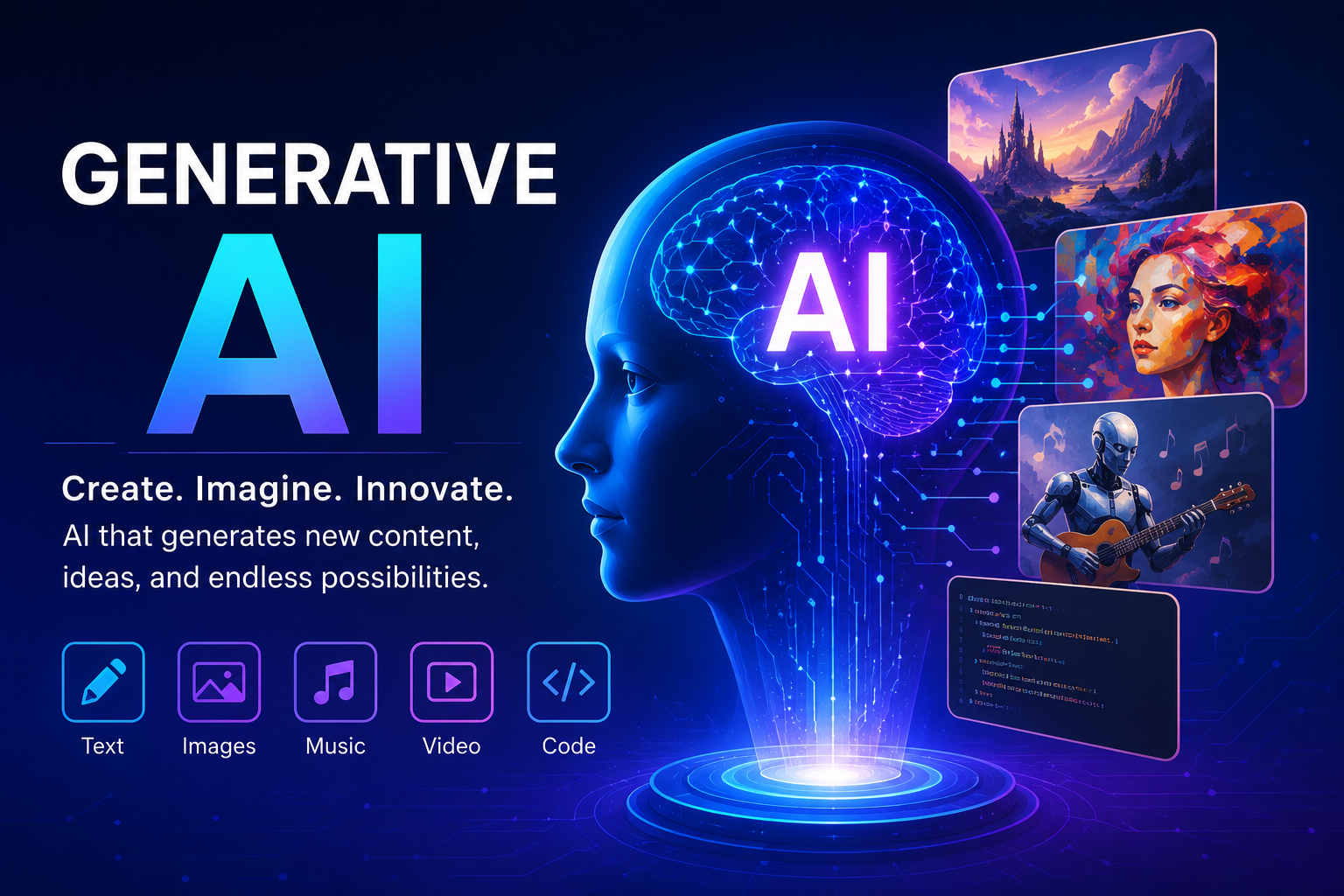
Generative AI (GenAI) is a branch of Artificial Intelligence that can create new content instead of simply analyzing existing data. It can generate text, images, videos, music, code, presentations, websites, and even 3D models based on user instructions (called prompts).
Unlike traditional AI, which mainly predicts or classifies information, Generative AI produces original and human-like content by learning patterns from massive datasets.
Examples include ChatGPT, image generators, AI coding assistants, AI video creators, and AI music generators.
What Does Generative AI Generate?
Generative AI can create almost any type of digital content.
- Text
- Images
- Videos
- Audio
- Music
- Source Code
- Documents
- Presentations
- Websites
- Emails
- Stories
- Logos
- Animations
- Marketing Content
How Does Generative AI Work?
Generative AI follows a simple process.
          USER
            │
            ▼
     Enter Prompt
            │
            ▼
     AI Understands
      Your Request
            │
            ▼
     Large AI Model
 (Learns from Training Data)
            │
            ▼
    Generates New Content
            │
            ▼
 User Reviews & Edits Result
Example: AI Creates a Blog Post
┌────────────────────────────┐
│ User Prompt                │
│ "Write a blog on AI"       │
└──────────────┬─────────────┘
               │
               ▼
┌────────────────────────────┐
│ Generative AI              │
│ Understands the Prompt     │
└──────────────┬─────────────┘
               │
               ▼
┌────────────────────────────┐
│ AI Searches Learned        │
│ Patterns & Knowledge       │
└──────────────┬─────────────┘
               │
               ▼
┌────────────────────────────┐
│ Generates                  │
│ • Title                    │
│ • Content                  │
│ • Images                   │
│ • Code                     │
│ • Tables                   │
└──────────────┬─────────────┘
               │
               ▼
┌────────────────────────────┐
│ Final Human Review         │
│ Publish the Blog           │
└────────────────────────────┘
Key Features of Generative AI
- Generates original content
- Understands natural language
- Supports multiple languages
- Creates high-quality images
- Writes computer code
- Generates videos
- Produces presentations
- Answers questions intelligently
- Learns patterns from huge datasets
- Saves time and effort
- Improves productivity
- Works 24/7
Types of Generative AI
Text Generation
Creates articles, emails, books, blogs and reports.
Image Generation
Creates artwork, posters, logos and illustrations.
Video Generation
Creates AI videos from text.
Audio Generation
Produces speech, podcasts and voiceovers.
Music Generation
Composes original music.
Code Generation
Writes software code automatically.
Real-Life Examples
Education
Creates notes, assignments and explanations.
Healthcare
Generates medical reports and assists doctors.
Marketing
Creates advertisements, social media posts and product descriptions.
Software Development
Writes code and finds bugs.
Customer Support
Generates automatic responses.
Graphic Design
Creates logos, posters and banners.
Entertainment
Creates movies, music and animations.
Banking
Generates financial reports.
Popular Generative AI Tools
- ChatGPT
- Google Gemini
- Claude
- Microsoft Copilot
- Midjourney
- Stable Diffusion
- Adobe Firefly
- GitHub Copilot
- Runway
- Canva AI
Advantages
- Saves time
- Reduces manual work
- Boosts creativity
- Generates high-quality content
- Supports multiple languages
- Improves business productivity
- Creates content instantly
- Automates repetitive tasks
- Available anytime
- Assists professionals and students
Disadvantages
- Can generate incorrect information
- Depends on training data quality
- Copyright concerns
- Privacy risks
- Fake content generation
- May replace some routine jobs
- Bias in generated outputs
- Requires human verification
Applications
- Education
- Healthcare
- Banking
- Agriculture
- E-commerce
- Marketing
- Software Development
- Gaming
- Robotics
- Manufacturing
- Research
- Cybersecurity
- Finance
- Journalism
- Government Services
Future of Generative AI
The future of Generative AI is expected to include:
- AI-powered software development
- Autonomous AI assistants
- AI teachers
- Personalized healthcare
- AI-generated movies
- AI scientists
- AI business assistants
- Intelligent robots
- Smart factories
- AI-powered education
- Digital humans
- Advanced content creation
Generative AI will continue to transform industries by making content creation faster, more accessible, and more personalized.
Generative AI vs Traditional AI
| Feature | Traditional AI | Generative AI |
|---|---|---|
| Analyzes Data | ✅ | ✅ |
| Generates Content | ❌ | ✅ |
| Creates Images | ❌ | ✅ |
| Writes Code | Limited | ✅ |
| Writes Articles | ❌ | ✅ |
| Creates Videos | ❌ | ✅ |
| Human-like Responses | Limited | ✅ |
Frequently Asked Questions (FAQs)
What is Generative AI?
Generative AI is an artificial intelligence technology that creates new content such as text, images, videos, music, and code based on user prompts.
Is ChatGPT a Generative AI?
Yes. ChatGPT is a Generative AI model that generates human-like text and assists with writing, coding, learning, and problem-solving.
Where is Generative AI used?
It is widely used in education, healthcare, marketing, software development, customer support, finance, entertainment, and research.
Is Generative AI safe?
It can be safe when used responsibly. Users should verify AI-generated content for accuracy and be mindful of privacy and copyright considerations.
Can Generative AI replace humans?
Generative AI is designed to assist people by automating repetitive tasks and enhancing creativity. Human expertise, judgment, and oversight remain essential.
Conclusion
Generative AI is one of the most transformative technologies of the modern era. It enables individuals and businesses to create high-quality content quickly, improve productivity, and unlock new creative possibilities. As the technology evolves, it will play an even greater role in education, healthcare, software development, entertainment, and many other fields. Using Generative AI responsibly while combining it with human expertise will lead to the best outcomes.