

Meta Description:
Learn what Advanced Robotics is, how it works, its key technologies, applications, benefits, challenges, and future trends. Discover how AI-powered robots are transforming industries, healthcare, manufacturing, logistics, agriculture, and everyday life.
🤖 Advanced Robotics: Revolutionizing the Future of Automation
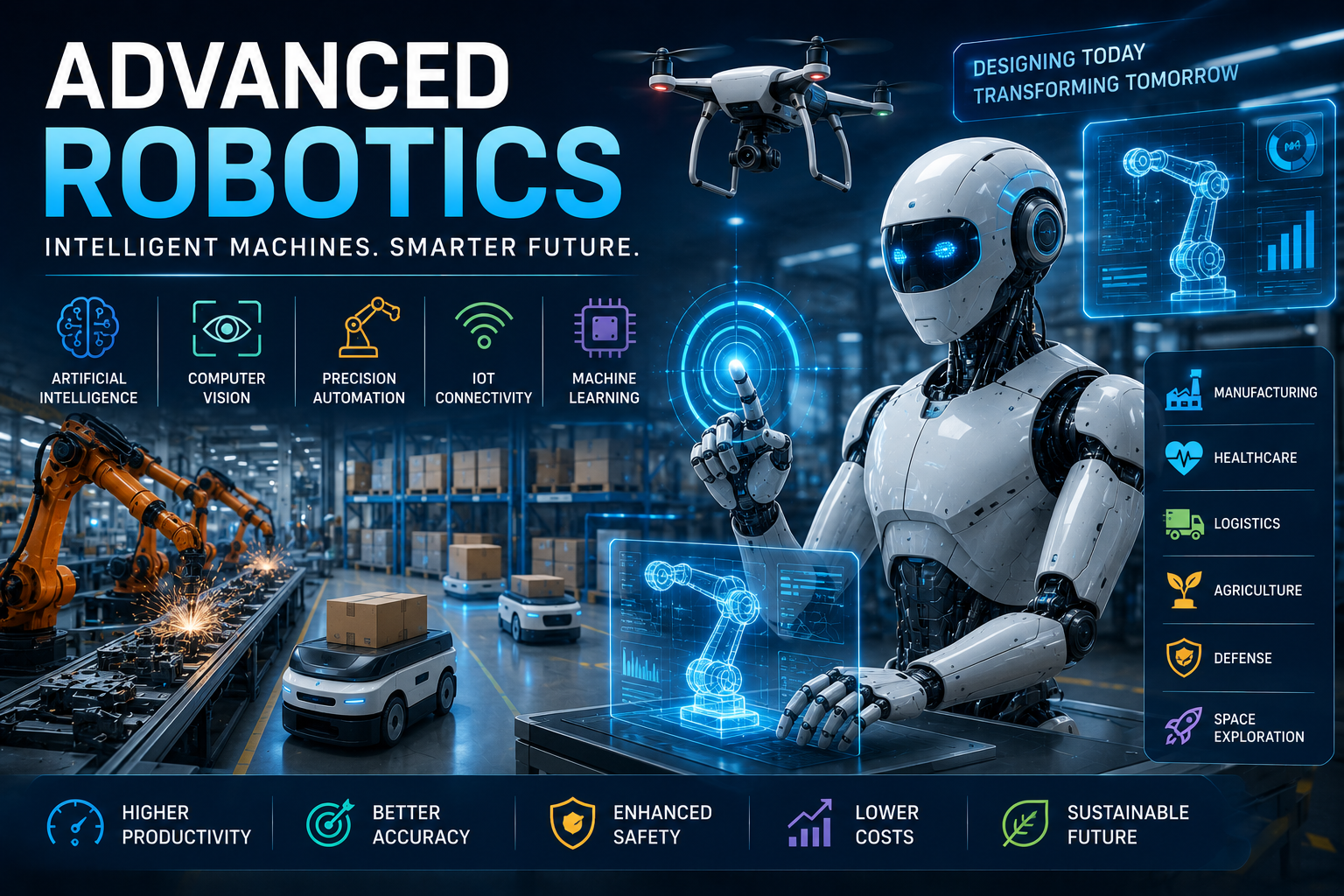
Robots have evolved far beyond simple machines that perform repetitive tasks. Today’s Advanced Robotics combines Artificial Intelligence (AI), Machine Learning (ML), Computer Vision, Internet of Things (IoT), advanced sensors, and autonomous decision-making to create intelligent machines capable of interacting with the real world.
Advanced robots can learn from experience, recognize objects and people, navigate complex environments, collaborate with humans, and perform tasks with remarkable precision. These capabilities are transforming industries ranging from manufacturing and healthcare to agriculture, logistics, and space exploration.
What is Advanced Robotics?
Advanced Robotics is the field of designing and developing intelligent robots that can perceive their surroundings, process information, make decisions, and perform complex tasks with minimal human intervention.
Unlike traditional industrial robots that follow pre-programmed instructions, advanced robots can:
- Learn from data
- Adapt to changing environments
- Make autonomous decisions
- Collaborate safely with humans
- Perform highly precise operations
Simple Definition
Advanced Robotics = Intelligent Robots + Artificial Intelligence + Automation + Real-Time Decision Making
How Advanced Robotics Works
Advanced robotics combines hardware and intelligent software into a unified system.
Step 1 – Data Collection
Sensors collect information from the environment.
Examples:
- Cameras
- LiDAR
- Radar
- GPS
- Ultrasonic sensors
- Force sensors
- Temperature sensors
↓
Step 2 – AI Processing
Artificial Intelligence analyzes incoming data.
The robot can:
- Recognize objects
- Detect obstacles
- Understand voice commands
- Identify people
- Predict movements
↓
Step 3 – Decision Making
Machine learning algorithms determine the best action.
↓
Step 4 – Motion Control
Motors and actuators execute the required movement.
↓
Step 5 – Continuous Learning
The robot improves its performance through new data and experience.
Simple Diagram
        Sensors & Cameras
               │
               ▼
      AI + Machine Learning
               │
               ▼
      Decision-Making Engine
               │
      ┌────────┼────────┐
      ▼        ▼        ▼
 Computer   Navigation  Vision
               │
               ▼
      Motors & Actuators
               │
               ▼
      Intelligent Robot
               │
      Performs Real-Time Tasks
Core Technologies Behind Advanced Robotics
🤖 Artificial Intelligence (AI)
AI enables robots to:
- Learn from data
- Make decisions
- Recognize speech
- Understand images
- Plan tasks
🧠 Machine Learning (ML)
ML allows robots to improve performance without explicit reprogramming.
Applications include:
- Pattern recognition
- Predictive maintenance
- Object classification
👁️ Computer Vision
Computer vision enables robots to:
- Detect objects
- Recognize faces
- Read text
- Inspect products
- Navigate safely
🌐 Internet of Things (IoT)
IoT connects robots with:
- Sensors
- Cloud platforms
- Smart factories
- Other machines
📡 Edge AI
Edge AI allows robots to process data locally, enabling:
- Faster responses
- Reduced latency
- Better privacy
- Offline operation
🛰️ Navigation Technologies
Advanced robots use:
- GPS
- LiDAR
- SLAM (Simultaneous Localization and Mapping)
- Inertial Measurement Units (IMUs)
⚙️ Robotics Hardware
Key hardware includes:
- Servo motors
- Electric actuators
- Robotic arms
- End-effectors (grippers, tools)
- Batteries
- AI processors
Types of Advanced Robots
🏭 Industrial Robots
Used for:
- Assembly
- Welding
- Painting
- Material handling
- Quality inspection
🤝 Collaborative Robots (Cobots)
Designed to work safely alongside humans.
Applications:
- Manufacturing
- Warehousing
- Electronics assembly
🧍 Humanoid Robots
Human-like robots used for:
- Customer service
- Healthcare
- Research
- Education
Examples:
- Tesla Optimus
- Ameca
- Atlas
🚗 Autonomous Mobile Robots (AMRs)
Used in:
- Warehouses
- Hospitals
- Airports
- Manufacturing plants
🚁 Drones
Applications:
- Surveying
- Agriculture
- Disaster response
- Infrastructure inspection
- Delivery services
🚑 Medical Robots
Used for:
- Robotic surgery
- Rehabilitation
- Hospital logistics
- Patient assistance
🌊 Underwater Robots
Support:
- Ocean exploration
- Pipeline inspection
- Marine research
🚀 Space Robots
Used for:
- Planetary exploration
- Satellite maintenance
- Scientific experiments
- Space station support
Applications of Advanced Robotics
🏭 Manufacturing
Robots improve:
- Productivity
- Precision
- Safety
- Product quality
- 24/7 operations
🏥 Healthcare
Advanced robotics enables:
- Robotic-assisted surgery
- Drug delivery
- Rehabilitation therapy
- Elderly care
- Medical diagnostics
📦 Logistics & Warehousing
Robots perform:
- Order picking
- Package sorting
- Inventory tracking
- Autonomous transportation
🌾 Agriculture
Robots assist with:
- Precision farming
- Crop monitoring
- Harvesting
- Weed removal
- Soil analysis
🛒 Retail
Applications include:
- Inventory management
- Shelf scanning
- Customer assistance
- Automated checkout
🏠 Smart Homes
Home robots can:
- Clean floors
- Mow lawns
- Monitor security
- Assist elderly family members
🚒 Disaster Response
Robots are used in:
- Firefighting
- Earthquake rescue
- Hazardous material handling
- Nuclear facility inspection
Benefits of Advanced Robotics
⚡ Increased Productivity
Robots can operate continuously with consistent performance.
🎯 Higher Accuracy
They reduce human errors in repetitive and precision tasks.
🛡️ Improved Safety
Robots handle dangerous or hazardous work environments.
💰 Lower Operating Costs
Automation reduces long-term labor and maintenance costs.
😊 Better Quality
Consistent performance leads to fewer defects and higher-quality products.
🌍 Greater Accessibility
Assistive robots help people with disabilities and support independent living.
Challenges
Despite significant progress, Advanced Robotics still faces challenges:
- High development and deployment costs
- Complex programming and integration
- Battery life limitations
- Cybersecurity risks
- Ethical concerns
- Regulatory compliance
- Workforce reskilling requirements
Advanced Robotics and Artificial Intelligence
AI is the driving force behind modern robotics. It enables robots to:
- Learn from experience
- Understand natural language
- Recognize objects and faces
- Plan complex tasks
- Collaborate with humans
- Adapt to new environments
As AI advances, robots are becoming more autonomous, flexible, and capable of solving increasingly complex problems.
Future of Advanced Robotics
The future of Advanced Robotics is expected to be shaped by innovations in AI, sensors, connectivity, and materials science.
Key trends include:
- AI-powered humanoid robots
- Swarm robotics for coordinated tasks
- Soft robotics inspired by biology
- Autonomous delivery robots
- Medical nanorobots
- Space exploration robots
- Edge AI-enabled robots
- 6G-connected robotic systems
- Self-learning collaborative robots
- Sustainable and energy-efficient robotic platforms
Experts predict that robots will increasingly work alongside humans rather than replace them, handling repetitive, dangerous, or highly precise tasks while people focus on creativity, strategy, and complex decision-making.
Why Advanced Robotics Matters
Advanced Robotics is transforming industries by making operations smarter, safer, and more efficient. From manufacturing and healthcare to logistics and agriculture, intelligent robots are helping organizations improve productivity while addressing labor shortages and enhancing workplace safety.
As technology continues to evolve, Advanced Robotics will become a key pillar of the digital economy and Industry 4.0.
Conclusion
Advanced Robotics represents the next generation of automation, combining intelligent software with sophisticated hardware to create machines capable of learning, adapting, and working alongside humans. By integrating AI, computer vision, IoT, and autonomous decision-making, these robots are reshaping industries and improving quality of life.
With ongoing innovations in artificial intelligence and robotics engineering, Advanced Robotics is set to play a vital role in building smarter factories, hospitals, cities, and homes, driving innovation and sustainable growth worldwide.
Frequently Asked Questions (FAQs)
What is Advanced Robotics?
Advanced Robotics is the development of intelligent robots that use AI, sensors, computer vision, and automation to perform complex tasks with minimal human intervention.
How is Advanced Robotics different from traditional robotics?
Traditional robots follow fixed programs, while advanced robots can learn, adapt, make decisions, and respond to changing environments.
Where is Advanced Robotics used?
It is used in manufacturing, healthcare, logistics, agriculture, retail, defense, space exploration, disaster response, and smart homes.
What technologies power Advanced Robotics?
Artificial Intelligence, Machine Learning, Computer Vision, IoT, Edge AI, LiDAR, advanced sensors, and autonomous navigation technologies.
What is the future of Advanced Robotics?
The future includes AI-powered humanoid robots, autonomous mobile robots, swarm robotics, medical nanorobots, and intelligent systems working collaboratively with humans.