
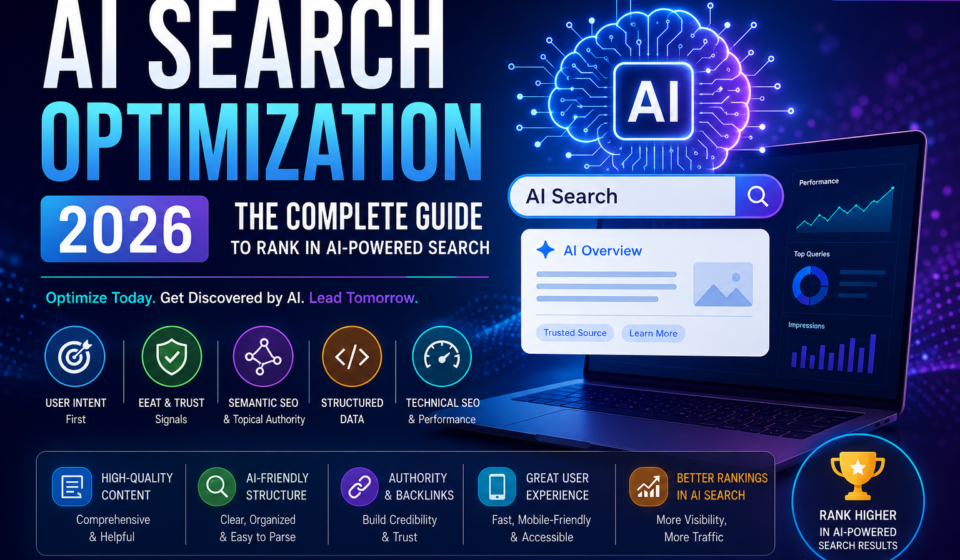

Search is undergoing one of its biggest transformations since the introduction of modern search engines. Instead of simply matching keywords, AI-powered search systems now understand user intent, analyze context, and generate comprehensive answers using information from trusted sources.
This shift has introduced a new discipline known as AI Search Optimization (ASO). While traditional SEO remains essential, ASO focuses on making content understandable, trustworthy, and useful for AI-driven search experiences such as Google AI Mode, AI Overviews, conversational search assistants, and other AI-powered discovery platforms.
If you want your website to stay competitive in 2026 and beyond, this guide explains what AI Search Optimization is, why it matters, and how to implement it effectively.

Table of Contents
What Is AI Search Optimization (ASO)?
AI Search Optimization (ASO) is the process of creating and optimizing content so that AI-powered search engines can understand, evaluate, and reference it when generating answers for users.
Unlike traditional SEO, which often emphasizes keyword placement, ASO prioritizes:
- User intent
- Context and meaning
- Topical depth
- Content quality
- Trustworthiness
- Structured information
- Clear organization
- Technical performance
The goal is to become a reliable source that AI systems are confident referencing.
Why AI Search Optimization Matters in 2026
AI-powered search is changing how people discover information. Users increasingly ask complete questions and expect direct, conversational answers.
As a result, websites that publish comprehensive, accurate, and user-focused content have greater opportunities to earn visibility both in traditional search results and AI-generated experiences.
Key benefits include:
- Increased organic visibility
- Higher trust and authority
- Better user engagement
- Improved long-tail keyword coverage
- Greater likelihood of being referenced in AI-generated responses
How AI Search Works
A simplified AI search workflow:
- User submits a natural-language question.
- AI identifies the search intent.
- The query is broken into relevant subtopics.
- Trusted and authoritative sources are evaluated.
- The AI synthesizes information.
- A conversational answer is generated.
- Supporting websites may be cited or recommended for further reading.
AI Search vs Traditional SEO
| Traditional SEO | AI Search Optimization |
|---|---|
| Keyword-focused | Intent-focused |
| Individual keywords | Topics and entities |
| Backlinks are primary | Authority and usefulness |
| Static rankings | Dynamic AI-generated responses |
| Blue links | Conversational answers |
| Short articles | Comprehensive resources |
Core Principles of AI Search Optimization
Successful ASO relies on several pillars:
- Create original, people-first content.
- Demonstrate expertise and credibility.
- Cover topics comprehensively.
- Use clear headings and logical structure.
- Implement structured data.
- Maintain fast, mobile-friendly pages.
- Keep information current.
- Build topical authority through related content.
Build Content for User Intent
Think beyond keywords and answer the questions users actually have.
For example, instead of targeting only:
“AI Search Optimization”
Cover related questions such as:
- What is AI Search Optimization?
- How does AI Search work?
- How is ASO different from SEO?
- What tools help with AI optimization?
- What mistakes should I avoid?
This approach improves topical completeness.
Strengthen EEAT Signals
Experience, Expertise, Authoritativeness, and Trustworthiness (EEAT) remain essential.
Improve EEAT by:
- Including author biographies and credentials.
- Referencing authoritative sources.
- Updating content regularly.
- Providing original examples and insights.
- Publishing transparent contact and editorial information.
Use Semantic SEO
Semantic SEO helps search engines understand the relationships between concepts.
Instead of repeating the same keyword, naturally include related terms such as:
- AI-powered search
- Conversational search
- Search intent
- Knowledge graphs
- Natural language processing
- Machine learning
- Structured data
- Content optimization
- AI Overviews
- Google AI Mode
Technical SEO for AI
Ensure your website includes:
- HTTPS
- Fast loading speeds
- Mobile responsiveness
- Core Web Vitals optimization
- XML sitemap
- Robots.txt
- Canonical URLs
- Clean URL structure
- Accessible navigation
Strong technical foundations improve crawlability and user experience.
Implement Structured Data
Schema markup provides machine-readable context for your content.
Useful schema types include:
- Article
- FAQ
- HowTo
- Breadcrumb
- Organization
- Person
- VideoObject
- ImageObject
- WebPage
Structured data can improve how search engines interpret your pages.
Format Content for AI Readability
To make content easier for AI systems and readers to process:
- Use descriptive H2 and H3 headings.
- Keep paragraphs concise.
- Add numbered steps where appropriate.
- Include bullet lists for key points.
- Provide summaries and FAQs.
- Use tables to compare concepts.
- Optimize images with descriptive alt text.
Optimize Images and Videos
For images:
- Use descriptive filenames.
- Write meaningful alt text.
- Compress files for faster loading.
- Prefer modern formats such as WebP.
For videos:
- Add transcripts.
- Include timestamps or chapters.
- Optimize titles and descriptions.
- Use VideoObject schema when appropriate.
Build a Strong Internal Linking Structure
Connect related articles so users and search engines can explore your content more effectively.
For example, link this article to guides on:
- Technical SEO
- Schema Markup
- Core Web Vitals
- Google AI Mode
- Prompt Engineering
- AI Agents
- AI Chatbots
- Zero Trust Security (if relevant to your audience)
Internal linking reinforces topical authority.
Common AI Search Optimization Mistakes
Avoid:
- Keyword stuffing
- Thin or duplicate content
- Publishing unreviewed AI-generated text
- Ignoring EEAT
- Missing structured data
- Poor heading hierarchy
- Slow page speeds
- Outdated information
- Weak internal linking
- Broken links
AI Search Optimization Checklist
- ✅ Understand user intent.
- ✅ Publish comprehensive, accurate content.
- ✅ Demonstrate EEAT.
- ✅ Use semantic SEO.
- ✅ Implement schema markup.
- ✅ Optimize Core Web Vitals.
- ✅ Improve mobile usability.
- ✅ Optimize images and videos.
- ✅ Strengthen internal linking.
- ✅ Update content regularly.
Best Tools for AI Search Optimization
- Google Search Console
- Google Analytics 4
- Google PageSpeed Insights
- Google Rich Results Test
- Google Trends
- Google Keyword Planner
- Ahrefs
- Semrush
- Screaming Frog SEO Spider
- Microsoft Clarity
Frequently Asked Questions
What is AI Search Optimization?
AI Search Optimization is the practice of improving content so AI-powered search systems can better understand, evaluate, and reference it when answering user questions.
Is SEO still important?
Yes. Traditional SEO remains important, but AI Search Optimization builds upon it by emphasizing user intent, authority, structured information, and content quality.
Does AI-generated content rank automatically?
No. AI-assisted content should be reviewed, fact-checked, edited, and enhanced with original expertise and value.
Does schema markup help AI search?
Yes. Proper schema markup provides structured information that helps search engines interpret your content more accurately.
Conclusion
AI Search Optimization is the natural evolution of modern SEO. As AI-powered search becomes more sophisticated, success depends on creating content that is comprehensive, trustworthy, technically sound, and genuinely helpful. By combining strong technical SEO, semantic optimization, structured data, EEAT, and people-first content, you can improve your visibility in both traditional search results and AI-driven search experiences throughout 2026 and beyond.
Further Reading & Official Resources
To deepen your understanding of AI Search Optimization (ASO) and stay updated with the latest AI-powered search developments, explore these trusted resources:
- Google Search Central – Official documentation on SEO best practices, crawling, indexing, and ranking.
https://developers.google.com/search - Google Search Blog – The latest announcements on Google Search, AI Mode, and AI Overviews.
https://blog.google/products/search/ - Google Search Console – Monitor your website’s indexing, search performance, and technical issues.
https://search.google.com/search-console - Google Structured Data Documentation – Learn how to implement Schema Markup for enhanced search visibility.
https://developers.google.com/search/docs/appearance/structured-data - Google Rich Results Test – Validate structured data and check eligibility for rich results.
https://search.google.com/test/rich-results - Google PageSpeed Insights – Analyze page speed and Core Web Vitals performance.
https://pagespeed.web.dev/ - Chrome Lighthouse – Audit your website for SEO, accessibility, performance, and best practices.
https://developer.chrome.com/docs/lighthouse - web.dev – Core Web Vitals – Learn how to improve page experience and loading performance.
https://web.dev/vitals/ - Schema.org – Official structured data vocabulary recognized by major search engines.
https://schema.org/ - Google Analytics – Measure website traffic, engagement, and conversions.
https://analytics.google.com/ - Google Trends – Discover trending search topics and keyword opportunities.
https://trends.google.com/ - Google Keyword Planner – Research high-value keywords for SEO and content planning.
https://ads.google.com/home/tools/keyword-planner/ - Bing Webmaster Tools – Optimize your website for Microsoft Bing Search.
https://www.bing.com/webmasters - OpenAI – Explore the latest AI technologies and large language models.
https://openai.com/ - Anthropic – Learn about Claude AI and AI safety research.
https://www.anthropic.com/ - MDN Web Docs – Comprehensive reference for HTML, CSS, JavaScript, and web technologies.
https://developer.mozilla.org/ - W3C Web Standards – Official web standards for building accessible and interoperable websites.
https://www.w3.org/
🔗 Related Articles
Continue learning with these related topics: