

Google Search is evolving faster than ever. Traditional SEO is no longer enough to secure top rankings. With the introduction of Google AI Mode, search results are becoming more intelligent, conversational, and personalized.
Instead of displaying only blue links, Google AI Mode analyzes multiple trusted sources and generates AI-powered answers directly in search results. Websites that provide accurate, structured, authoritative, and user-focused content have a much better chance of being referenced.
If you want your website to continue receiving organic traffic in the AI era, this guide will show you exactly how to optimize your content for Google AI Mode.

Table of Contents
What is Google AI Mode?
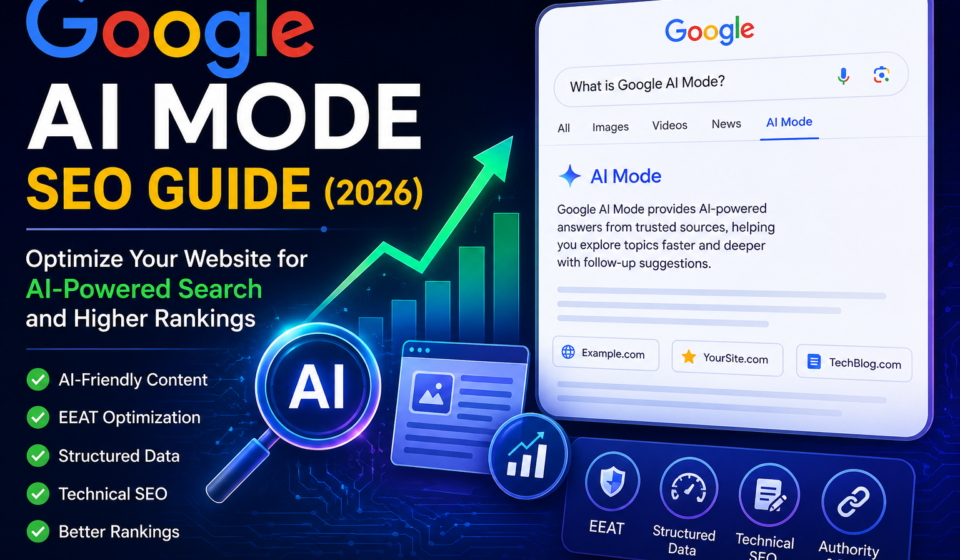
Google AI Mode is Google’s next-generation search experience powered by advanced AI models. Instead of simply matching keywords, it understands the meaning behind a query and generates comprehensive answers by combining information from multiple reliable sources.
Its goal is to help users complete tasks faster while still providing links to authoritative websites for deeper information.
How Google AI Mode Works
Google AI Mode follows a multi-step process:
- Understands user intent.
- Breaks complex questions into smaller tasks.
- Searches trusted web sources.
- Evaluates website authority.
- Generates AI-powered responses.
- Suggests follow-up questions.
- Displays supporting website links.
This means your content must answer complete user questions, not just target keywords.
Traditional SEO vs Google AI SEO
| Traditional SEO | Google AI SEO |
|---|---|
| Keyword focused | Intent focused |
| Single page ranking | Multiple trusted sources |
| Backlinks dominate | Authority + usefulness |
| Exact keyword match | Semantic understanding |
| Blue links | AI-generated answers |
| Short articles | Comprehensive content |
Why Google AI Mode Changes SEO
AI Mode rewards content that demonstrates:
- Real expertise
- Complete topic coverage
- Helpful explanations
- Updated information
- Reliable references
- Strong website reputation
Thin content is far less likely to be surfaced.
EEAT Is More Important Than Ever
Google emphasizes Experience, Expertise, Authoritativeness, and Trustworthiness (EEAT).
To strengthen EEAT:
- Publish author profiles with credentials.
- Cite trustworthy references.
- Keep articles up to date.
- Include original examples, screenshots, and case studies.
- Display clear contact and about pages.
Write AI-Friendly Content
Focus on User Intent
Rather than writing for keywords alone, answer the questions users are actually asking.
Example:
Poor:
Google AI Mode SEO
Better:
How can I optimize my website for Google AI Mode?
Cover the Entire Topic
Instead of a 500-word overview, create comprehensive guides that include:
- Definitions
- Benefits
- How it works
- Examples
- Best practices
- Common mistakes
- FAQs
Use Natural Language
AI understands conversational writing better than keyword stuffing.
Good example:
Google AI Mode evaluates content quality, topical authority, and user intent before deciding which pages to reference.
Optimize Your Heading Structure
Use a logical hierarchy:
H1
 ├── H2
 │    ├── H3
 │    ├── H3
 │
 ├── H2
 │    ├── H3
Avoid duplicate H1, H2, or H3 headings.
Technical SEO Requirements
Your website should have:
- HTTPS
- Mobile-friendly design
- Fast page speed
- Core Web Vitals optimization
- XML sitemap
- Robots.txt
- Canonical URLs
- Breadcrumb navigation
- Clean URL structure
Use Structured Data (Schema Markup)
Structured data helps search engines understand your content.
Useful schema types include:
- Article
- FAQ
- HowTo
- Organization
- Person
- Breadcrumb
- WebPage
- VideoObject
- ImageObject
Semantic SEO
Instead of repeating the same keyword, include related terms.
For this topic, examples include:
- AI Search
- Search Generative Experience
- Google Search AI
- AI Overviews
- Generative Search
- Conversational Search
- Machine Learning Search
- Search Intent
- Natural Language Processing
This improves topical relevance.
Internal Linking Strategy
Link to related content such as:
- Prompt Engineering
- AI Chatbots
- AI Agents
- Technical SEO
- Schema Markup
- Core Web Vitals
- Google Search Console
- Keyword Research
A strong internal linking structure helps both users and search engines.
Optimize Images for AI Search
For every image:
- Use descriptive filenames.
- Add meaningful alt text.
- Compress images.
- Use modern formats such as WebP.
- Include captions when appropriate.
Example:
Filename
google-ai-mode-seo-guide.webp
Alt Text
Google AI Mode SEO optimization workflow diagram
Video SEO
AI search increasingly references video content.
Best practices:
- Add transcripts.
- Use chapters.
- Optimize titles and descriptions.
- Include VideoObject schema.
- Host on YouTube and embed on your site.
Local SEO for AI Mode
If you serve local audiences:
- Keep your Google Business Profile updated.
- Collect genuine reviews.
- Maintain consistent NAP (Name, Address, Phone) information.
- Add LocalBusiness schema where applicable.
Common SEO Mistakes
Avoid:
- Keyword stuffing
- Duplicate headings
- Thin content
- AI-generated content without review
- Slow-loading pages
- Broken links
- Missing image alt text
- Poor internal linking
- Outdated information
- No structured data
Google AI Mode SEO Checklist
✅ Create comprehensive content
✅ Match user intent
✅ Improve EEAT signals
✅ Add structured data
✅ Optimize Core Web Vitals
✅ Build topical authority
✅ Keep content updated
✅ Add FAQs
✅ Optimize images
✅ Strengthen internal linking
✅ Use descriptive headings
✅ Earn quality backlinks
Best Tools for AI SEO
- Google Search Console
- Google Analytics 4 (GA4)
- Google PageSpeed Insights
- Google Rich Results Test
- Google Keyword Planner
- Ahrefs
- Semrush
- Screaming Frog SEO Spider
- Microsoft Clarity
Future of AI Search
AI-powered search will continue to evolve with:
- More personalized results
- Multi-step reasoning
- Voice and visual search integration
- Greater emphasis on trusted sources
- Richer multimodal experiences
- More conversational search journeys
Sites that consistently publish authoritative, user-focused content are best positioned to succeed.
Frequently Asked Questions (FAQs)
What is Google AI Mode?
Google AI Mode is an AI-powered search experience that generates conversational answers using information from multiple trusted sources while linking users to relevant websites.
Does traditional SEO still matter?
Yes. Technical SEO, quality content, backlinks, and user experience remain important, but they should be complemented with AI-friendly, intent-focused optimization.
How do I optimize for Google AI Mode?
Focus on:
- High-quality content
- EEAT
- Structured data
- Semantic SEO
- Fast page speed
- Comprehensive topic coverage
- Helpful user experience
Is AI-generated content enough to rank?
No. AI-assisted writing should be reviewed, fact-checked, edited, and enhanced with original expertise, examples, and insights.
Does Schema help AI search?
Yes. Proper schema markup makes it easier for search engines to understand your content and may improve eligibility for rich search features.
Conclusion
Google AI Mode represents a significant evolution in search. Success now depends on creating content that is comprehensive, trustworthy, well-structured, and genuinely useful. Rather than optimizing only for keywords, focus on answering real user questions, demonstrating expertise, and maintaining excellent technical SEO. By combining EEAT, semantic optimization, structured data, and a strong user experience, your website will be better positioned to earn visibility in both traditional search results and AI-powered search experiences.
🔗 Official Resources & Further Reading
If you want to master Google AI Mode SEO and stay updated with Google’s latest search recommendations, explore these trusted resources:
- Google Search Central – Learn Google’s official SEO best practices.
https://developers.google.com/search - Google Search Blog – Stay updated with the latest Google Search and AI announcements.
https://blog.google/products/search/ - Google Search Console – Monitor your website’s indexing, rankings, and performance.
https://search.google.com/search-console - Google Structured Data Documentation – Learn how to implement schema markup for rich search results.
https://developers.google.com/search/docs/appearance/structured-data - Google PageSpeed Insights – Analyze your website’s loading speed and Core Web Vitals.
https://pagespeed.web.dev/ - Google Rich Results Test – Validate structured data and rich result eligibility.
https://search.google.com/test/rich-results - Google Lighthouse – Audit your website for SEO, accessibility, and performance.
https://developer.chrome.com/docs/lighthouse - Core Web Vitals Guide – Understand Google’s page experience ranking signals.
https://web.dev/vitals/ - Schema.org – Official structured data vocabulary used by Google and other search engines.
https://schema.org/ - Google Analytics – Track website traffic, user behavior, and conversions.
https://analytics.google.com/ - Google Trends – Discover trending topics and keyword opportunities.
https://trends.google.com/ - Google Keyword Planner – Find high-value keywords for your SEO strategy.
https://ads.google.com/home/tools/keyword-planner/
Related Articles You May Like