
Electronics: A Complete Guide to Electronic Devices, Components, Working Principles, Applications, and Future Technology (2026)

Electronics: The Backbone of Modern Technology
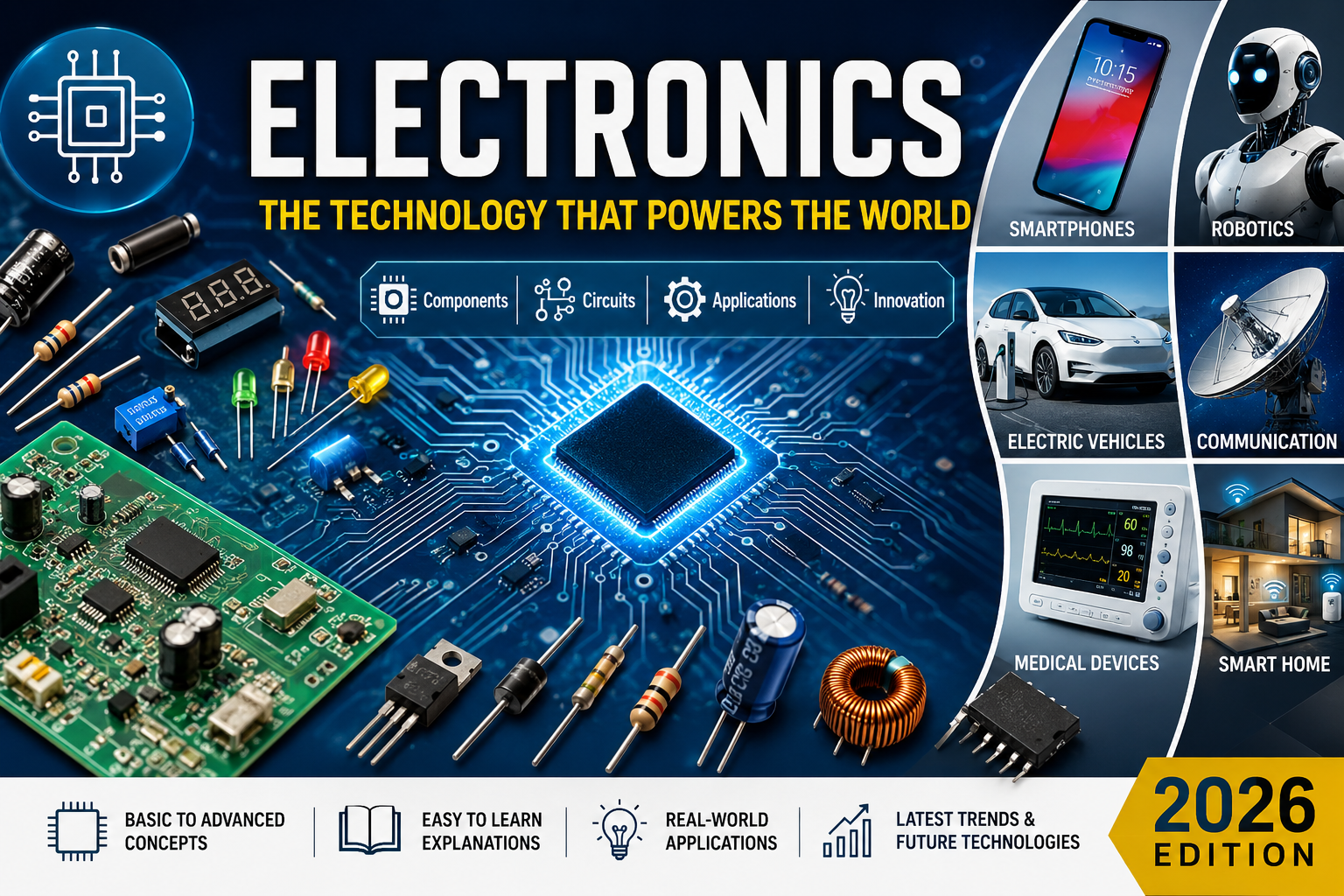
Electronics is one of the most important branches of science and engineering that deals with the study, design, and application of electrical circuits using active components such as transistors, diodes, integrated circuits (ICs), and semiconductors. Electronics powers nearly every modern technology, from smartphones and computers to satellites, medical equipment, electric vehicles, industrial automation, and artificial intelligence systems.
Without electronics, today’s digital world would not exist.
Table of Contents
What is Electronics?
Electronics is the branch of science and engineering that controls the flow of electrons through semiconductor devices to process information, amplify signals, and perform computations.
Unlike electrical engineering, which mainly deals with high-power systems such as power generation and transmission, electronics focuses on low-power signal processing and intelligent control.
Examples include:
- Smartphones
- Computers
- Smart TVs
- Washing Machines
- Drones
- Medical Equipment
- Smart Watches
- AI Robots
- Satellites
History of Electronics
| Year | Development |
|---|---|
| 1897 | Electron discovered by J. J. Thomson |
| 1904 | Vacuum Tube invented |
| 1947 | Transistor invented at Bell Labs |
| 1958 | First Integrated Circuit (IC) |
| 1971 | Intel released first Microprocessor (4004) |
| 1980s | Personal Computers became common |
| 1990s | Internet Revolution |
| 2007 | Smartphone Era |
| 2020 | AI Electronics |
| 2026 | Intelligent Autonomous Electronics |
Evolution of Electronics
Vacuum Tubes
      │
      ▼
Transistors
      │
      ▼
Integrated Circuits
      │
      ▼
Microprocessors
      │
      ▼
Microcontrollers
      │
      ▼
IoT Devices
      │
      ▼
AI Electronics
      │
      ▼
Quantum Electronics
How Electronics Works
Electronic devices work by controlling the movement of electrons.
Power Supply
      │
      ▼
Input Signal
      │
      ▼
Electronic Components
      │
      ▼
Signal Processing
      │
      ▼
Output Device
Example:
Button Press
↓
Microcontroller receives signal
↓
Program executes
↓
LED turns ON
Basic Electronic Components

1. Resistor
Purpose:
Limits electric current.
Symbol
──/\/\/──
Applications
- LED circuits
- Voltage division
- Current limiting
2. Capacitor
Purpose
Stores electrical energy temporarily.
Applications
- Power supply filtering
- Timing circuits
- Signal coupling
3. Inductor
Purpose
Stores energy in a magnetic field.
Applications
- Filters
- Transformers
- Power supplies
4. Diode
Purpose
Allows current in one direction only.
Applications
- Rectifiers
- Reverse polarity protection
5. LED
Light Emitting Diode converts electricity into light.
Applications
- Displays
- Indicators
- Lighting
6. Transistor
Acts as a switch or amplifier.
Applications
- Processors
- Amplifiers
- Digital logic
- Power control
7. Integrated Circuit (IC)
An IC combines thousands to billions of transistors on a single chip.
Examples
- 555 Timer
- Operational Amplifier
- Microprocessor
- Memory Chip
8. Microcontroller
A programmable chip used in embedded systems.
Examples
- Arduino
- ESP32
- STM32
- PIC
Types of Electronic Circuits
Analog Circuits
Process continuously varying signals.
Examples
- Audio amplifier
- Radio receiver
- Sensors
Digital Circuits
Process binary signals (0 and 1).
Examples
- Computers
- Smartphones
- Digital clocks
Mixed Signal Circuits
Combine analog and digital electronics.
Examples
- Mobile phones
- Cameras
- Medical devices
Semiconductor Technology
Modern electronics depends on semiconductor materials.
Common Materials
- Silicon (Si)
- Germanium (Ge)
- Gallium Nitride (GaN)
- Silicon Carbide (SiC)
Applications
- CPUs
- GPUs
- Memory
- Power Electronics
Power Electronics
Power electronics controls electrical energy efficiently.
Applications
- Electric Vehicles
- Solar Inverters
- UPS Systems
- Motor Drives
- Battery Chargers
Main Devices
- MOSFET
- IGBT
- SCR
- TRIAC
Digital Electronics
Digital electronics forms the foundation of computing.
Key Concepts
- Binary Numbers
- Logic Gates
- Flip-Flops
- Registers
- Counters
- Processors
Logic Gates
AND
OR
NOT
NAND
NOR
XOR
XNOR
Embedded Systems
Embedded systems combine hardware and software for dedicated tasks.
Examples
- Smart TV
- Washing Machine
- Microwave Oven
- Car ECU
- Smart Meter
- Medical Devices
Consumer Electronics
Examples include:
- Smartphones
- Tablets
- Laptops
- Gaming Consoles
- Cameras
- Smart Speakers
- Smart Watches
- Smart TVs
Industrial Electronics
Applications
- Robotics
- PLC Systems
- Factory Automation
- CNC Machines
- Process Control
- Industrial Sensors
Medical Electronics
Used in:
- MRI Machines
- CT Scanners
- ECG Machines
- Blood Pressure Monitors
- Ventilators
- Ultrasound Machines
Automotive Electronics
Modern vehicles contain over 100 electronic control units (ECUs).
Applications
- ABS
- Airbags
- Electric Power Steering
- Navigation
- Autonomous Driving
- Battery Management Systems
Aerospace Electronics
Used in:
- Aircraft
- Satellites
- Radar
- Navigation Systems
- Spacecraft
- Missile Guidance
Advantages of Electronics
- High speed processing
- Compact size
- Low power consumption
- High efficiency
- Reliable operation
- Automation capabilities
- Easy communication
- Intelligent decision making
- Precision control
- Cost-effective mass production
Disadvantages
- Electronic waste (e-waste)
- Repair complexity
- Cybersecurity risks
- Heat generation
- Dependence on power supply
- Environmental impact from manufacturing
Latest Innovations in Electronics (2026)
- AI-powered Edge Electronics
- Flexible Electronics
- Printed Electronics
- Wearable Electronics
- Quantum Electronics
- Neuromorphic Chips
- 3D Integrated Circuits
- Gallium Nitride (GaN) Power Devices
- Silicon Carbide (SiC) Electronics
- Smart Sensors
- Autonomous Robotics Electronics
- Energy-Harvesting Devices
Future of Electronics
The future of electronics is driven by artificial intelligence, advanced semiconductor manufacturing, and sustainable design.
Emerging trends include:
- AI-integrated consumer devices
- Quantum computing hardware
- Flexible and foldable electronics
- Smart healthcare wearables
- Brain–computer interfaces
- Internet of Things (IoT)
- 6G communication hardware
- Autonomous vehicles
- Smart cities
- Green electronics with recyclable materials
Real-Life Examples
| Device | Electronic Components Used |
|---|---|
| Smartphone | CPU, RAM, Flash Memory, Sensors, Display Driver |
| Laptop | Motherboard, Processor, SSD, GPU, RAM |
| Smart TV | Display Controller, Audio IC, Wi-Fi Module |
| Electric Vehicle | Battery Management System, Inverter, Motor Controller |
| Drone | Flight Controller, GPS, ESC, IMU |
| Smartwatch | Microcontroller, Bluetooth Module, Sensors, Battery |
Frequently Asked Questions (FAQs)
What is electronics?
Electronics is the science of controlling electrons using semiconductor devices to process information, amplify signals, and control systems.
What is the difference between electrical and electronics?
Electrical engineering deals with high-power generation, transmission, and distribution of electricity, while electronics focuses on low-power circuits, semiconductor devices, communication, and computing.
What are the basic electronic components?
Resistors, capacitors, inductors, diodes, LEDs, transistors, integrated circuits (ICs), sensors, and microcontrollers.
Why are semiconductors important?
Semiconductors form the foundation of modern electronic devices because they enable precise control of electrical current in compact, efficient circuits.
Where is electronics used?
Electronics is used in consumer devices, healthcare, automotive systems, aerospace, telecommunications, industrial automation, renewable energy, and defense.
Conclusion
Electronics has transformed the modern world by enabling intelligent machines, high-speed communication, automation, and advanced computing. From tiny semiconductor chips inside smartphones to sophisticated control systems in spacecraft, electronics is the foundation of nearly every technological innovation. As AI, quantum computing, wearable devices, and sustainable technologies continue to evolve, electronics will remain at the heart of future advancements.
Suggested External References
- IEEE – https://www.ieee.org/
- Electronics Tutorials – https://www.electronics-tutorials.ws/
- All About Circuits – https://www.allaboutcircuits.com/
- Texas Instruments – https://www.ti.com/
- STMicroelectronics – https://www.st.com/
- NXP Semiconductors – https://www.nxp.com/
- Analog Devices – https://www.analog.com/
- Intel – https://www.intel.com/
- ARM – https://www.arm.com/
- Raspberry Pi – https://www.raspberrypi.com/
This structure is optimized for WordPress with clear headings, keyword-rich content, FAQ sections, and external references that support SEO and reader engagement.