
Computer History: The Complete Timeline from Abacus to Artificial Intelligence (AI)


Computers have transformed nearly every aspect of modern life—from education and healthcare to business, entertainment, scientific research, and space exploration. Today’s smartphones possess more computing power than the room-sized computers of the 1940s, highlighting the extraordinary pace of technological advancement.
Understanding the history of computers helps us appreciate how centuries of innovation, mathematics, engineering, and scientific discovery have shaped the digital world we live in today.
This guide explores the complete evolution of computers, major milestones, famous inventors, generations of computers, and what the future holds.
Table of Contents
What is Computer History?
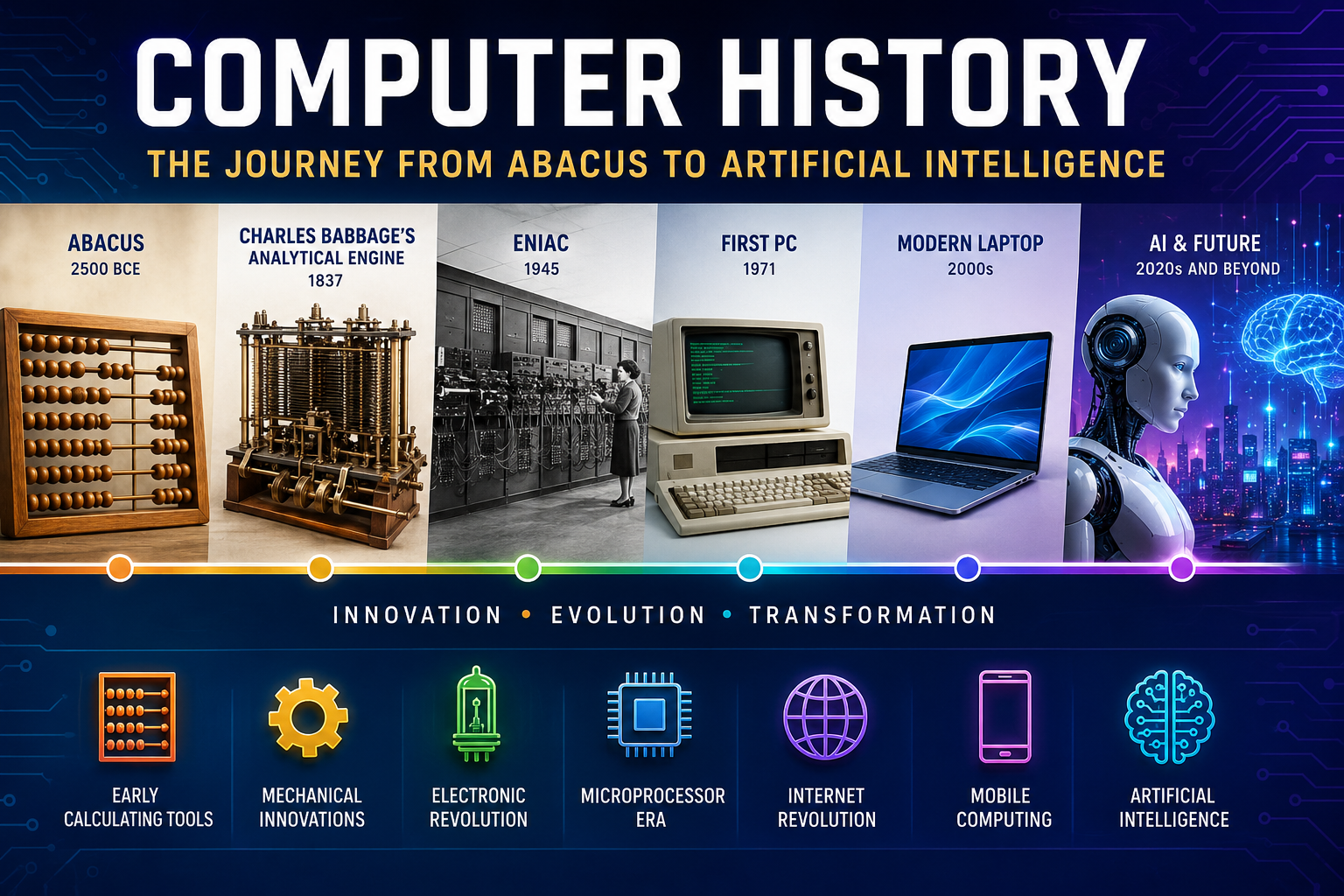
Computer history refers to the development and evolution of calculating machines into today’s powerful digital systems. It spans thousands of years—from simple counting devices to quantum computing and artificial intelligence.
The journey includes:
- Manual calculation tools
- Mechanical calculators
- Electromechanical computers
- Vacuum tube computers
- Transistor computers
- Integrated circuits
- Microprocessors
- Personal computers
- Internet
- Smartphones
- Artificial Intelligence
- Quantum Computing
Early Calculating Devices


1. Abacus (Around 2500 BCE)
The Abacus is considered the world’s first calculating device.
Features
- Manual calculations
- Addition
- Subtraction
- Multiplication
- Division
Although simple, it laid the foundation for computational thinking.
2. Napier’s Bones (1617)
Invented by Scottish mathematician John Napier, this device simplified multiplication and division using numbered rods.
Major contribution:
- Introduced logarithms
- Faster calculations
3. Pascaline (1642)
Blaise Pascal developed the Pascaline, one of the first mechanical calculators.
Capabilities:
- Addition
- Subtraction
4. Stepped Reckoner (1673)
Created by Gottfried Wilhelm Leibniz.
It introduced:
- Multiplication
- Division
- Square roots
Charles Babbage – The Father of the Computer


Charles Babbage is widely known as the Father of the Computer.
His revolutionary ideas inspired every modern computer.
Difference Engine (1822)
Purpose:
- Automatic mathematical tables
Analytical Engine (1837)
The Analytical Engine introduced concepts still used today:
- CPU
- Memory
- Input
- Output
- Programming
Although never completed during Babbage’s lifetime, it became the blueprint for modern computers.
Ada Lovelace – The First Computer Programmer
Ada Lovelace wrote the first algorithm intended for the Analytical Engine.
She predicted computers could someday create:
- Music
- Art
- Scientific discoveries
Her vision was more than a century ahead of its time.
The First Electronic Computers
Harvard Mark I (1944)
Developed with support from IBM.
Features:
- Electromechanical
- Automatic calculations
- Military applications
ENIAC (1945)


The Electronic Numerical Integrator and Computer (ENIAC) was among the first large-scale electronic general-purpose computers.
Specifications
- 18,000 vacuum tubes
- Weight: 30 tons
- Occupied an entire room
- Thousands of operations per second
UNIVAC I (1951)
The first commercially produced computer in the United States.
Achievements:
- Business applications
- Government data processing
- Census analysis
The Five Generations of Computers
| Generation | Years | Main Technology | Characteristics |
|---|---|---|---|
| First | 1940–1956 | Vacuum Tubes | Large, expensive, high power consumption |
| Second | 1956–1963 | Transistors | Smaller, faster, more reliable |
| Third | 1964–1971 | Integrated Circuits | Higher performance, lower cost |
| Fourth | 1971–Present | Microprocessors | Personal computers, laptops, smartphones |
| Fifth | Present & Future | Artificial Intelligence | Machine learning, robotics, natural language processing |
Microprocessor Revolution (1971)
The invention of the microprocessor transformed computing forever.
Benefits
- Entire CPU on one chip
- Smaller computers
- Lower cost
- Higher speed
- Portable devices
This breakthrough enabled personal computers and eventually smartphones.
Personal Computer Revolution
The late 1970s and early 1980s marked the rise of personal computing.
Major milestones include:
- Apple II
- IBM PC
- Microsoft DOS
- Windows operating system
- Graphical User Interface (GUI)
These developments brought computing into homes, schools, and offices.


Internet Revolution
The 1990s connected computers worldwide through the Internet.
Key developments
- Websites
- Search engines
- E-commerce
- Online education
- Social media
- Cloud computing
The Internet fundamentally changed communication, business, and access to information.
Mobile Computing Era
Modern smartphones combine:
- Computer
- Camera
- GPS
- Internet
- Artificial Intelligence
- Digital payments
Billions of people now carry powerful computers in their pockets.
Artificial Intelligence Era
Today’s computers can:
- Recognize speech
- Translate languages
- Generate images
- Write code
- Drive vehicles
- Diagnose diseases
- Create music
Machine learning and AI are redefining what computers can accomplish.
Famous Computers in History
| Computer | Year | Importance |
|---|---|---|
| Abacus | 2500 BCE | First calculating tool |
| Difference Engine | 1822 | Mechanical calculator |
| Analytical Engine | 1837 | First programmable computer concept |
| Harvard Mark I | 1944 | Electromechanical computer |
| ENIAC | 1945 | Large-scale electronic computer |
| UNIVAC I | 1951 | Commercial computer |
| IBM PC | 1981 | Popular personal computer |
Complete Timeline
| Year | Event |
|---|---|
| 2500 BCE | Abacus invented |
| 1617 | Napier’s Bones |
| 1642 | Pascaline |
| 1673 | Stepped Reckoner |
| 1822 | Difference Engine |
| 1837 | Analytical Engine |
| 1944 | Harvard Mark I |
| 1945 | ENIAC |
| 1951 | UNIVAC I |
| 1971 | Microprocessor |
| 1981 | IBM PC |
| 1990s | Internet expansion |
| 2007 | Smartphone revolution |
| 2020s | AI revolution |
Future of Computers
Emerging technologies include:
- Quantum Computing
- Artificial Intelligence
- Neuromorphic Computing
- Optical Computing
- DNA Computing
- Edge AI
- Autonomous Systems
- Brain–Computer Interfaces
- Green Computing
Future computers are expected to become faster, more energy-efficient, and increasingly capable of solving complex scientific and societal challenges.
Interesting Facts
- The Abacus is over 4,000 years old.
- ENIAC weighed approximately 30 tons.
- Today’s smartphones are vastly more powerful than early supercomputers.
- Billions of transistors can fit on a single modern processor.
- AI systems now assist in scientific research, healthcare, and software development.
Frequently Asked Questions (FAQ)
Who is known as the Father of the Computer?
Charles Babbage is widely regarded as the Father of the Computer because of his designs for the Difference Engine and Analytical Engine.
Who was the first computer programmer?
Ada Lovelace is recognized as the world’s first computer programmer.
What was the first electronic computer?
ENIAC is one of the earliest large-scale electronic general-purpose computers.
What are the five generations of computers?
- Vacuum Tubes
- Transistors
- Integrated Circuits
- Microprocessors
- Artificial Intelligence
What is the future of computers?
The future includes AI, quantum computing, edge computing, and sustainable high-performance systems.
Conclusion
The history of computers is a story of continuous innovation, from the simple Abacus to intelligent AI systems capable of learning, reasoning, and assisting humans in complex tasks. Each technological breakthrough—from mechanical calculators and vacuum tubes to microprocessors and cloud computing—has accelerated scientific progress and transformed everyday life.
As quantum computing, artificial intelligence, and next-generation architectures mature, computers will continue to reshape industries, research, education, and communication for decades to come.
Recommended External Reference Links
- Computer History Museum
- Encyclopaedia Britannica – History of Computers
- NASA Technology
- IBM History
- Intel Museum & History
- IEEE Computer Society
- Association for Computing Machinery (ACM)
- National Institute of Standards and Technology (NIST)