Quantum Computing: The Complete Beginner to Advanced Guide (2026)
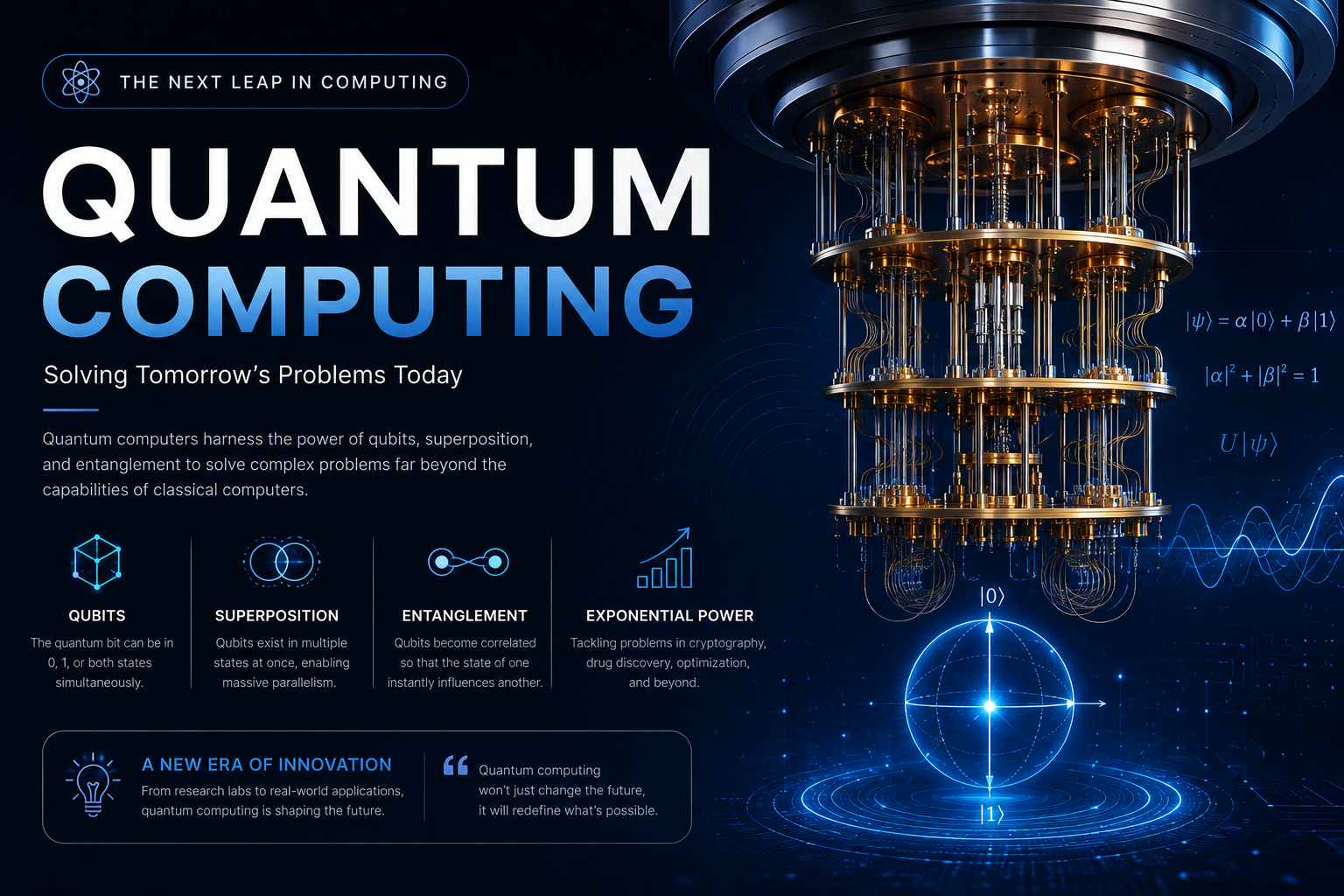
Quantum Computing is one of the most revolutionary technologies of the 21st century. Unlike traditional computers that process information using binary bits (0 and 1), quantum computers use qubits, allowing them to perform multiple calculations simultaneously. This breakthrough has the potential to transform industries such as healthcare, cybersecurity, finance, logistics, artificial intelligence, and scientific research.
Although quantum computing is still in its early stages, leading companies like IBM, Google, Microsoft, Intel, Amazon, and startups worldwide are investing billions of dollars to make practical quantum computers a reality.
Father of Quantum Computer:
British physicist David Deutsch is widely recognized as the “father of quantum computing”. In 1985, he published a seminal paper establishing the theoretical foundation for the field by describing the first universal quantum computer and formulating the concept of a quantum Turing machine
Table of Contents
What is Quantum Computing?
Quantum Computing is a new computing technology based on the principles of Quantum Mechanics, the branch of physics that explains how particles behave at atomic and subatomic levels.
Instead of storing information as 0 or 1, quantum computers use Quantum Bits (Qubits) that can exist in multiple states simultaneously.
This enables quantum computers to solve extremely complex mathematical problems much faster than today’s supercomputers.
History of Quantum Computing
Year
Milestone
1980
Paul Benioff proposed quantum computation.
1982
Richard Feynman introduced the concept of quantum computers.
1985
David Deutsch developed the universal quantum computer model.
1994
Peter Shor introduced Shor’s Algorithm.
1996
Grover’s Search Algorithm was developed.
2019
Google announced Quantum Supremacy.
2026
Rapid development of practical quantum processors continues globally.
How Quantum Computers Work
Quantum computers process information differently than classical computers.
Step 1: Qubits
Instead of binary bits, quantum computers use Qubits.
A qubit can represent:
0
1
Both simultaneously
Step 2: Superposition
Superposition allows a qubit to exist in multiple states simultaneously.
Instead of checking possibilities one by one, quantum computers evaluate many possibilities at the same time.
Step 3: Entanglement
Two qubits can become connected regardless of physical distance.
Changing one instantly influences the other, allowing extremely efficient information processing.
Step 4: Quantum Gates
Quantum gates manipulate qubits.
Examples include:
Hadamard Gate
Pauli-X Gate
Pauli-Y Gate
Pauli-Z Gate
CNOT Gate
Step 5: Measurement
When computation finishes, the quantum state collapses into a measurable classical value (0 or 1), producing the final output.
Enhances correct solutions while suppressing incorrect ones.
Quantum Decoherence
Loss of quantum information due to environmental interference.
Components of a Quantum Computer
Quantum Processor
Qubits
Cryogenic Cooling System
Quantum Control Electronics
Microwave Generators
Laser Systems (for certain qubit technologies)
Quantum Software Stack
Classical Computer Interface
Popular Quantum Algorithms
Shor’s Algorithm
Used for integer factorization.
Applications:
Cryptography
Cybersecurity
Grover’s Algorithm
Provides faster searching in unsorted databases.
Applications:
AI
Database optimization
Quantum Fourier Transform
Used in many advanced quantum algorithms.
Variational Quantum Eigensolver (VQE)
Designed for chemistry and material science.
Applications of Quantum Computing
Artificial Intelligence
Faster AI model training
Machine learning optimization
Neural network acceleration
Drug Discovery
Molecular simulation
Protein analysis
Vaccine development
Financial Services
Portfolio optimization
Fraud detection
Risk analysis
Cybersecurity
Quantum cryptography
Secure communication
Encryption research
Logistics
Route optimization
Supply chain planning
Fleet management
Weather Forecasting
Climate simulation
Disaster prediction
Environmental modeling
Manufacturing
Material discovery
Process optimization
Industrial automation
Space Research
Satellite optimization
Mission planning
Deep space simulations
Advantages of Quantum Computing
Extremely fast processing
Solves complex optimization problems
Improved AI capabilities
Better scientific simulations
Advances medical research
Stronger secure communication methods
Accelerates innovation
Challenges of Quantum Computing
Very expensive hardware
Qubit instability
Error correction difficulties
Requires ultra-low temperatures
Limited practical software
High maintenance costs
Skilled workforce shortage
Future of Quantum Computing
The next decade is expected to bring significant advances in quantum hardware, error correction, and software development. Potential future impacts include:
Commercial quantum cloud services
Quantum-powered AI
Personalized medicine
Next-generation cybersecurity
Smart manufacturing
Climate modeling
Financial optimization
Advanced robotics
Space exploration
Breakthrough scientific discoveries
Top Companies Working on Quantum Computing
IBM Quantum
Google Quantum AI
Microsoft Azure Quantum
Amazon Braket
Intel Quantum
Rigetti Computing
IonQ
D-Wave Systems
Quantinuum
PsiQuantum
How to Learn Quantum Computing
Learn the Basics
Linear Algebra
Probability
Quantum Mechanics
Python Programming
Learn Quantum Programming
Popular frameworks include:
Qiskit
Cirq
PennyLane
Q#
Practice on Quantum Simulators
IBM Quantum Experience
Google Cirq Simulator
Amazon Braket
Frequently Asked Questions (FAQs)
Is Quantum Computing replacing traditional computers?
No. Quantum computers are designed for specialized problems and will complement, not replace, classical computers.
What is a qubit?
A qubit is the basic unit of information in a quantum computer. Unlike a classical bit, it can represent multiple states simultaneously through superposition.
Is Quantum Computing available today?
Yes, but mainly through cloud-based experimental systems and research platforms. Large-scale, fault-tolerant quantum computers are still under development.
It requires understanding mathematics, programming, and quantum physics, but many beginner-friendly learning resources are now available.
Conclusion
Quantum Computing is poised to redefine the future of technology by solving problems beyond the reach of classical computers. From accelerating drug discovery and optimizing logistics to advancing artificial intelligence and enhancing cybersecurity, its potential is immense. As hardware matures and software ecosystems evolve, quantum computing will become a cornerstone of innovation across industries. Learning its fundamentals today can prepare individuals and organizations for the next era of computing.