

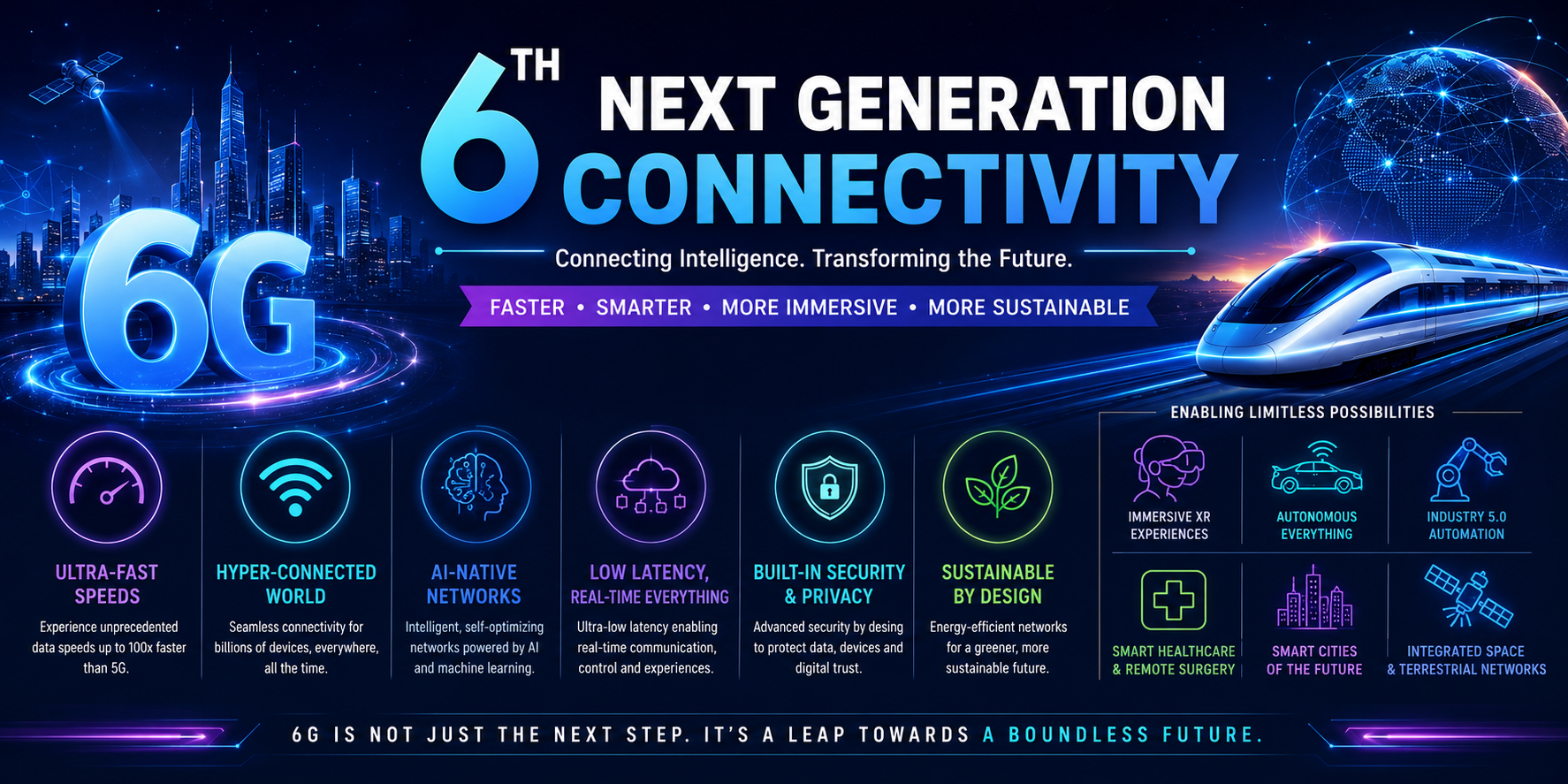
6th and Next-Generation Connectivity: The Complete Guide to 6G, Beyond 6G & Future Wireless Networks (2026)

6th and Next-Generation Connectivity: Everything You Need to Know
The world is becoming increasingly connected. Every year, billions of new devices join the internet, from smartphones and laptops to autonomous vehicles, smart factories, drones, satellites, and wearable devices. While 5G has significantly improved wireless communication, it is only the beginning of a much larger transformation.
6th and Next-Generation Connectivity, commonly known as 6G and Beyond, represents the next evolution of wireless communication. It promises ultra-fast internet, near-zero latency, intelligent networks powered by Artificial Intelligence (AI), and seamless connectivity between humans, machines, and digital environments.
This guide explores how 6G works, its architecture, key technologies, benefits, real-world applications, challenges, and what the future of global connectivity will look like.
Table of Contents
What is 6th and Next-Generation Connectivity?
6th and Next-Generation Connectivity refers to the future evolution of wireless communication technologies that will succeed 5G. It aims to provide:
- Ultra-high-speed internet
- AI-powered networking
- Massive IoT connectivity
- Intelligent communication systems
- Secure wireless infrastructure
- Real-time data transmission
- Global internet coverage
- Holographic communication
Unlike previous generations that primarily improved speed, 6G will focus on making networks intelligent, autonomous, adaptive, and environmentally sustainable.
Evolution of Mobile Networks
| Generation | Launch Period | Maximum Speed | Major Innovation |
|---|---|---|---|
| 1G | 1980s | Voice Only | Analog Communication |
| 2G | 1990s | 64 Kbps | Digital Voice & SMS |
| 3G | 2000s | 2 Mbps | Mobile Internet |
| 4G LTE | 2010s | 100 Mbps–1 Gbps | HD Streaming |
| 5G | 2020s | Up to 20 Gbps | IoT & Low Latency |
| 6G | Around 2030 | Up to 1 Tbps | AI-Powered Intelligent Networks |
Why Do We Need 6G?
The demand for data is growing rapidly due to:
- Artificial Intelligence
- Internet of Things (IoT)
- Autonomous Vehicles
- Robotics
- Digital Twins
- Virtual Reality
- Augmented Reality
- Smart Cities
- Space Communication
- Industrial Automation
5G cannot fully support the enormous data requirements expected in the next decade.
6G is being designed specifically for this future.
Key Features of 6th and Next-Generation Connectivity
Ultra-Fast Speed
6G may achieve download speeds of up to 1 Terabit per second (Tbps), making data transfers nearly instantaneous.
Extremely Low Latency
Expected latency could be less than 0.1 milliseconds, enabling real-time communication for mission-critical applications.
AI-Native Networks
Artificial Intelligence will be integrated into every layer of the network to:
- Optimize traffic
- Predict failures
- Improve security
- Allocate bandwidth dynamically
- Reduce energy consumption
Massive IoT Support
6G will connect billions of devices simultaneously, including:
- Smart homes
- Industrial sensors
- Medical devices
- Connected vehicles
- Agricultural equipment
Terahertz Communication
6G is expected to utilize Terahertz (THz) frequencies, enabling significantly higher bandwidth and data transmission rates than current networks.
Integrated Satellite Connectivity
Future networks will seamlessly combine:
- Cellular towers
- Satellites
- Drones
- High-altitude platforms
- Underwater communication systems
This integration aims to provide internet access even in remote and underserved areas.
Holographic Communication
6G could support immersive holographic meetings where participants appear as life-sized 3D projections, enhancing remote collaboration and communication.
Architecture of 6G Networks
                User Devices
                     │
        Smartphones • Wearables • Vehicles
                     │
        ─────────────────────────────
          AI Edge Computing Layer
                     │
        Intelligent Network Controller
                     │
    Terrestrial + Satellite + Drone Networks
                     │
           Cloud & Quantum Computing
                     │
            Internet & Digital Services
Core Technologies Behind 6G
Artificial Intelligence
AI will manage network optimization, security, predictive maintenance, and autonomous operations.
Edge Computing
Processing data closer to users reduces latency and improves responsiveness.
Digital Twins
Virtual replicas of physical systems will enable real-time monitoring and simulation.
Quantum Communication
Quantum technologies may provide highly secure communication channels.
Blockchain
Blockchain can enhance trust, identity management, and secure data exchange in decentralized networks.
Intelligent Reflecting Surfaces
Smart surfaces may improve signal quality by dynamically directing wireless signals.
Advantages of 6th and Next-Generation Connectivity
- Ultra-fast internet speeds
- Near-zero latency
- Smarter AI-driven networks
- Improved cybersecurity
- Global connectivity
- Better energy efficiency
- Reliable communication
- Enhanced industrial automation
- Superior user experiences
- Support for future technologies
Real-World Applications
Smart Cities
- Intelligent traffic systems
- Smart utilities
- Public safety monitoring
- Energy optimization
Healthcare
- Remote robotic surgeries
- AI-assisted diagnostics
- Continuous patient monitoring
- Connected medical devices
Autonomous Vehicles
Vehicles will communicate with each other and infrastructure in real time, improving safety and reducing traffic congestion.
Industry 5.0
Factories will leverage AI-powered robots, predictive maintenance, and autonomous production systems.
Education
Students may participate in immersive virtual classrooms with realistic 3D learning experiences.
Agriculture
Smart sensors and drones will monitor crops, optimize irrigation, and improve farming efficiency.
Space Communication
6G is expected to support reliable communication between Earth, satellites, and future space missions.
6G vs 5G Comparison
| Feature | 5G | 6G |
|---|---|---|
| Speed | Up to 20 Gbps | Up to 1 Tbps |
| Latency | 1 ms | <0.1 ms |
| AI Integration | Limited | Native |
| IoT Devices | Millions | Billions |
| Coverage | Terrestrial | Global + Satellite |
| Security | Advanced | AI-Enhanced |
| Communication | Video | Holograms & XR |
| Automation | High | Fully Intelligent |
Challenges of 6G
Although promising, several challenges remain:
- High deployment costs
- Infrastructure upgrades
- Energy consumption
- Privacy concerns
- Cybersecurity threats
- Spectrum availability
- Global standardization
- Device compatibility
- Regulatory frameworks
Future Trends
The future of connectivity will include:
- AI-powered autonomous networks
- Space-based internet
- Quantum communication
- Brain-computer interfaces
- Digital Twin ecosystems
- Smart factories
- Autonomous transportation
- Immersive metaverse experiences
- Sustainable green networking
Frequently Asked Questions (FAQs)
What is 6th and Next-Generation Connectivity?
It refers to future wireless communication technologies, primarily 6G and beyond, designed to deliver intelligent, ultra-fast, secure, and globally connected networks.
When will 6G be available?
Commercial deployment is expected around 2030, although research, trials, and standardization efforts are already underway.
How fast will 6G be?
6G is expected to achieve speeds of up to 1 Tbps, which is significantly faster than current 5G networks.
Will 6G replace 5G?
Yes. Similar to previous generations, 6G will gradually complement and eventually succeed 5G while both may coexist during the transition.
Is 6G safe?
Researchers are actively studying spectrum use, security, and health considerations. Regulatory approvals and international standards will guide commercial deployment.
Conclusion
6th and Next-Generation Connectivity represents a major leap in the evolution of wireless communication. Beyond simply increasing speed, it aims to create intelligent, AI-driven, globally connected, and highly secure networks capable of supporting the digital demands of the future. As technologies such as Artificial Intelligence, Digital Twins, Quantum Computing, autonomous vehicles, and the Internet of Things continue to evolve, 6G will provide the foundation that enables these innovations to work together seamlessly.
Organizations, governments, and technology companies are already investing heavily in research and development, making 6G one of the most significant technological advancements expected over the next decade.


Hi gurugyaan.com,
I’m a Website Promotion & Digital Marketing Consultant, leading a team of 30+ professionals dedicated to helping businesses grow online.
Our services include:
.SEO (Search Engine Optimization)
• Social Media Marketing
• PPC Advertising
* Performance marketing
• Website Design & Redesign
• Google Business Profile Optimization
• Content Marketing
• Email Marketing
• Online Reputation Management
• Lead Generation Services
You can try our services for Six months and evaluate the results. We will give you guaranteed keywords ranking on 1st page google.
If you’re interested, I’d be happy to send you a short proposal explaining how we can help your business grow online.
Best regards,
Website Promotion & Digital Marketing Consultant