

Table of Contents
1. What is Artificial Intelligence (AI)?
Answer:
Artificial Intelligence (AI) is a branch of computer science that enables machines and software to perform tasks that normally require human intelligence. These tasks include learning, reasoning, problem-solving, understanding language, recognizing images, making decisions, and generating content.
AI systems analyze data, identify patterns, and improve their performance over time using algorithms and machine learning techniques. Unlike traditional software that follows fixed rules, AI can adapt based on experience and new information.
Today, AI powers many technologies we use every day, including virtual assistants, recommendation systems, chatbots, self-driving vehicles, and medical diagnostic tools.
Example:
- ChatGPT answers questions.
- Google Maps predicts traffic.
- Netflix recommends movies.
- Gmail filters spam emails.
Key Takeaway: AI allows computers to perform intelligent tasks that usually require human thinking.
2. How Does Artificial Intelligence Work?
Answer:
Artificial Intelligence works by collecting data, processing it using algorithms, learning patterns, and making predictions or decisions.
A typical AI system follows these steps:
- Collect data
- Clean and organize the data
- Train an AI model
- Learn from examples
- Make predictions
- Improve through feedback
For example, an AI image recognition system is trained using thousands of pictures of cats and dogs. After training, it can identify whether a new image contains a cat or a dog with high accuracy.
Modern AI often uses Machine Learning and Deep Learning to improve automatically as more data becomes available.
Key Takeaway: AI learns from data instead of relying only on manually programmed rules.
3. Who Invented Artificial Intelligence?
Answer:
Artificial Intelligence does not have a single inventor. Many scientists contributed to its development.
The term Artificial Intelligence was first introduced by John McCarthy in 1956 during the Dartmouth Conference. Because of this contribution, John McCarthy is widely known as the Father of Artificial Intelligence.
Other important pioneers include:
- Alan Turing
- Marvin Minsky
- Herbert Simon
- Allen Newell
- Geoffrey Hinton
- Yann LeCun
- Yoshua Bengio
Alan Turing proposed the famous Turing Test, which measures whether a machine can imitate human intelligence in conversation.
Today, AI research continues worldwide through universities, research organizations, and technology companies.
Key Takeaway: John McCarthy coined the term AI, while many researchers helped build the field.
4. What Is the History of Artificial Intelligence?
Answer:
The history of AI spans more than 70 years.
Major Milestones
1950
Alan Turing proposed the Turing Test.
1956
The Dartmouth Conference officially introduced Artificial Intelligence as a research field.
1960s–1970s
Researchers developed early AI programs for solving mathematical problems and playing games.
1980s
Expert Systems became popular in business.
1997
IBM Deep Blue defeated world chess champion Garry Kasparov.
2012
Deep Learning achieved major breakthroughs in image recognition.
2022
Generative AI became mainstream with powerful AI chatbots and image generators.
2023–2026
AI Agents, multimodal AI, autonomous assistants, and AI copilots became widely adopted across education, healthcare, finance, and software development.
Key Takeaway: AI has evolved from academic research into a technology used by billions of people worldwide.
5. Why Is Artificial Intelligence Important Today?
Answer:
Artificial Intelligence is important because it helps people work faster, make better decisions, automate repetitive tasks, and solve complex problems.
AI benefits many industries:
- Healthcare
- Education
- Banking
- Agriculture
- Manufacturing
- Transportation
- Cybersecurity
- Scientific Research
For students, AI provides personalized learning, instant explanations, language translation, coding assistance, and study support.
Businesses use AI to reduce costs, improve customer service, and increase productivity.
Governments use AI for disaster prediction, traffic management, and public services.
Key Takeaway: AI improves efficiency, accuracy, and innovation in nearly every industry.
6. What Are the Different Types of AI?
Answer:
Artificial Intelligence is commonly classified into three categories:
1. Narrow AI (Weak AI)
Designed for a specific task.
Examples:
- Chatbots
- Voice assistants
- Recommendation systems
2. General AI (AGI)
A theoretical AI capable of performing any intellectual task a human can perform.
Currently, AGI does not exist.
3. Super AI
A hypothetical AI that would surpass human intelligence in every field.
This remains a concept rather than a reality.
Another classification is based on functionality:
- Reactive Machines
- Limited Memory AI
- Theory of Mind AI
- Self-Aware AI
Most AI systems used today belong to the Narrow AI category.
7. What Is Narrow AI?
Answer:
Narrow AI, also known as Weak AI, is designed to perform one specific task extremely well.
Examples include:
- Face recognition
- Voice assistants
- Spam detection
- ChatGPT
- Google Translate
Although Narrow AI appears intelligent, it cannot think beyond the tasks for which it was trained.
For example, an AI that plays chess cannot suddenly drive a car without additional training.
Narrow AI powers almost every AI application used today.
8. What Is Artificial General Intelligence (AGI)?
Answer:
Artificial General Intelligence (AGI) refers to an AI system capable of learning and performing any intellectual task that a human can do.
Unlike today’s AI, AGI would:
- Learn new skills independently
- Solve unfamiliar problems
- Understand context deeply
- Apply knowledge across different fields
Currently, AGI remains a research goal and has not been achieved.
Researchers continue exploring methods to develop more flexible and adaptable AI systems while addressing important safety and ethical considerations.
9. What Is Super AI?
Answer:
Super AI is a hypothetical form of Artificial Intelligence that would exceed human intelligence in every aspect, including:
- Creativity
- Scientific research
- Decision-making
- Emotional understanding
- Problem-solving
- Strategic planning
At present, Super AI does not exist.
Scientists continue to debate its possibilities, benefits, and risks.
Many discussions about Super AI focus on AI safety, regulation, and responsible development.
10. What Are Real-World Applications of AI?
Answer:
Artificial Intelligence is used in almost every industry.
Examples include:
Healthcare
- Disease diagnosis
- Medical imaging
- Drug discovery
Education
- AI tutors
- Personalized learning
- Automatic grading
Finance
- Fraud detection
- Credit scoring
- Investment analysis
Transportation
- Navigation
- Traffic prediction
- Autonomous vehicles
Retail
- Product recommendations
- Customer support
- Inventory management
Cybersecurity
- Threat detection
- Malware analysis
- Network monitoring
AI continues to expand into nearly every area of modern life.
11. How Can Students Use AI Effectively?
Answer:
Students can use AI as a learning assistant rather than a shortcut. AI can explain difficult concepts, summarize long chapters, create study notes, generate practice quizzes, solve coding problems, and improve writing. It can also help with language learning, brainstorming project ideas, and preparing for interviews or competitive exams.
However, students should always verify AI-generated information with reliable textbooks, teachers, or trusted educational resources. Using AI responsibly means understanding the concepts instead of simply copying answers.
Key Takeaway: AI is most valuable when it supports learning and critical thinking, not when it replaces independent study.
12. Is AI Beneficial for Students?
Answer:
Yes. AI can make learning more personalized, interactive, and efficient. It provides instant explanations, adapts to different learning speeds, and is available 24/7. Students can receive help with mathematics, science, programming, writing, and exam preparation.
Benefits include:
- Faster research
- Better organization
- Personalized learning
- Improved productivity
- Enhanced creativity
Students should still develop problem-solving and analytical skills rather than depending entirely on AI.
13. Can AI Improve Learning Outcomes?
Answer:
Yes. AI can improve learning by identifying knowledge gaps, recommending personalized study plans, generating quizzes, and providing immediate feedback. Adaptive learning platforms adjust the difficulty level based on a student’s progress, making study sessions more effective.
Research and classroom experience show that AI is most effective when used alongside traditional teaching methods rather than as a complete replacement.
14. Can AI Help with Homework?
Answer:
Yes. AI can explain concepts, solve practice problems, suggest approaches, and provide examples. It is particularly useful for subjects such as mathematics, science, computer programming, and language learning.
Students should avoid submitting AI-generated homework without understanding it, as this can hinder learning and may violate school or university policies.
15. Can AI Create Study Notes?
Answer:
Yes. AI can convert long chapters, articles, or lecture transcripts into concise study notes. It can also organize information into bullet points, tables, flashcards, and mind maps, making revision easier.
Review the generated notes to ensure they accurately reflect your course material.
16. Can AI Summarize Textbooks?
Answer:
Yes. AI can summarize lengthy chapters by highlighting the main ideas, definitions, formulas, and key concepts. This saves time during revision, but summaries should complement—not replace—reading the original textbook.
17. Can AI Solve Mathematics Problems?
Answer:
Yes. AI can solve algebra, geometry, calculus, statistics, and many other mathematical problems. More importantly, many AI tools provide step-by-step explanations, helping students understand the solution process rather than just the final answer.
Always practice solving problems on your own to strengthen your mathematical skills.
18. Can AI Explain Science Concepts?
Answer:
Yes. AI can explain topics in physics, chemistry, biology, and environmental science using simple language, diagrams (when available), and real-life examples. It can also tailor explanations to different education levels, from school students to university learners.
19. Can AI Improve Writing Skills?
Answer:
Yes. AI can help improve grammar, vocabulary, sentence structure, clarity, and organization. It can suggest better word choices, rewrite paragraphs, and provide feedback on essays or reports. Students should use these suggestions to learn and improve their own writing style rather than relying on AI to write everything.
20. Can AI Help Students Prepare for Exams?
Answer:
Absolutely. AI can generate mock tests, practice questions, flashcards, revision schedules, and personalized study plans. It can identify weak areas and recommend additional practice, making exam preparation more focused and efficient.
For the best results, combine AI-assisted study with textbooks, classroom learning, and regular self-assessment.
21. How Can Beginners Start Learning AI?
Answer:
Learning Artificial Intelligence may seem difficult at first, but beginners can start with a structured approach. The key is to build a strong foundation before moving to advanced topics.
Step-by-Step Roadmap
- Learn basic computer concepts.
- Understand programming fundamentals (Python is recommended).
- Study mathematics, including algebra, probability, and statistics.
- Learn Machine Learning basics.
- Explore Deep Learning.
- Build small AI projects.
- Practice regularly using real datasets.
Many free online courses, tutorials, and AI tools make learning easier than ever before.
Best Tip: Spend at least 30–60 minutes daily practicing AI concepts and programming.
22. Is Coding Required to Learn AI?
Answer:
Not always.
If you only want to understand AI concepts or use AI tools like ChatGPT, coding is not required.
However, if you want to:
- Build AI applications
- Train Machine Learning models
- Develop AI software
- Become an AI Engineer
then programming is essential.
Python is the most widely used language because it has powerful AI libraries such as TensorFlow, PyTorch, and Scikit-learn.
Key Takeaway: You can learn AI without coding initially, but programming becomes important for creating AI systems.
23. Which Programming Language Is Best for AI?
Answer:
Several programming languages are used in AI, but Python is the most popular.
Top AI Programming Languages
| Language | Best For |
|---|---|
| Python | Machine Learning, Deep Learning |
| R | Data Analysis |
| Java | Enterprise AI Applications |
| C++ | Robotics & High Performance |
| JavaScript | AI-powered Websites |
| Julia | Scientific Computing |
Python remains the industry standard due to its simplicity and extensive ecosystem.
24. Why Is Python Popular for AI?
Answer:
Python has become the preferred programming language for AI because it is easy to learn, readable, and supported by a vast collection of AI libraries.
Popular AI libraries include:
- TensorFlow
- PyTorch
- Scikit-learn
- Keras
- OpenCV
- NumPy
- Pandas
Python also has a large developer community, making it easy to find tutorials, examples, and support.
Key Takeaway: Most AI professionals use Python because it speeds up development and simplifies complex tasks.
25. What Is Machine Learning?
Answer:
Machine Learning (ML) is a branch of Artificial Intelligence that enables computers to learn from data without being explicitly programmed for every task.
Instead of following fixed rules, Machine Learning models identify patterns in data and improve their predictions over time.
Examples
- Spam email detection
- Product recommendations
- Credit card fraud detection
- Voice recognition
- Weather prediction
Types of Machine Learning
- Supervised Learning
- Unsupervised Learning
- Reinforcement Learning
Key Takeaway: Machine Learning helps computers improve through experience rather than manual programming.
26. What Is Deep Learning?
Answer:
Deep Learning is an advanced area of Machine Learning that uses artificial neural networks with multiple layers to process complex information.
Deep Learning excels at:
- Image recognition
- Speech recognition
- Language translation
- AI chatbots
- Autonomous vehicles
Unlike traditional Machine Learning, Deep Learning automatically discovers important features from large datasets.
Examples include facial recognition systems, ChatGPT, and image generation tools.
27. What Is a Neural Network?
Answer:
A Neural Network is a computer model inspired by the structure of the human brain.
It consists of interconnected nodes called neurons that process information in multiple layers.
Main Components
- Input Layer
- Hidden Layers
- Output Layer
Neural networks are widely used in:
- Image recognition
- Voice assistants
- Language translation
- Medical diagnosis
- Financial forecasting
Modern AI systems rely heavily on deep neural networks.
28. What Is Natural Language Processing (NLP)?
Answer:
Natural Language Processing (NLP) is a branch of AI that enables computers to understand, interpret, and generate human language.
NLP powers many applications, including:
- Chatbots
- Language translation
- Voice assistants
- Grammar checking
- Text summarization
- Sentiment analysis
Examples include ChatGPT, Google Translate, Grammarly, and virtual assistants.
NLP combines Machine Learning, linguistics, and statistics to help computers communicate with people more naturally.
29. What Is Computer Vision?
Answer:
Computer Vision is a field of AI that enables computers to analyze and understand images and videos.
Applications include:
- Face recognition
- Self-driving cars
- Medical image analysis
- Security surveillance
- Industrial quality inspection
- Barcode scanning
Computer Vision often uses Deep Learning models trained on millions of images to recognize objects with high accuracy.
30. What Is Reinforcement Learning?
Answer:
Reinforcement Learning is a Machine Learning technique where an AI agent learns by interacting with an environment.
The AI receives:
- Rewards for correct actions
- Penalties for incorrect actions
Over time, it learns the best strategy to maximize rewards.
Applications include:
- Robotics
- Video games
- Autonomous vehicles
- Resource optimization
Reinforcement Learning is inspired by how humans and animals learn through trial and error.
31. What Is ChatGPT?
Answer:
ChatGPT is an AI-powered conversational assistant developed by OpenAI. It can understand natural language and generate human-like responses.
Students use ChatGPT to:
- Learn new topics
- Solve coding problems
- Improve writing
- Generate ideas
- Prepare for interviews
- Practice languages
- Summarize notes
ChatGPT should be used as a learning assistant rather than a replacement for textbooks or teachers.
32. What Is Google Gemini?
Answer:
Google Gemini is Google’s family of AI models designed to assist with writing, coding, research, reasoning, and content generation.
Gemini integrates with several Google products, helping users work with documents, presentations, spreadsheets, and online research more efficiently.
Students can use Gemini to:
- Summarize articles
- Brainstorm ideas
- Solve programming questions
- Explain difficult concepts
33. What Is Claude AI?
Answer:
Claude AI is an AI assistant developed by Anthropic. It is designed to help users write, analyze, summarize, brainstorm ideas, answer questions, and assist with programming.
Claude is known for handling long documents and providing detailed explanations.
Students often use Claude for:
- Research assistance
- Essay improvement
- Document summarization
- Programming help
- Study planning
34. What Is Microsoft Copilot?
Answer:
Microsoft Copilot is an AI assistant integrated into Microsoft products such as Word, Excel, PowerPoint, Outlook, and Windows.
It helps users:
- Draft documents
- Analyze spreadsheets
- Create presentations
- Summarize emails
- Generate reports
- Write code
For students, Copilot can save time when preparing assignments and presentations.
35. What Is Perplexity AI?
Answer:
Perplexity AI is an AI-powered search and answer platform that combines conversational responses with cited sources.
Instead of providing only a list of links like a traditional search engine, it generates summarized answers while pointing users to supporting references.
Students often use Perplexity AI for:
- Research
- Fact-checking
- Academic exploration
- Current information
- Literature reviews
Always verify information using reliable academic sources when working on assignments.
36. Which AI Tool Is Best for Students?
Answer:
The best AI tool depends on the student’s needs.
| Task | Recommended Tool |
|---|---|
| Learning concepts | ChatGPT |
| Research | Perplexity AI |
| Long document analysis | Claude AI |
| Google ecosystem | Gemini |
| Microsoft Office | Microsoft Copilot |
Many students use more than one AI tool depending on the task.
37. Which AI Tools Are Free?
Answer:
Many AI platforms offer free plans with usage limits.
Popular free AI tools include:
- ChatGPT (Free version)
- Google Gemini
- Claude AI (Free tier)
- Microsoft Copilot
- Perplexity AI
- Canva AI (limited features)
- Notion AI (trial or limited features)
Free plans are often sufficient for learning, studying, and personal projects.
38. Can AI Generate PowerPoint Presentations?
Answer:
Yes.
Modern AI tools can automatically create presentation outlines, generate slide content, suggest layouts, and even produce speaker notes.
Students can use AI to:
- Create class presentations
- Summarize research
- Design educational slides
- Generate diagrams
- Improve slide formatting
Always review and edit AI-generated presentations before submitting them.
39. Can AI Write Essays?
Answer:
Yes.
AI can generate essays, outlines, introductions, conclusions, and supporting arguments.
However, students should use AI responsibly by:
- Understanding the topic
- Editing the content
- Adding personal insights
- Verifying facts
- Following academic integrity policies
Submitting AI-generated essays without review or attribution may violate school or university rules.
40. Can AI Create Quizzes and Flashcards?
Answer:
Yes.
AI can automatically generate:
- Multiple-choice questions
- True/False quizzes
- Fill-in-the-blank exercises
- Flashcards
- Revision notes
- Practice tests
These resources help students reinforce learning, identify weak areas, and prepare more effectively for exams.
41. How Is Artificial Intelligence Transforming Education?
Answer:
Artificial Intelligence (AI) is transforming education by making learning more personalized, interactive, and accessible. Instead of using the same teaching method for every student, AI-powered platforms analyze individual learning styles, strengths, and weaknesses to recommend customized lessons and study materials.
AI is being used for:
- Personalized learning paths
- Intelligent tutoring systems
- Automated grading
- Virtual classrooms
- Language translation
- Learning analytics
- Accessibility for students with disabilities
For example, AI can identify topics a student finds difficult and automatically provide additional practice questions or video tutorials.
Teachers also benefit by using AI to reduce administrative tasks, allowing them to spend more time mentoring students.
Key Takeaway: AI enhances education by supporting both students and teachers, making learning more effective and engaging.
42. Can AI Replace Teachers?
Answer:
No. AI cannot fully replace teachers.
While AI can explain concepts, answer questions, generate quizzes, and personalize learning, it cannot replace the human qualities that teachers bring to education.
Teachers provide:
- Emotional support
- Motivation
- Classroom management
- Critical thinking guidance
- Ethical decision-making
- Real-life experiences
- Mentorship
AI works best as a teaching assistant rather than a replacement.
Key Takeaway: The future of education is likely to combine skilled teachers with AI-powered learning tools.
43. What Is AI-Powered Personalized Learning?
Answer:
AI-powered personalized learning is an educational approach where AI adapts lessons, exercises, and study materials based on each student’s progress and learning style.
For example, if a student struggles with algebra but performs well in geometry, the AI system can recommend additional algebra practice while reducing repetitive geometry exercises.
Benefits include:
- Customized lessons
- Individual learning speed
- Better engagement
- Improved retention
- Faster progress tracking
This approach helps students learn more efficiently than a one-size-fits-all curriculum.
44. How Do Schools Use AI?
Answer:
Schools use AI in many ways to improve teaching, learning, and administration.
Common applications include:
- Smart tutoring systems
- Automated attendance
- Online learning platforms
- Assignment grading
- Plagiarism detection
- Student performance analysis
- Adaptive learning software
- AI-powered chatbots for student support
Some schools also use AI to identify students who may need additional academic support based on learning patterns.
45. What Is an AI Tutor?
Answer:
An AI tutor is an intelligent software application that provides personalized learning support to students.
Unlike traditional educational software, AI tutors can:
- Explain concepts
- Answer questions instantly
- Generate practice exercises
- Track learning progress
- Adapt to the student’s skill level
- Provide instant feedback
AI tutors are available 24/7, making them valuable for independent learning outside the classroom.
However, they should complement—not replace—human teachers.
46. Can AI Grade Assignments?
Answer:
Yes.
AI can automatically grade many types of assignments, especially:
- Multiple-choice questions
- Coding exercises
- Mathematics problems
- Grammar tests
- Short-answer quizzes
For essays and creative writing, AI can provide suggestions on grammar, clarity, and structure. However, human teachers are still better at evaluating creativity, originality, and critical thinking.
Many educational institutions use AI to reduce grading time while keeping teachers involved in final assessments.
47. Can AI Evaluate Exams?
Answer:
Yes.
AI is increasingly used to evaluate online exams and assessments.
It can:
- Score objective questions
- Analyze performance
- Detect unusual patterns
- Generate detailed reports
- Identify learning gaps
Some AI systems also assist with online exam monitoring by detecting suspicious behavior, although privacy and fairness considerations are important.
Human oversight remains essential, especially for high-stakes examinations.
48. What Is Adaptive Learning?
Answer:
Adaptive learning is an educational technology that uses AI to adjust lessons based on a student’s performance.
Instead of presenting the same content to every learner, adaptive systems continuously analyze results and modify future lessons.
For example:
- Students who answer correctly may receive more advanced questions.
- Students who struggle receive additional explanations and easier practice.
Benefits include:
- Faster learning
- Personalized education
- Better engagement
- Improved academic performance
Adaptive learning helps students progress at their own pace.
49. Can AI Improve Online Learning?
Answer:
Yes.
AI enhances online learning by making courses more interactive and personalized.
AI can:
- Recommend learning resources
- Generate quizzes
- Translate content into multiple languages
- Provide instant feedback
- Track progress
- Suggest study schedules
- Answer common questions
These features improve the learning experience for students studying remotely.
50. How Does AI Help Teachers?
Answer:
AI supports teachers by reducing repetitive administrative tasks and providing valuable insights into student performance.
Teachers can use AI to:
- Create lesson plans
- Generate quizzes
- Prepare presentations
- Analyze student progress
- Identify struggling learners
- Automate grading
- Develop personalized learning materials
By saving time, AI allows teachers to focus more on teaching and mentoring students.
51. Is AI Safe to Use?
Answer:
AI is generally safe when used responsibly and with appropriate safeguards.
However, AI systems can sometimes generate incorrect information, produce biased outputs, or make inaccurate predictions.
Students should:
- Verify important information
- Protect personal data
- Avoid sharing sensitive information
- Use trusted AI platforms
- Follow school guidelines
Safe AI use depends on responsible design and informed users.
52. Can AI Make Mistakes?
Answer:
Yes.
AI can make mistakes because it predicts answers based on patterns in data rather than truly understanding every situation.
Common AI mistakes include:
- Incorrect facts
- Outdated information
- Misinterpreting questions
- Generating misleading content
- Mathematical errors
- Programming mistakes
Students should always review AI-generated answers before using them in assignments or research.
53. Can AI Be Biased?
Answer:
Yes.
AI systems can reflect biases present in the data they were trained on. If training data contains unfair or incomplete information, the AI may produce biased results.
Examples include:
- Gender bias
- Cultural bias
- Language bias
- Historical bias
Developers work to reduce bias by improving datasets, testing models, and implementing fairness measures.
Students should recognize that AI is not always neutral or objective.
54. What Is AI Ethics?
Answer:
AI ethics refers to the principles and guidelines that promote the responsible design, development, and use of Artificial Intelligence.
Important ethical principles include:
- Fairness
- Transparency
- Privacy
- Accountability
- Safety
- Human oversight
- Non-discrimination
Ethical AI aims to benefit society while reducing harm and protecting human rights.
Governments, researchers, and technology companies continue developing frameworks for responsible AI.
55. Is AI Always Accurate?
Answer:
No.
Although modern AI systems can achieve impressive accuracy, they are not perfect.
Accuracy depends on:
- Data quality
- Training methods
- User prompts
- Domain knowledge
- Model limitations
For important decisions involving health, law, finance, or education, AI outputs should always be verified using trusted sources or expert advice.
56. Can AI Spread Misinformation?
Answer:
Yes.
AI can unintentionally generate inaccurate or misleading information, especially if it relies on incorrect or incomplete data.
Students can reduce this risk by:
- Checking multiple reliable sources
- Using official websites
- Reading textbooks
- Consulting teachers
- Verifying facts before sharing them
Critical thinking remains essential when using AI-generated content.
57. Should Students Trust AI Completely?
Answer:
No.
Students should think of AI as a helpful assistant rather than a perfect authority.
AI can:
- Explain concepts
- Suggest ideas
- Summarize information
However, it can also make errors or omit important context.
The best approach is to combine AI assistance with independent research, textbooks, and guidance from teachers.
58. How Can Students Verify AI-Generated Information?
Answer:
Students should verify AI-generated information by comparing it with trusted and authoritative sources.
Reliable sources include:
- School textbooks
- Peer-reviewed journals
- Government websites
- University publications
- Educational institutions
- Official documentation
Cross-checking information improves accuracy and helps students develop strong research skills.
59. What Are the Risks of Using AI?
Answer:
Although AI offers many benefits, there are also potential risks.
These include:
- Incorrect information
- Privacy concerns
- Data security issues
- Overdependence on AI
- Academic dishonesty
- Bias
- Misinformation
- Copyright concerns
Students should use AI responsibly, understand its limitations, and continue developing independent thinking and problem-solving skills.
60. How Can AI Be Used Responsibly?
Answer:
Responsible AI use means using AI ethically, safely, and honestly.
Students should:
- Use AI to learn—not to cheat.
- Verify important information.
- Protect personal information.
- Respect copyright and intellectual property.
- Cite AI use when required by school or university policies.
- Think critically about AI-generated answers.
- Continue developing their own skills.
Responsible AI use helps students become better learners while maintaining academic integrity.
61. Is AI a Good Career Choice?
Answer:
Yes. Artificial Intelligence is one of the fastest-growing career fields in the world. Organizations across healthcare, finance, manufacturing, education, cybersecurity, retail, agriculture, and entertainment are adopting AI to improve efficiency and decision-making.
Some of the most in-demand AI careers include:
- AI Engineer
- Machine Learning Engineer
- Data Scientist
- Data Analyst
- AI Research Scientist
- Robotics Engineer
- Computer Vision Engineer
- NLP Engineer
- AI Product Manager
- AI Consultant
According to industry reports, demand for AI professionals continues to grow as more businesses integrate AI into their products and services.
Skills Needed
- Python programming
- Mathematics and statistics
- Machine Learning
- Deep Learning
- Problem-solving
- Communication
- Cloud computing
Key Takeaway: AI offers excellent career opportunities, competitive salaries, and strong long-term demand.
62. What Careers Are Available in AI?
Answer:
AI supports a wide variety of career paths depending on your interests and educational background.
Popular AI careers include:
- AI Engineer
- Machine Learning Engineer
- Data Scientist
- Data Engineer
- AI Researcher
- Robotics Engineer
- NLP Engineer
- Computer Vision Engineer
- Prompt Engineer
- AI Ethics Specialist
- AI Security Specialist
- Business Intelligence Analyst
- AI Software Developer
- AI Product Manager
Many of these roles combine programming, mathematics, business knowledge, and problem-solving.
Key Takeaway: AI is a multidisciplinary field with opportunities in technology, research, healthcare, finance, and business.
63. How Do I Become an AI Engineer?
Answer:
Becoming an AI Engineer requires a combination of technical knowledge, practical experience, and continuous learning.
Step-by-Step Roadmap
- Learn computer programming (Python recommended).
- Study mathematics (linear algebra, probability, statistics, calculus).
- Learn data structures and algorithms.
- Understand Machine Learning concepts.
- Learn Deep Learning frameworks.
- Build AI projects.
- Learn cloud platforms and deployment.
- Create a GitHub portfolio.
- Participate in AI competitions or open-source projects.
- Apply for internships and entry-level AI jobs.
Key Takeaway: Hands-on projects are just as important as theoretical knowledge.
64. What Skills Are Required for AI Jobs?
Answer:
Employers look for a combination of technical and soft skills.
Technical Skills
- Python
- SQL
- Machine Learning
- Deep Learning
- Data Analysis
- TensorFlow
- PyTorch
- Git
- Cloud Platforms
- APIs
Soft Skills
- Communication
- Critical Thinking
- Problem Solving
- Teamwork
- Creativity
- Continuous Learning
Students who combine technical expertise with strong communication skills often have better career opportunities.
65. What Is Data Science?
Answer:
Data Science is the process of collecting, analyzing, and interpreting data to solve real-world problems and support decision-making.
Data Scientists use:
- Statistics
- Programming
- Machine Learning
- Data Visualization
- Business Knowledge
Examples include:
- Predicting customer behavior
- Detecting fraud
- Forecasting sales
- Medical research
- Climate analysis
Data Science and AI often work together, but Data Science focuses more broadly on extracting insights from data.
66. What Is Data Analytics?
Answer:
Data Analytics is the process of examining data to identify trends, patterns, and insights.
Unlike AI, which often predicts future outcomes or automates decisions, Data Analytics focuses on understanding what has happened and why.
Common applications include:
- Business reporting
- Sales analysis
- Website traffic analysis
- Financial reporting
- Marketing performance
Popular tools include:
- Excel
- SQL
- Power BI
- Tableau
- Python
- R
67. What Is Robotics in AI?
Answer:
Robotics combines Artificial Intelligence with mechanical engineering and electronics to build intelligent machines that can perform physical tasks.
AI-powered robots can:
- Recognize objects
- Navigate environments
- Understand voice commands
- Learn from experience
- Perform repetitive work
Applications include:
- Manufacturing
- Healthcare
- Agriculture
- Space exploration
- Warehousing
- Disaster response
Modern robots use Computer Vision, Machine Learning, and sensors to interact with the real world.
68. What Is Prompt Engineering?
Answer:
Prompt Engineering is the skill of writing clear and effective instructions (prompts) for AI systems to generate accurate and useful responses.
A good prompt includes:
- Clear objectives
- Relevant context
- Desired output format
- Specific constraints
Example:
Instead of writing:
“Explain AI”
Write:
“Explain Artificial Intelligence to a Class 10 student using simple language and real-world examples in less than 300 words.”
Well-designed prompts often produce more accurate and useful AI outputs.
69. What Is AI Engineering?
Answer:
AI Engineering focuses on designing, developing, testing, deploying, and maintaining AI systems in real-world environments.
AI Engineers work on:
- Machine Learning models
- Chatbots
- Recommendation systems
- Predictive analytics
- Computer Vision applications
- NLP systems
Their responsibilities include:
- Preparing data
- Training models
- Evaluating performance
- Deploying AI applications
- Monitoring results
- Improving accuracy
AI Engineering combines software engineering with data science and machine learning.
70. What Certifications Are Best for AI?
Answer:
Professional certifications can help students demonstrate their knowledge and improve their employability.
Popular certifications include:
- Google AI courses
- Microsoft AI certifications
- IBM AI certifications
- AWS AI and Machine Learning certifications
- NVIDIA Deep Learning certifications
- TensorFlow Developer Certificate
- Coursera AI Specializations
- edX AI Programs
Certifications should complement practical experience and personal projects.
71. Can AI Write Code?
Answer:
Yes. Modern AI tools can generate code in many programming languages, including Python, Java, JavaScript, C++, PHP, and more.
AI can help developers by:
- Writing functions
- Creating templates
- Explaining code
- Fixing bugs
- Suggesting improvements
- Generating documentation
Developers should always review, test, and understand AI-generated code before using it in production.
72. Can AI Debug Programming Errors?
Answer:
Yes. AI can identify syntax errors, explain runtime exceptions, suggest fixes, and improve code quality.
For example, AI can:
- Explain error messages
- Suggest optimized solutions
- Detect logical mistakes
- Improve readability
- Recommend best practices
However, developers should still learn debugging fundamentals to understand why errors occur.
73. Can AI Generate Websites?
Answer:
Yes. AI can assist in building websites by generating:
- HTML
- CSS
- JavaScript
- React components
- WordPress content
- Landing pages
- SEO metadata
- UI ideas
Some AI tools can even create complete website layouts from simple text descriptions.
AI speeds up development but usually requires human review, testing, and customization.
74. Can AI Develop Mobile Applications?
Answer:
Yes. AI can help create Android, iOS, and cross-platform applications by generating code, designing user interfaces, suggesting features, and identifying bugs.
AI supports development using technologies such as:
- Flutter
- React Native
- Kotlin
- Swift
- Java
Developers still need to test, secure, and maintain applications before release.
75. Which AI Tools Help Programmers?
Answer:
Several AI-powered coding assistants can improve productivity.
Popular tools include:
- ChatGPT
- GitHub Copilot
- Claude AI
- Google Gemini
- Microsoft Copilot
- Amazon CodeWhisperer
- Cursor AI
These tools can:
- Generate code
- Explain algorithms
- Debug programs
- Write documentation
- Suggest optimizations
They are most effective when used alongside programming knowledge.
76. Is Java Useful for AI?
Answer:
Yes. Although Python is the most popular language for AI, Java remains useful for enterprise applications, large-scale systems, and Android development.
Java offers:
- Strong performance
- Scalability
- Cross-platform compatibility
- Mature development tools
Some AI libraries are also available for Java, making it suitable for certain AI projects.
77. Is C++ Used in AI?
Answer:
Yes. C++ is widely used in AI applications that require high performance and low-level system control.
Examples include:
- Robotics
- Autonomous vehicles
- Computer vision
- Game AI
- Embedded systems
Many AI frameworks use C++ internally because of its speed and efficiency.
78. Can Beginners Learn AI Programming?
Answer:
Absolutely.
Students with no prior experience can start by learning Python and basic programming concepts before moving to Machine Learning.
A beginner-friendly learning path is:
- Python basics
- Variables and data types
- Loops and functions
- Data structures
- NumPy and Pandas
- Machine Learning
- AI projects
Consistency and regular practice are more important than prior experience.
79. How Long Does It Take to Learn AI?
Answer:
The learning time depends on your goals and prior knowledge.
Approximate timeline:
- AI basics: 2–4 weeks
- Python programming: 2–3 months
- Machine Learning fundamentals: 3–6 months
- Deep Learning: 6–12 months
- Job-ready AI skills: 12–24 months
Daily practice, hands-on projects, and continuous learning significantly improve progress.
80. Which Free AI Courses Should Students Take?
Answer:
Many high-quality AI courses are available online at no cost or with free audit options.
Popular learning platforms include:
- Coursera (selected free courses)
- edX (selected free courses)
- Google AI learning resources
- Microsoft Learn
- IBM SkillsBuild
- Kaggle Learn
- DeepLearning.AI short courses
- Harvard Online (selected offerings)
Students should choose courses that include practical exercises and projects rather than only video lectures.
Key Takeaway: Combining structured courses with real-world projects is one of the best ways to build AI skills.
81. How Is AI Used in Smartphones?
Answer:
Artificial Intelligence is integrated into modern smartphones to improve performance, security, and user experience. Many features that people use every day are powered by AI behind the scenes.
Common AI-powered smartphone features include:
- Face Unlock and fingerprint recognition
- Voice assistants
- Camera scene detection and image enhancement
- Predictive text and autocorrect
- Spam call filtering
- Battery optimization
- Language translation
- Photo organization
AI also helps smartphones learn user habits, such as suggesting frequently used apps or optimizing battery life based on daily usage patterns.
Key Takeaway: AI makes smartphones smarter, faster, and more personalized.
82. How Does AI Improve Healthcare?
Answer:
AI is transforming healthcare by helping doctors diagnose diseases earlier, analyze medical images, discover new medicines, and improve patient care.
Examples include:
- Medical image analysis
- Disease prediction
- Drug discovery
- Personalized treatment plans
- Virtual health assistants
- Hospital resource management
- Remote patient monitoring
AI supports healthcare professionals by analyzing large amounts of medical data quickly. However, medical decisions should always involve qualified healthcare professionals.
Key Takeaway: AI improves healthcare efficiency but complements rather than replaces medical expertise.
83. How Is AI Used in Banking?
Answer:
Banks use AI to improve security, customer service, and financial decision-making.
AI applications in banking include:
- Fraud detection
- Credit scoring
- Risk assessment
- Personalized financial advice
- Chatbots for customer support
- Loan processing
- Identity verification
- Investment analysis
AI helps banks detect suspicious transactions within seconds, reducing financial fraud and improving customer protection.
84. How Does AI Help Agriculture?
Answer:
AI is making agriculture more productive and sustainable by helping farmers make informed decisions.
Applications include:
- Crop health monitoring
- Weather forecasting
- Pest detection
- Precision farming
- Soil analysis
- Smart irrigation
- Yield prediction
- Livestock monitoring
Drones, sensors, and AI-powered software enable farmers to reduce waste while improving crop production.
85. How Is AI Used in Transportation?
Answer:
AI plays an important role in modern transportation systems by improving safety, efficiency, and traffic management.
Examples include:
- Navigation apps
- Traffic prediction
- Route optimization
- Autonomous vehicles
- Fleet management
- Railway monitoring
- Airport operations
- Driver assistance systems
AI analyzes real-time traffic data to recommend faster and safer travel routes.
86. How Does AI Improve Business Operations?
Answer:
Businesses use AI to automate repetitive tasks, improve customer experiences, and make better decisions based on data.
Common applications include:
- Customer support chatbots
- Sales forecasting
- Marketing automation
- Inventory management
- Business analytics
- Supply chain optimization
- Document processing
- Human resource management
AI helps organizations save time, reduce costs, and improve productivity.
87. How Does AI Enhance Customer Service?
Answer:
AI improves customer service by providing fast, accurate, and personalized support.
Examples include:
- AI chatbots
- Virtual assistants
- Voice bots
- Email response automation
- Customer sentiment analysis
- Personalized recommendations
AI can answer frequently asked questions 24/7, allowing human agents to focus on more complex issues.
88. How Is AI Used in Gaming?
Answer:
AI makes video games more engaging by creating intelligent characters and adaptive gameplay.
Applications include:
- Smart non-player characters (NPCs)
- Dynamic difficulty adjustment
- Game testing
- Procedural content generation
- Anti-cheat systems
- Player behavior analysis
Modern AI helps create more realistic gaming experiences and supports game developers during development.
89. How Does AI Work in Social Media?
Answer:
Social media platforms use AI to personalize user experiences and improve platform safety.
AI is used for:
- Content recommendations
- News feed ranking
- Advertisement targeting
- Spam detection
- Fake account detection
- Content moderation
- Image recognition
- Language translation
These systems analyze user interactions to recommend relevant content while helping detect harmful or misleading material.
90. How Is AI Used in Cybersecurity?
Answer:
AI strengthens cybersecurity by detecting threats faster than traditional security systems.
AI applications include:
- Malware detection
- Network monitoring
- Intrusion detection
- Phishing identification
- Threat intelligence
- User behavior analysis
- Automated incident response
- Fraud prevention
By analyzing large volumes of security data, AI helps organizations identify unusual activities and respond more quickly to cyber threats.
91. Will AI Replace Human Jobs?
Answer:
AI will automate certain tasks and may change some jobs, but it is also expected to create new opportunities.
Jobs involving repetitive and predictable tasks are more likely to be automated, while roles requiring creativity, leadership, empathy, and complex decision-making remain valuable.
Many professionals will work alongside AI rather than be replaced by it.
Key Takeaway: Learning new skills and adapting to technological changes will be essential in the future job market.
92. Which Jobs Are Least Likely to Be Replaced by AI?
Answer:
Jobs that rely heavily on human judgment, creativity, interpersonal communication, or physical adaptability are generally less likely to be fully automated.
Examples include:
- Teachers
- Doctors
- Nurses
- Psychologists
- Scientists
- Engineers
- Lawyers
- Artists
- Designers
- Entrepreneurs
- Social workers
- Skilled technicians
AI is more likely to assist these professionals than completely replace them.
93. Will AI Create New Career Opportunities?
Answer:
Yes.
As AI adoption grows, demand is increasing for professionals who can build, manage, secure, and use AI systems responsibly.
Emerging roles include:
- AI Engineer
- Machine Learning Engineer
- Prompt Engineer
- AI Product Manager
- AI Ethics Specialist
- AI Security Specialist
- Data Scientist
- Robotics Engineer
AI also creates opportunities in education, research, consulting, healthcare, and business.
94. What Is Generative AI?
Answer:
Generative AI is a type of Artificial Intelligence that creates new content instead of simply analyzing existing information.
It can generate:
- Text
- Images
- Videos
- Music
- Code
- Presentations
- 3D models
Popular applications include AI writing assistants, image generators, coding assistants, and video creation tools.
Generative AI is widely used in education, business, entertainment, and software development.
95. What Are AI Agents?
Answer:
AI Agents are intelligent software systems designed to perform tasks autonomously by observing their environment, making decisions, and taking actions to achieve specific goals.
Unlike traditional chatbots, AI Agents can:
- Plan tasks
- Use external tools
- Search for information
- Execute multi-step workflows
- Learn from feedback
- Interact with other software
Examples include virtual assistants that schedule meetings, analyze documents, or automate business processes.
96. What Is Agentic AI?
Answer:
Agentic AI refers to advanced AI systems capable of independently planning, reasoning, and completing complex goals with minimal human supervision.
Key characteristics include:
- Goal-oriented behavior
- Long-term planning
- Tool usage
- Memory
- Decision-making
- Workflow automation
Agentic AI is expected to play a significant role in software development, scientific research, business automation, and digital assistants.
97. Can AI Think Like Humans?
Answer:
Current AI systems can simulate aspects of human reasoning and conversation, but they do not think, understand, or possess consciousness in the same way humans do.
AI generates responses by identifying patterns in data rather than experiencing emotions, awareness, or genuine understanding.
Researchers continue exploring Artificial General Intelligence (AGI), but today’s AI remains specialized and task-focused.
98. What Is the Future of Artificial Intelligence?
Answer:
The future of AI is expected to include more capable, reliable, and integrated systems across industries.
Potential developments include:
- Smarter virtual assistants
- Improved healthcare diagnostics
- Autonomous scientific research
- Personalized education
- Advanced robotics
- Sustainable agriculture
- Safer transportation
- Enhanced cybersecurity
Future progress will also depend on responsible AI development, regulation, privacy protection, and ethical practices.
99. Should Every Student Learn AI?
Answer:
Yes.
Understanding AI is becoming an essential digital skill, regardless of career choice.
Students who learn AI can:
- Improve problem-solving skills
- Increase productivity
- Understand emerging technologies
- Prepare for future careers
- Use AI responsibly
Even students who do not plan to become AI professionals can benefit from understanding how AI affects society, education, and the workplace.
100. How Can Students Prepare for an AI-Driven Future?
Answer:
Students can prepare for the future by combining technical knowledge with strong human skills.
Learn Technical Skills
- Artificial Intelligence basics
- Python programming
- Data analysis
- Machine Learning fundamentals
- Cybersecurity awareness
- Cloud computing
- Prompt engineering
Develop Human Skills
- Critical thinking
- Creativity
- Communication
- Teamwork
- Leadership
- Adaptability
- Ethical decision-making
Build Practical Experience
- Complete online courses
- Build AI projects
- Join coding communities
- Participate in hackathons
- Contribute to open-source projects
- Create a portfolio showcasing your work
Final Takeaway: AI is transforming the world, but the most successful students will be those who combine AI literacy with curiosity, continuous learning, and strong problem-solving abilities.
🎓 Conclusion
Artificial Intelligence is no longer a technology of the future—it is a part of everyday life. From education and healthcare to cybersecurity and business, AI is changing how we learn, work, and solve problems.
For students, AI offers powerful opportunities to enhance learning, develop new skills, and prepare for future careers. At the same time, it is important to use AI responsibly, verify information, respect academic integrity, and continue building independent thinking skills.
By understanding AI fundamentals, exploring modern AI tools, and staying informed about ethical and practical considerations, students can confidently navigate an AI-driven world and make the most of the opportunities it provides.
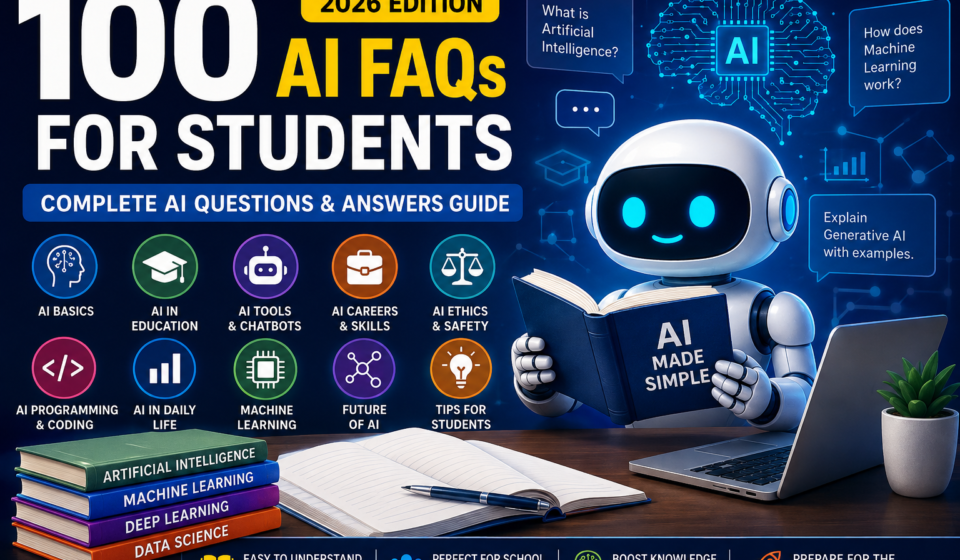
Congratulations! You now have a complete 100 AI FAQs for Students (2026 Edition) guide, suitable for publication as a comprehensive SEO-friendly resource on your website.