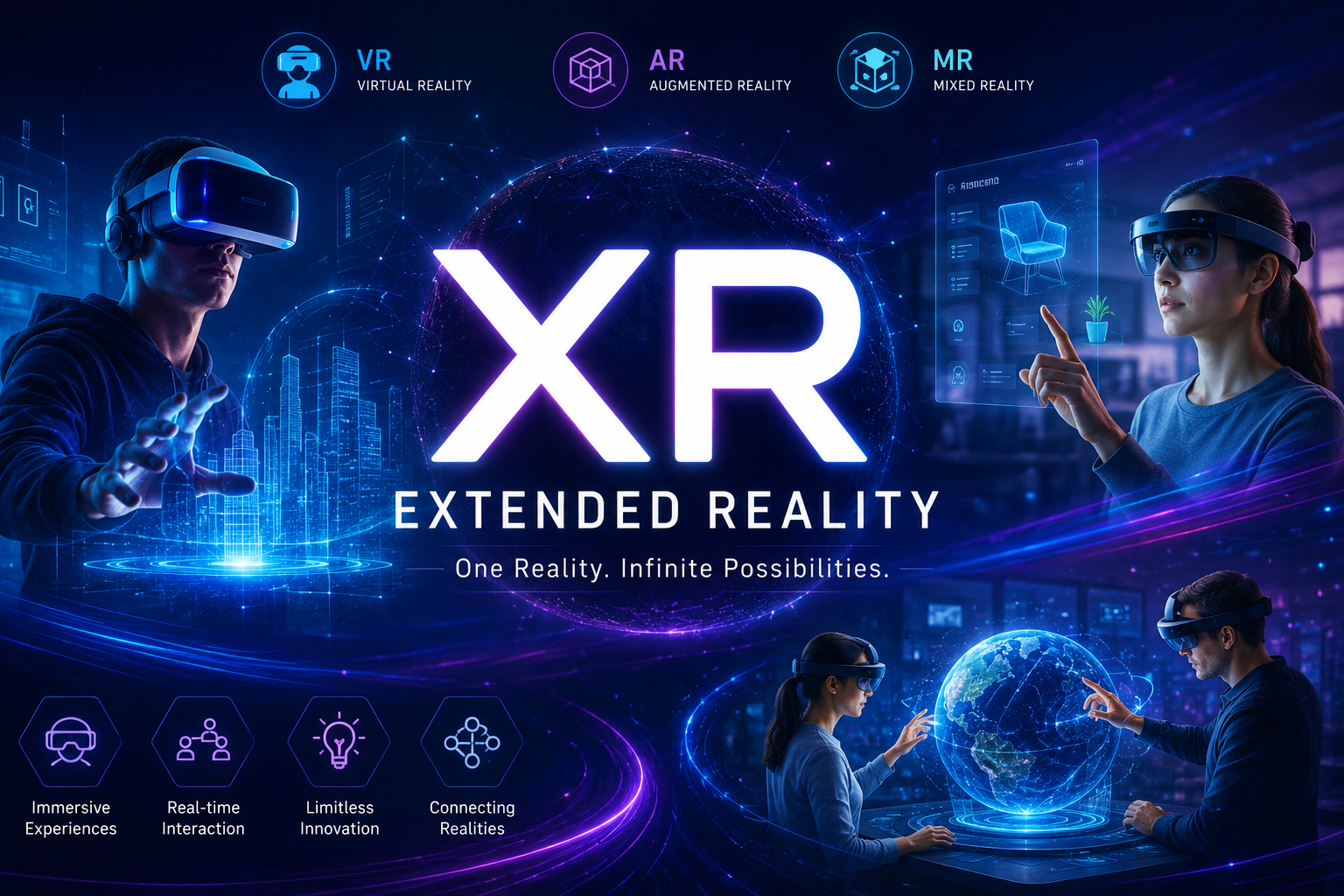

Extended Reality (XR) is a revolutionary technology that combines the physical and digital worlds to create immersive and interactive experiences. It is an umbrella term that includes Augmented Reality (AR), Virtual Reality (VR), and Mixed Reality (MR). XR is transforming the way we learn, work, communicate, and entertain ourselves.
As technologies like Artificial Intelligence (AI), 5G, and the upcoming 6G networks continue to evolve, XR is expected to become an essential part of our daily lives.
What Does XR Stand For?
XR (Extended Reality) refers to all immersive technologies that either enhance the real world or create completely virtual environments.
XR = AR + MR + VR
Extended Reality (XR)
XR = AR + MR + VR
📱 AR
Augmented RealityDigital objects are added to the real world.
🕶️ MR
Mixed RealityReal and virtual objects interact together.
🎮 VR
Virtual RealityA completely immersive digital environment.
Types of Extended Reality
📱 Augmented Reality (AR)
Augmented Reality overlays digital information, images, or 3D objects onto the real world using smartphones, tablets, or AR glasses.
Examples:
- Pokémon GO
- Google Maps Live View
- IKEA Place furniture app
- Snapchat and Instagram AR filters
🕶️ Mixed Reality (MR)
Mixed Reality combines the physical and digital worlds, allowing virtual objects to appear fixed in real space and interact with users.
Examples:
- Industrial equipment maintenance
- Medical visualization
- Collaborative 3D design
- Interactive engineering models
🎮 Virtual Reality (VR)
Virtual Reality creates a completely digital environment that users experience through a VR headset.
Examples:
- Virtual gaming
- Flight simulators
- Medical and military training
- Virtual tourism
How XR Works
Real World
     │
     ▼
Sensors + Cameras + AI
     │
     ▼
XR Device (Phone / Glasses / Headset)
     │
     ▼
Digital Objects & 3D Content
     │
     ▼
Interactive User Experience
Applications of XR
🏥 Healthcare
- Surgical training
- Medical education
- Remote healthcare assistance
- Therapy and rehabilitation
📚 Education
- Virtual classrooms
- Interactive science laboratories
- Historical site exploration
- Practical skill development
🏭 Manufacturing
- Equipment maintenance
- Employee training
- Digital twins
- Quality inspection
🛒 Retail & E-commerce
- Virtual try-on
- Product visualization
- Interactive shopping experiences
🏗 Architecture & Real Estate
- Virtual property tours
- Building design visualization
- Interior design previews
🎮 Entertainment
- Immersive gaming
- Live virtual concerts
- Interactive storytelling
Benefits of XR
- Immersive learning experiences
- Better employee training
- Improved remote collaboration
- Enhanced customer engagement
- Reduced operational costs
- Increased productivity
- Faster design and development
- Safer workplace simulations
Challenges of XR
- High hardware costs
- Privacy and security concerns
- Motion sickness for some users
- Battery limitations
- Limited high-quality content
- Need for faster internet connectivity
XR and the Future of 6G
The next generation of wireless communication, 6G, is expected to unlock the full potential of Extended Reality.
6G will provide:
- Ultra-fast data speeds
- Near-zero latency
- AI-native networking
- Massive device connectivity
- Real-time holographic communication
- Seamless cloud rendering
These capabilities will enable realistic virtual meetings, immersive education, remote surgery, smart factories, and intelligent digital twins.
Future of Extended Reality
Industry experts expect XR to become one of the most influential technologies of the next decade. As devices become lighter, more affordable, and powered by AI and 6G, XR will increasingly be used across education, healthcare, manufacturing, entertainment, retail, and everyday communication.
Businesses adopting XR early will be better positioned to improve customer experiences, streamline operations, and drive innovation.
Conclusion
Extended Reality (XR) is reshaping the digital world by combining Augmented Reality (AR), Mixed Reality (MR), and Virtual Reality (VR) into one powerful technology. From immersive learning and smart manufacturing to virtual collaboration and next-generation entertainment, XR is opening new possibilities across industries.
With the arrival of AI-powered applications and 6G connectivity, Extended Reality is poised to become a cornerstone of the future digital economy.