
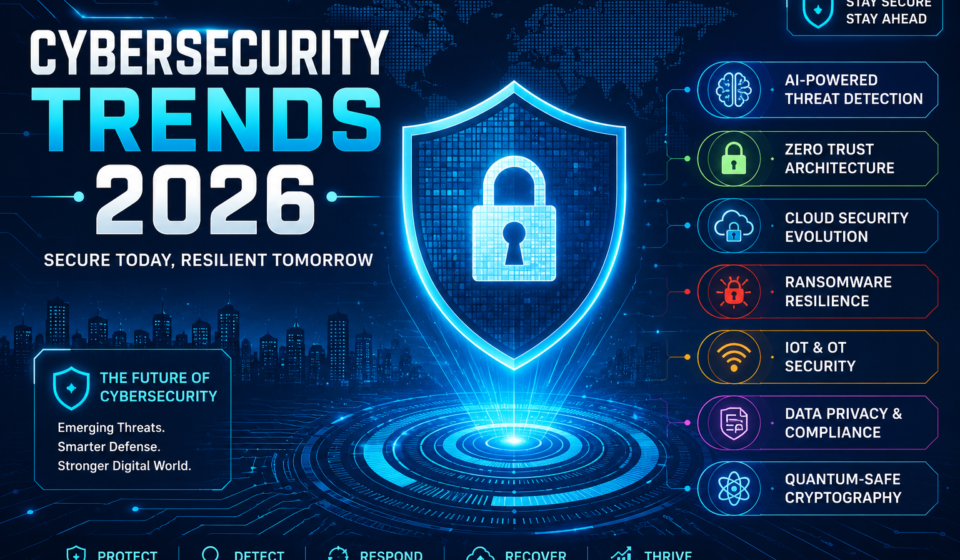

Cybersecurity has entered a new era. In 2026, cyberattacks are more sophisticated, automated, and financially motivated than ever before. The rapid adoption of Artificial Intelligence (AI), cloud computing, Internet of Things (IoT), hybrid work environments, and digital transformation has significantly expanded the attack surface for organizations worldwide.
At the same time, attackers are leveraging AI to automate phishing campaigns, discover software vulnerabilities, generate malicious code, and evade traditional security systems. Governments, enterprises, healthcare providers, financial institutions, and critical infrastructure operators now face increasingly complex cyber risks.
This article provides a professional analysis of the most significant cybersecurity trends shaping 2026 and explains how organizations can strengthen their security posture against evolving threats.
Table of Contents
Executive Summary
The cybersecurity industry is transitioning from reactive defense to predictive, AI-assisted protection. Security operations now prioritize:
- AI-assisted threat detection
- Identity-centric access control
- Zero Trust Architecture
- Cloud-native security
- Supply chain protection
- Quantum-resistant cryptography
- Automated incident response
Organizations that modernize their security strategies today will be better prepared to defend against tomorrow’s threats.
Global Cybersecurity Landscape
Organizations now manage:
- Multi-cloud environments
- Remote and hybrid workforces
- Billions of connected IoT devices
- AI-enabled business applications
- Expanding digital supply chains
Every new connected system creates additional opportunities for attackers.
Modern cybersecurity focuses on reducing attack surfaces while improving detection and response capabilities.
1. AI-Powered Cyber Attacks
Artificial Intelligence has become one of the most powerful tools for cybercriminals.
Attackers now use AI to:
- Generate convincing phishing emails
- Create realistic deepfake voice attacks
- Develop malware variants
- Discover software vulnerabilities
- Automate reconnaissance
- Improve password guessing attacks
- Produce polymorphic malware
Example
Instead of sending identical phishing emails to thousands of users, attackers now generate personalized messages using publicly available information, increasing the likelihood of success.
2. AI-Powered Cyber Defense
Fortunately, defenders are also leveraging AI.
Modern Security Operations Centers (SOCs) use machine learning to:
- Detect anomalies
- Identify insider threats
- Analyze billions of log entries
- Correlate attack patterns
- Prioritize alerts
- Reduce false positives
- Automate investigations
AI enables faster threat detection and more efficient incident response.
3. Zero Trust Architecture Becomes Standard
Traditional perimeter-based security is no longer sufficient.
The Zero Trust model operates on the principle:
Never trust, always verify.
Core principles include:
- Continuous authentication
- Least-privilege access
- Device verification
- Micro-segmentation
- Continuous monitoring
- Context-aware authorization
Organizations are increasingly adopting Zero Trust frameworks to protect distributed workforces and cloud environments.
4. Identity Becomes the New Security Perimeter
Most modern attacks begin with compromised identities rather than exploited software vulnerabilities.
Organizations are investing in:
- Multi-Factor Authentication (MFA)
- Passwordless authentication
- Identity threat detection
- Privileged Access Management (PAM)
- Adaptive authentication
- Behavioral analytics
Identity protection has become a cornerstone of modern cybersecurity strategies.
5. Quantum Computing and Post-Quantum Cryptography
Quantum computing poses a future risk to many widely used cryptographic algorithms.
Although large-scale quantum attacks are not yet practical, organizations are beginning to prepare by adopting Post-Quantum Cryptography (PQC).
Migration planning is already underway for sectors handling long-lived sensitive data, such as government, finance, and healthcare.
6. Cloud Security Evolution
Cloud environments continue to dominate enterprise infrastructure.
Security priorities include:
- Cloud Security Posture Management (CSPM)
- Cloud-Native Application Protection Platforms (CNAPP)
- Container security
- Kubernetes security
- Serverless security
- Secrets management
- Data encryption
Misconfigured cloud resources remain one of the leading causes of data breaches.
7. Ransomware 3.0
Ransomware has evolved significantly.
Modern ransomware groups now employ:
- Double extortion (encrypting and stealing data)
- Triple extortion (adding pressure through customers or partners)
- AI-assisted victim profiling
- Automated lateral movement
- Supply chain compromise
Rather than targeting only large enterprises, attackers increasingly focus on small and medium-sized businesses that may have weaker defenses.
8. Supply Chain Security
Software supply chain attacks continue to rise.
Attackers exploit:
- Third-party software
- Open-source libraries
- Build pipelines
- CI/CD systems
- Software updates
Organizations are adopting practices such as:
- Software Bill of Materials (SBOM)
- Code signing
- Dependency scanning
- Secure software development lifecycle (SSDLC)
9. API Security
APIs are essential to modern applications but also represent a growing attack surface.
Common API risks include:
- Broken authentication
- Excessive data exposure
- Authorization flaws
- Injection attacks
- Rate-limit bypass
- Insecure endpoints
Organizations are deploying dedicated API gateways, runtime monitoring, and continuous API testing to reduce these risks.
10. Internet of Things (IoT) Security
Billions of connected devices are now used across industries.
Common targets include:
- Smart factories
- Medical devices
- Smart cities
- Industrial sensors
- Connected vehicles
Key security measures:
- Device authentication
- Firmware integrity
- Secure boot
- Network segmentation
- Continuous monitoring
- Regular patching
11. Extended Detection and Response (XDR)
XDR platforms consolidate data from multiple security tools, including:
- Endpoints
- Networks
- Cloud services
- Identity systems
- Servers
Benefits include:
- Unified visibility
- Faster investigations
- Improved threat correlation
- Reduced response times
12. Security Automation
Security teams face increasing alert volumes.
Automation helps by:
- Prioritizing alerts
- Blocking malicious IPs
- Isolating compromised devices
- Resetting credentials
- Launching investigations
- Collecting forensic evidence
Security Orchestration, Automation, and Response (SOAR) platforms are becoming a standard component of mature security operations.
13. Cybersecurity Skills Gap
Despite advances in automation, there remains a global shortage of skilled cybersecurity professionals.
Organizations are addressing this challenge by:
- Investing in workforce training
- Using AI to assist analysts
- Outsourcing managed detection and response (MDR)
- Expanding security awareness programs
Human expertise remains essential for strategic decision-making and complex incident handling.
14. Regulatory Compliance
Governments are strengthening cybersecurity and privacy regulations.
Organizations should prepare for:
- Stricter breach reporting requirements
- Enhanced software security standards
- Greater accountability for third-party risk
- Stronger protection of critical infrastructure
- Increased regulatory oversight of AI systems
Compliance should be integrated into security governance rather than treated as a standalone activity.
Cybersecurity Best Practices for 2026
Organizations should prioritize the following actions:
- Adopt Zero Trust Architecture.
- Enforce Multi-Factor Authentication across all critical systems.
- Maintain a comprehensive asset inventory.
- Implement continuous vulnerability management.
- Encrypt sensitive data both at rest and in transit.
- Regularly back up critical systems and test recovery processes.
- Secure APIs and cloud environments.
- Monitor supply chain risks.
- Train employees to recognize phishing and social engineering.
- Develop and regularly exercise an incident response plan.
Future Predictions
Looking ahead, cybersecurity is expected to evolve in several key areas:
- AI-powered security copilots will become standard in Security Operations Centers.
- Autonomous threat detection and response will reduce response times.
- Post-quantum cryptography adoption will accelerate.
- Passwordless authentication will become more widespread.
- Identity-centric security will replace traditional perimeter defenses.
- Organizations will place greater emphasis on resilience and rapid recovery, not just prevention.
Conclusion
Cybersecurity in 2026 is defined by intelligent adversaries, expanding digital ecosystems, and the increasing role of AI in both attack and defense. Traditional security models are no longer sufficient to protect modern enterprises.
Organizations that embrace Zero Trust principles, strengthen identity security, secure cloud-native environments, prepare for quantum-resistant cryptography, and leverage AI responsibly will be better positioned to manage future cyber risks.
Cybersecurity is no longer solely an IT function—it is a strategic business priority that underpins operational continuity, regulatory compliance, customer trust, and long-term resilience.
Frequently Asked Questions (FAQ)
Q1. What is the biggest cybersecurity trend in 2026?
AI-driven cybersecurity is the dominant trend, with artificial intelligence being used for both advanced cyberattacks and real-time threat detection and response.
Q2. Why is Zero Trust important?
Zero Trust assumes no user or device is trusted by default, reducing the risk of unauthorized access and limiting the impact of compromised credentials.
Q3. How does quantum computing affect cybersecurity?
Future quantum computers could break some widely used encryption methods, prompting organizations to begin migrating to post-quantum cryptographic algorithms.
Q4. What industries face the highest cyber risk?
Financial services, healthcare, government, manufacturing, energy, telecommunications, and critical infrastructure remain among the most targeted sectors.
Q5. How can organizations prepare for emerging threats?
By adopting Zero Trust, implementing strong identity management, securing cloud and API environments, using AI-assisted security tools, conducting regular security assessments, and investing in employee awareness and incident response capabilities.
Suggested Internal Links
- AI Agents Explained
- Agentic AI Guide
- Post-Quantum Cryptography Explained
- Cloud Computing Security Best Practices
- Zero Trust Architecture Guide
- Ethical Hacking for Beginners
- Computer Virus History and Types
Suggested External References
- National Institute of Standards and Technology (NIST): https://www.nist.gov/
- MITRE ATT&CK Framework: https://attack.mitre.org/
- CISA (Cybersecurity & Infrastructure Security Agency): https://www.cisa.gov/
- OWASP Foundation: https://owasp.org/
- FIRST (Forum of Incident Response and Security Teams): https://www.first.org/
- ENISA (European Union Agency for Cybersecurity): https://www.enisa.europa.eu/