

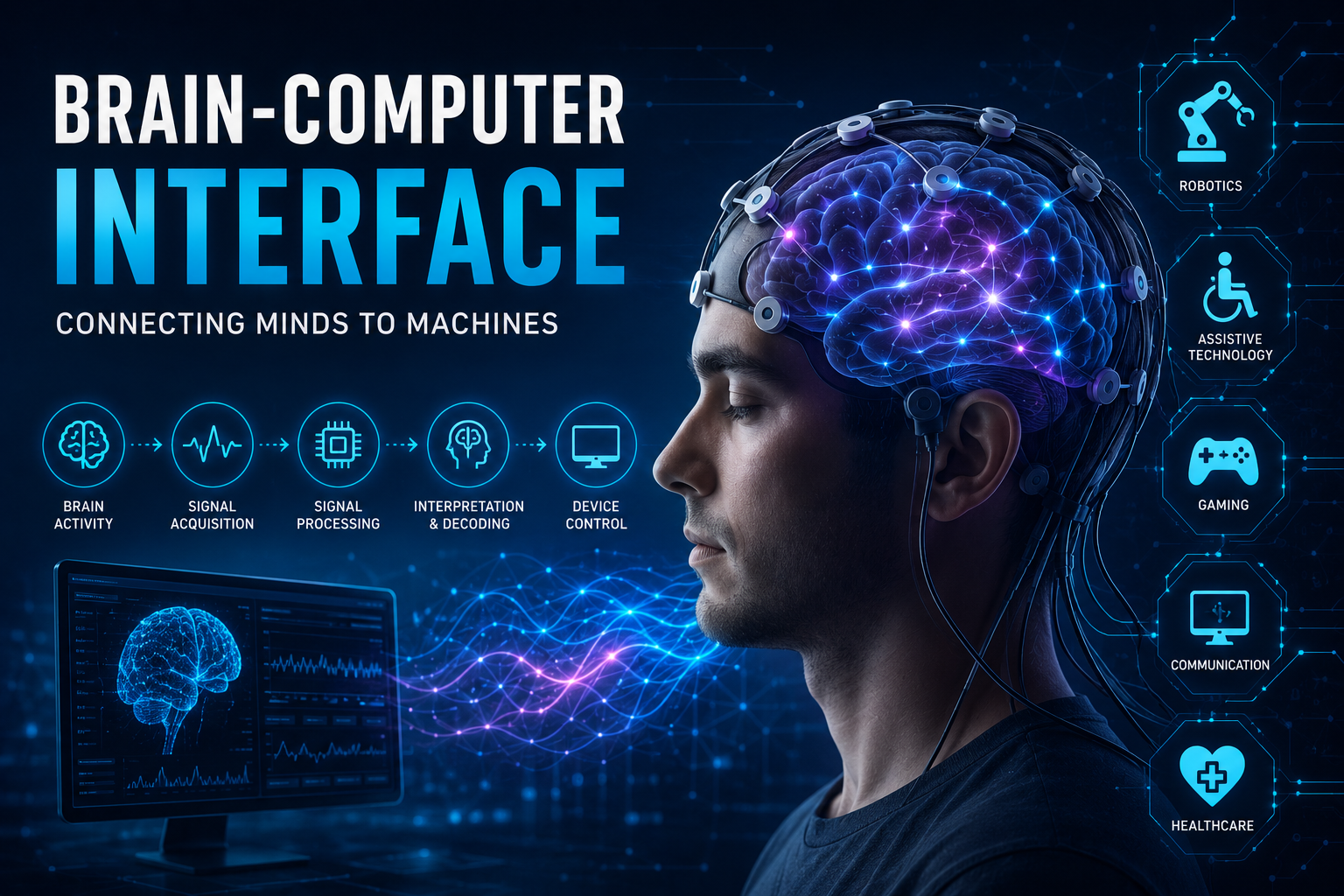
Brain-Computer Interfaces (BCI): Complete Guide to How Brain-Computer Interfaces Work, Types, Applications, Benefits, Challenges & Future (2026)

Brain-Computer Interfaces (BCI): The Future of Human-Machine Communication
Brain-Computer Interfaces (BCIs) are among the most revolutionary technologies of the 21st century. They enable direct communication between the human brain and external devices, allowing users to control computers, robots, prosthetic limbs, wheelchairs, and even smart home systems using only their thoughts.
With rapid advancements in Artificial Intelligence (AI), neuroscience, sensors, and machine learning, BCIs are becoming more accurate, faster, and practical. Companies like Neuralink, Synchron, Blackrock Neurotech, and many research institutions are driving innovations that could transform healthcare, education, communication, gaming, and everyday life.
In this comprehensive guide, you’ll learn how Brain-Computer Interfaces work, their types, applications, advantages, challenges, and future possibilities.
Table of Contents
What is Brain-Computer Interface (BCI)?
A Brain-Computer Interface (BCI) is a technology that establishes a direct communication pathway between the human brain and an external electronic device.
Instead of using a keyboard, mouse, touchscreen, or voice commands, a BCI interprets brain signals and converts them into digital commands.
In simple terms:
Brain → Signal Processing → Computer Command → Device Action
The system reads electrical activity generated by neurons, analyzes it using AI algorithms, and performs the intended action.
History of Brain-Computer Interfaces
1970s
- First BCI research begins.
- EEG-based experiments started.
1990s
- Medical BCIs helped patients move cursors.
2000s
- Robotic arms controlled by brain signals.
2010s
- Deep learning improved signal recognition.
- Consumer EEG headsets became available.
2020–2026
- Neural implants became more advanced.
- AI significantly improved decoding accuracy.
- Clinical trials expanded globally.
How Brain-Computer Interfaces Work
A Brain-Computer Interface follows several stages to translate thoughts into actions.
Step 1: Brain Signal Generation
When a person thinks, neurons generate electrical impulses.
Examples:
- Move left hand
- Move right hand
- Speak
- Focus attention
- Imagine movement
Step 2: Signal Acquisition
Sensors capture brain activity.
Technologies include:
- EEG
- ECoG
- MEG
- fNIRS
- Intracortical electrodes
Step 3: Signal Processing
The captured signals are cleaned by removing:
- Noise
- Eye blinking artifacts
- Muscle movement
- Environmental interference
Step 4: Feature Extraction
Machine learning identifies useful brain patterns.
Examples include:
- Motor imagery
- Attention
- Visual response
- Emotion recognition
Step 5: Classification
AI predicts what the user intends to do.
Example:
Brain Pattern → Move Cursor Left
Step 6: Device Control
The computer sends commands to devices such as:
- Robot
- Wheelchair
- Computer
- Prosthetic arm
- Drone
- Smart home appliances
Components of a Brain-Computer Interface System
Brain Signal Sensors
Collect electrical brain activity.
Examples:
- EEG headset
- Brain implant
- Neural electrodes
Signal Processor
Filters and improves signal quality.
AI Decoder
Interprets brain activity using Machine Learning and Deep Learning algorithms.
Output Device
Examples include:
- Computer
- Prosthetic limb
- Wheelchair
- Drone
- Robot
- Smart home system
Feedback System
Provides visual, audio, or tactile feedback so users can improve control.
Types of Brain-Computer Interfaces
1. Invasive BCI
Electrodes are implanted directly inside the brain.
Advantages
- Highest accuracy
- Fast response
- Rich neural information
Disadvantages
- Brain surgery required
- High cost
- Medical risks
2. Partially Invasive BCI
Electrodes are placed on the brain surface.
Benefits
- Better signals than EEG
- Lower surgical risk
3. Non-Invasive BCI
Sensors remain outside the skull.
Examples:
- EEG headset
- Wearable devices
Advantages
- Safe
- Affordable
- Easy to use
Disadvantages
- Lower signal quality
- More noise
Brain-Computer Interface Architecture
Human Brain
      │
      ▼
Brain Signals
      │
      ▼
Signal Acquisition
      │
      ▼
Signal Processing
      │
      ▼
AI & Machine Learning
      │
      ▼
Command Generation
      │
      ▼
External Device
Applications of Brain-Computer Interfaces
Healthcare
BCIs are transforming medicine by enabling:
- Paralysis assistance
- Stroke rehabilitation
- ALS communication
- Prosthetic control
- Epilepsy monitoring
- Parkinson’s disease treatment
Education
BCIs can measure:
- Student attention
- Mental fatigue
- Learning performance
- Personalized learning experiences
Gaming
Players can control games using thoughts.
Examples:
- VR games
- AR games
- Esports training
- Brain-controlled characters
Military
Potential uses include:
- Hands-free drone control
- Soldier monitoring
- Cognitive enhancement
- Decision support
Smart Homes
Users can control:
- Lights
- Fans
- Doors
- Television
- Air conditioners
using brain commands.
Robotics
Brain-controlled robots assist in:
- Manufacturing
- Hazardous environments
- Elderly care
- Medical assistance
Communication
BCIs help people with severe disabilities communicate using brain activity alone.
Benefits of Brain-Computer Interfaces
- Direct communication between brain and machines
- Restores independence for disabled individuals
- Enables hands-free computer control
- Improves rehabilitation outcomes
- Enhances accessibility
- Faster human-computer interaction
- Supports scientific research
- Potential cognitive enhancement
Challenges and Limitations
Technical Challenges
- Signal noise
- Limited accuracy
- Calibration time
- Battery life
- Latency
Medical Challenges
- Surgical risks
- Infection
- Long-term implant durability
Ethical Challenges
- Brain data privacy
- Data ownership
- Cybersecurity
- User consent
- Potential misuse
Artificial Intelligence and BCI
AI is a critical component of modern BCIs.
It enables:
- Pattern recognition
- Adaptive learning
- Real-time decoding
- Personalized models
- Continuous performance improvement
Deep learning models help decode complex neural activity more accurately than traditional methods.
Major Companies Developing Brain-Computer Interfaces
- Neuralink
- Synchron
- Blackrock Neurotech
- Precision Neuroscience
- Paradromics
- EMOTIV
- Kernel
Future of Brain-Computer Interfaces
Experts predict significant progress in the coming years, including:
- Wireless brain implants
- Higher decoding accuracy
- AI-powered neural assistants
- Brain-controlled prosthetics
- Brain-to-brain communication research
- Integration with Augmented Reality (AR) and Virtual Reality (VR)
- Personalized healthcare applications
- Consumer-grade wearable BCIs
As AI, neuroscience, and hardware continue to evolve, BCIs may become as common as smartphones are today.
Frequently Asked Questions (FAQs)
What is a Brain-Computer Interface?
A Brain-Computer Interface (BCI) is a technology that enables direct communication between the brain and an external device by interpreting neural signals.
Is BCI safe?
Non-invasive BCIs are generally considered safe. Invasive BCIs require surgery and carry associated medical risks.
What are BCIs used for?
They are used in healthcare, assistive technology, robotics, gaming, education, scientific research, and smart environments.
Can a BCI read thoughts?
Current BCIs detect specific patterns of neural activity related to intended actions or responses. They cannot broadly “read minds” or access all of a person’s thoughts.
What is the future of Brain-Computer Interfaces?
Future BCIs are expected to become more accurate, wireless, AI-powered, and widely adopted for both medical and consumer applications.
Conclusion
Brain-Computer Interfaces (BCIs) are reshaping the relationship between humans and machines by enabling direct communication through neural signals. Their potential spans healthcare, accessibility, robotics, education, and entertainment. While technical, ethical, and privacy challenges remain, advances in AI, neuroscience, and wearable technology are accelerating their development. As research continues, BCIs are likely to play a significant role in the future of human-computer interaction.