

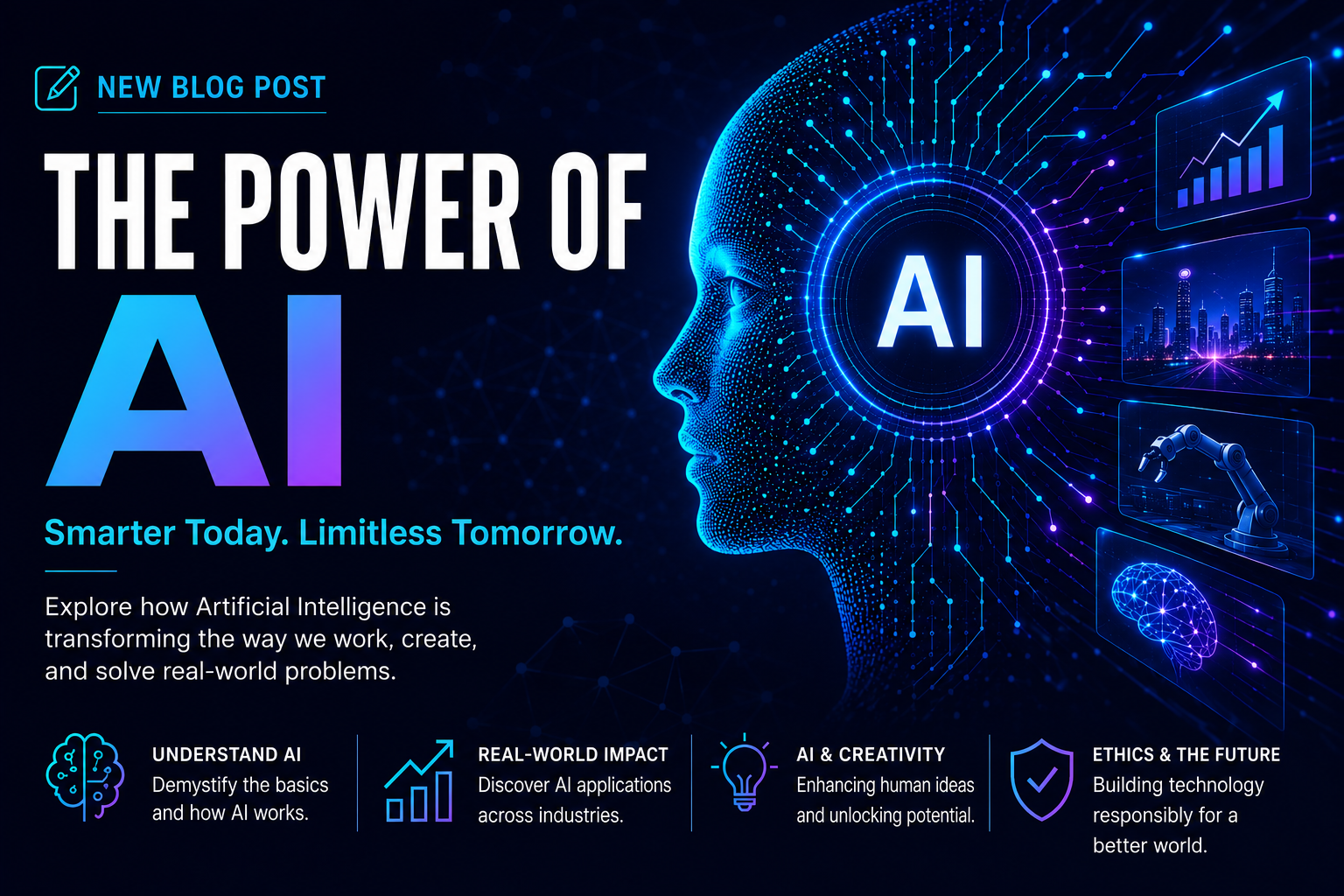
Artificial Intelligence (AI): Complete Guide to How AI Works, Types, Benefits, Applications & Future (2026)

Artificial Intelligence (AI): The Complete Guide (2026)
Artificial Intelligence (AI) has become one of the most revolutionary technologies of the modern era. From voice assistants like Siri and Google Assistant to self-driving cars and advanced healthcare systems, AI is transforming every industry. It enables machines to think, learn, analyze data, solve problems, and make decisions with minimal human intervention.
This comprehensive guide explains everything about Artificial Intelligence, including its working principles, types, applications, advantages, challenges, future trends, and real-world examples.
Table of Contents
What is Artificial Intelligence (AI)?
Artificial Intelligence (AI) is a branch of computer science that develops intelligent systems capable of performing tasks that normally require human intelligence.
These tasks include:
- Learning
- Problem-solving
- Decision-making
- Language understanding
- Image recognition
- Speech recognition
- Planning
- Creativity
AI systems continuously improve by learning from data and experience rather than relying solely on fixed programming.
History of Artificial Intelligence
1950 – The Beginning
Alan Turing introduced the famous Turing Test, proposing that machines could demonstrate intelligence.
1956 – Birth of AI
The term Artificial Intelligence was officially introduced during the Dartmouth Conference.
1980s – Expert Systems
Businesses began using AI-based expert systems for decision-making.
1997 – Deep Blue
IBM’s Deep Blue defeated world chess champion Garry Kasparov.
2012 – Deep Learning Revolution
Neural networks achieved significant breakthroughs in image recognition.
2020–2026 – Generative AI Era
Modern AI models can generate text, images, videos, music, and code, making AI accessible to businesses and individuals worldwide.
How Artificial Intelligence Works
Artificial Intelligence follows a structured workflow:
Step 1: Data Collection
AI gathers data from:
- Databases
- Cameras
- Sensors
- Websites
- User interactions
↓
Step 2: Data Processing
The collected data is cleaned and organized for training.
↓
Step 3: Model Training
Machine learning algorithms identify patterns and relationships within the data.
↓
Step 4: Prediction
The trained AI model predicts outcomes or makes decisions.
↓
Step 5: Continuous Learning
The AI system improves its performance using new data and feedback.
Core Components of Artificial Intelligence
Machine Learning (ML)
Allows computers to learn from historical data without explicit programming.
Examples
- Email spam filtering
- Product recommendations
- Fraud detection
Deep Learning
Uses artificial neural networks with multiple layers to solve complex problems.
Examples
- Face recognition
- Speech recognition
- Medical imaging
Natural Language Processing (NLP)
Enables machines to understand, interpret, and generate human language.
Examples
- Chatbots
- Translation tools
- AI writing assistants
Computer Vision
Allows computers to analyze and interpret visual information from images and videos.
Examples
- Facial recognition
- Self-driving cars
- Medical diagnostics
Robotics
Combines AI with physical machines to automate tasks in manufacturing, healthcare, logistics, and exploration.
Types of Artificial Intelligence
1. Narrow AI (Weak AI)
Designed for a single specific task.
Examples
- Siri
- Alexa
- Google Maps
- Netflix recommendations
2. General AI (Strong AI)
A theoretical AI capable of performing any intellectual task that a human can.
Currently, General AI does not exist.
3. Super AI
A hypothetical AI that surpasses human intelligence in every aspect.
This remains a concept for future research.
Artificial Intelligence vs Machine Learning
| Artificial Intelligence | Machine Learning |
|---|---|
| Broad field of intelligent systems | Subset of AI |
| Mimics human intelligence | Learns from data |
| Includes reasoning and planning | Focuses on predictions |
| Uses multiple technologies | Uses statistical algorithms |
Real-World Applications of Artificial Intelligence
AI in Healthcare
- Disease diagnosis
- Medical imaging
- Drug discovery
- Virtual health assistants
- Robotic surgery
AI in Education
- Personalized learning
- Automated grading
- AI tutors
- Language learning
- Smart classrooms
AI in Finance
- Fraud detection
- Risk analysis
- Stock market prediction
- Customer service
- Automated trading
AI in Retail
- Product recommendations
- Inventory management
- Dynamic pricing
- Customer behavior analysis
AI in Manufacturing
- Predictive maintenance
- Industrial robots
- Quality inspection
- Supply chain optimization
AI in Transportation
- Autonomous vehicles
- Route optimization
- Traffic prediction
- Smart logistics
AI in Agriculture
- Crop monitoring
- Smart irrigation
- Disease detection
- Yield prediction
AI in Cybersecurity
- Threat detection
- Malware analysis
- Fraud prevention
- Security monitoring
AI in Entertainment
- Content recommendations
- AI-generated music
- Video creation
- Gaming intelligence
Benefits of Artificial Intelligence
Increased Productivity
Automates repetitive tasks and boosts operational efficiency.
Faster Decision-Making
Analyzes large datasets in seconds to support informed decisions.
Improved Accuracy
Reduces human error in calculations, diagnostics, and quality control.
24/7 Availability
AI-powered systems can operate continuously without fatigue.
Cost Savings
Streamlines operations and reduces long-term business costs.
Better Customer Experience
Provides personalized recommendations and instant support.
Challenges of Artificial Intelligence
Data Privacy
AI systems often require large volumes of user data.
Job Displacement
Automation may replace certain repetitive job roles.
Bias in AI Models
Poor-quality or biased training data can lead to unfair outcomes.
High Development Cost
Building advanced AI systems requires significant investment.
Security Risks
AI can be targeted by cyberattacks or misused for malicious purposes.
Ethical Considerations in AI
Responsible AI development focuses on:
- Transparency
- Fairness
- Privacy
- Accountability
- Human oversight
- Bias reduction
- Explainable AI
Organizations should ensure AI systems are designed and deployed responsibly.
Future of Artificial Intelligence
The future of AI includes:
- AI-powered healthcare diagnostics
- Autonomous transportation
- Human-AI collaboration
- AI-driven scientific discoveries
- Smart cities
- Personalized education
- Advanced robotics
- Sustainable energy optimization
- AI-powered cybersecurity
- Multimodal and Agentic AI systems
AI is expected to become an integral part of everyday life, driving innovation across industries.
Career Opportunities in Artificial Intelligence
High-demand AI roles include:
- AI Engineer
- Machine Learning Engineer
- Data Scientist
- NLP Engineer
- Computer Vision Engineer
- Robotics Engineer
- AI Research Scientist
- AI Product Manager
- Prompt Engineer
- AI Ethics Specialist
Best Artificial Intelligence Tools
- ChatGPT
- Google Gemini
- Microsoft Copilot
- Claude AI
- Perplexity AI
- Midjourney
- DALL·E
- GitHub Copilot
- Notion AI
- Grammarly AI
Frequently Asked Questions (FAQs)
What is Artificial Intelligence?
Artificial Intelligence (AI) is the simulation of human intelligence by machines, enabling them to learn, reason, solve problems, and make decisions.
Is AI the same as Machine Learning?
No. Machine Learning is a subset of Artificial Intelligence that focuses on learning from data.
What are the main types of AI?
- Narrow AI
- General AI
- Super AI
Where is AI used?
AI is widely used in healthcare, education, finance, retail, manufacturing, agriculture, transportation, cybersecurity, and entertainment.
Is Artificial Intelligence safe?
AI can be safe when developed responsibly with proper governance, transparency, privacy protections, and human oversight.
Conclusion
Artificial Intelligence (AI) is reshaping how people live, work, and innovate. By combining technologies such as Machine Learning, Deep Learning, Natural Language Processing, and Computer Vision, AI enables intelligent systems to solve complex problems and automate tasks across nearly every industry.
As AI continues to evolve, understanding its capabilities, limitations, and ethical implications will be essential for businesses, professionals, and individuals. Staying informed about AI trends and best practices will help you leverage its potential while adapting to the rapidly changing digital landscape.
Suggested Internal Links
- What is Machine Learning?
- Generative AI Explained
- Agentic AI Guide
- Multimodal AI Explained
- Edge AI Guide
- Internet of Things (IoT)
- Blockchain Technology
- Quantum Computing
- Cybersecurity Guide