

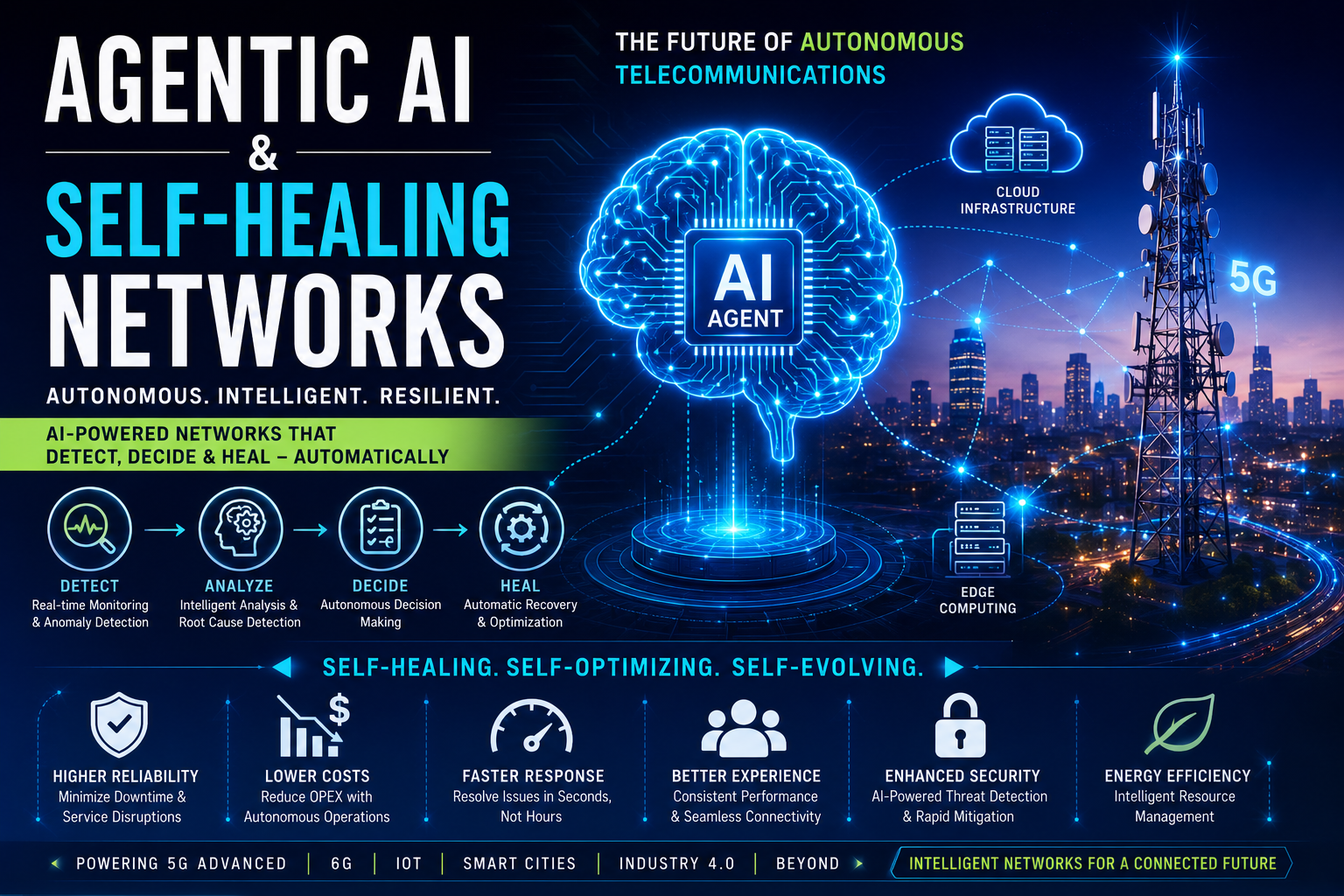
Agentic AI & Self-Healing Networks: How Autonomous AI is Transforming Future Telecom Networks

What is Agentic AI & Self-Healing Networks?
Agentic AI refers to artificial intelligence systems that can perceive, reason, plan, make decisions, and take autonomous actions to achieve specific goals with minimal human intervention.
When integrated with Self-Healing Networks, Agentic AI enables communication networks to automatically detect, diagnose, predict, and repair faults before they impact users.
Instead of waiting for engineers to identify and resolve network issues, AI agents continuously monitor the infrastructure, analyze vast amounts of operational data, and take corrective actions in real time.
This combination is expected to become one of the most important technologies powering 5G Advanced, 6G, cloud-native networks, IoT, edge computing, and smart cities.
Table of Contents
Why Agentic AI Matters in Telecommunications
Modern telecom networks are becoming increasingly complex due to:
- Millions of connected devices
- Massive IoT deployments
- Cloud-native infrastructure
- Multi-vendor ecosystems
- Edge computing
- Private 5G networks
- Autonomous vehicles
- AI-powered applications
Traditional network management is often reactive and relies on manual intervention. Agentic AI shifts this model to proactive and autonomous operations.
What is a Self-Healing Network?
A Self-Healing Network (SHN) is an intelligent communication network capable of:
- Detecting failures automatically
- Identifying root causes
- Predicting future issues
- Recovering services without human intervention
- Continuously optimizing performance
In essence, the network can “heal itself” after faults or disruptions.

How Agentic AI Powers Self-Healing Networks
Step 1: Continuous Monitoring
AI agents monitor network elements, including:
- Base stations
- Routers
- Switches
- Cloud servers
- Edge nodes
- Fiber links
- Satellites
- IoT devices
Step 2: Data Collection
Millions of metrics are collected every second:
- CPU utilization
- Network latency
- Signal strength
- Packet loss
- Bandwidth usage
- Power consumption
- Temperature
- Device health
Step 3: Intelligent Analysis
Machine learning models analyze:
- Traffic patterns
- User behavior
- Equipment performance
- Historical failures
- Security events
- Environmental conditions
Step 4: Fault Prediction
Instead of reacting after failure, Agentic AI predicts:
- Hardware failures
- Network congestion
- Fiber cuts
- Power outages
- Cyberattacks
- Capacity shortages
Step 5: Autonomous Decision-Making
AI decides the optimal response, such as:
- Rerouting traffic
- Restarting services
- Scaling cloud resources
- Switching backup links
- Allocating bandwidth
- Isolating compromised systems
Step 6: Self-Healing
The network automatically:
- Restores services
- Verifies performance
- Learns from the incident
- Updates future decision models
Self-Healing Network Workflow
Network Devices
        │
        ▼
Continuous Monitoring
        │
        ▼
AI Data Analysis
        │
        ▼
Fault Detection
        │
        ▼
Prediction Engine
        │
        ▼
AI Decision Making
        │
        ▼
Automatic Recovery
        │
        ▼
Continuous Optimization
Core Technologies
- Agentic AI
- Machine Learning (ML)
- Deep Learning
- Reinforcement Learning
- Generative AI
- Large Language Models (LLMs)
- Digital Twins
- Network Digital Twins (NDT)
- Edge AI
- AIOps
- Software-Defined Networking (SDN)
- Network Function Virtualization (NFV)
- Intent-Based Networking (IBN)
Key Features
- Autonomous network operations
- Real-time fault detection
- Predictive maintenance
- Automatic recovery
- Intelligent traffic management
- Zero-touch provisioning
- Dynamic resource allocation
- Continuous learning
- Reduced downtime
- Enhanced cybersecurity response
Benefits
Improved Network Reliability
Detects and resolves issues before users experience disruptions.
Lower Operational Costs
Reduces manual troubleshooting and maintenance.
Faster Incident Response
Responds to failures in seconds instead of hours.
Better User Experience
Maintains consistent network performance and lower latency.
Enhanced Security
Quickly identifies and isolates suspicious activity.
Energy Efficiency
Optimizes power usage by dynamically managing network resources.
Real-World Applications
| Industry | Application |
|---|---|
| Telecommunications | Autonomous 5G and 6G operations |
| Smart Cities | Intelligent traffic and utility networks |
| Healthcare | Reliable hospital communication systems |
| Manufacturing | Industrial IoT and predictive maintenance |
| Banking | High-availability financial networks |
| Transportation | Connected vehicles and logistics |
| Cloud Computing | Self-managing data centers |
| Defense | Mission-critical resilient communications |
Challenges
- Complex AI model governance
- Data privacy and security
- Multi-vendor interoperability
- Explainability of AI decisions
- Regulatory compliance
- High deployment costs
- Continuous model training
- Workforce upskilling
Future Trends
The future of Agentic AI and Self-Healing Networks includes:
- Fully autonomous 6G networks
- AI-native telecom infrastructure
- Autonomous satellite networks
- Predictive cybersecurity
- Digital twin-driven optimization
- Energy-aware AI networking
- Autonomous edge computing
- Intent-driven network orchestration
Frequently Asked Questions (FAQs)
Is Agentic AI different from traditional AI?
Yes. Traditional AI typically performs predefined tasks, while Agentic AI can reason, plan, and autonomously execute multi-step actions to achieve goals.
Can Self-Healing Networks eliminate downtime completely?
No. They significantly reduce downtime by detecting, predicting, and recovering from many failures automatically, but they cannot guarantee the elimination of all outages.
Which industries benefit the most?
Telecommunications, healthcare, manufacturing, transportation, finance, cloud computing, and smart city infrastructure are among the biggest beneficiaries.
Conclusion
Agentic AI and Self-Healing Networks represent the next evolution of intelligent telecommunications. By combining autonomous AI agents with real-time monitoring, predictive analytics, and automated recovery, these networks can deliver greater reliability, efficiency, and resilience. As 5G Advanced and 6G continue to expand, autonomous networking will become a foundational capability for supporting billions of connected devices and mission-critical digital services.
Further Reading & Official Resources
To better understand Agentic AI and Self-Healing Networks, explore these authoritative industry resources:
- TM Forum – Autonomous Networks Mission – Learn about the industry’s roadmap toward Zero-X (zero wait, zero touch, zero trouble) autonomous telecom operations. (TM Forum)
- TM Forum – Autonomous Networks Project – Official initiative covering self-healing, self-optimizing, and self-evolving telecom networks. (TM Forum)
- TM Forum – Agentic NOC: AI-Native Operations for the Autonomous Telco – Explains how Agentic AI can automate network operations using collaborative AI agents. (TM Forum)
- TM Forum – AI Native Open Digital Architecture (ODA) Roadmap – Learn how AI-native architectures support autonomous telecom operations. (TM Forum)
- Linux Foundation – CAMARA Network APIs for AI Applications – Understand how AI agents can securely access real-time telecom network capabilities through standardized APIs. (Linux Foundation)
- 3GPP Official Website – Global standards organization for LTE, 5G, 5G-Advanced, and future 6G mobile technologies.
- O-RAN Alliance – Learn about open and intelligent Radio Access Networks (Open RAN) and AI-enabled network automation.
- ETSI Official Website – European Telecommunications Standards Institute, responsible for standards related to network virtualization, AI, and next-generation communications.
- International Telecommunication Union (ITU) – Explore global telecommunications standards, spectrum management, and emerging AI-driven networking initiatives.
- NVIDIA AI for Telecommunications – Learn how AI, digital twins, and accelerated computing are being applied to telecom infrastructure.
References
- TM Forum – Autonomous Networks Mission
- TM Forum – Autonomous Networks Project
- TM Forum – Agentic NOC: AI-Native Operations for the Autonomous Telco
- TM Forum – AI Native Open Digital Architecture (ODA) Roadmap
- Linux Foundation – CAMARA Project
- 3GPP – Mobile Communication Standards
- O-RAN Alliance – Intelligent Open RAN Standards
- ETSI – Telecommunications Standards
- International Telecommunication Union (ITU)
- NVIDIA – AI for Telecommunications