
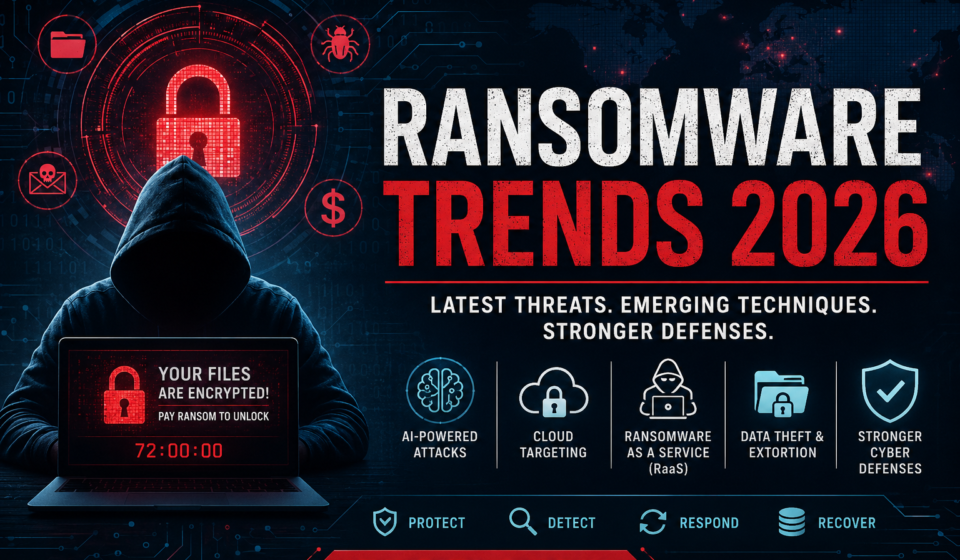
Ransomware Trends 2026: Everything You Need to Know About the Next Generation of Cyber Threats

Cybercriminals are becoming more organized, more automated, and more intelligent than ever before. Ransomware Trends 2026 reveal a major shift from simple file encryption attacks to AI-driven, identity-based, and multi-extortion campaigns that target businesses, governments, hospitals, educational institutions, and even individuals.
According to multiple cybersecurity reports published in 2026, ransomware remains one of the world’s most damaging cyber threats, with attackers increasingly focusing on stolen credentials, cloud infrastructure, AI-assisted phishing, and data theft rather than encryption alone.
This guide explains everything you need to know about ransomware in 2026, including:
- Latest ransomware trends
- AI-powered attacks
- Emerging hacker techniques
- Industries at highest risk
- Best protection strategies
- Future predictions
- Practical prevention checklist

Table of Contents
What is Ransomware?
Ransomware is a type of malicious software (malware) that prevents users from accessing their files, systems, or networks until a ransom is paid.
Modern ransomware no longer simply encrypts files.
Today’s ransomware groups:
- Steal confidential data
- Threaten public leaks
- Disable security software
- Encrypt backups
- Attack cloud environments
- Demand millions of dollars
How Ransomware Has Changed in 2026
The ransomware landscape has transformed dramatically.
| Before | Ransomware in 2026 |
|---|---|
| Encrypt files | Encrypt + Steal Data |
| Simple phishing | AI-generated phishing |
| Single ransom | Multi-extortion |
| Windows only | Windows, Linux, ESXi & Cloud |
| Manual attacks | Automated attacks |
| Individual hackers | Organized cybercrime businesses |
Threat actors increasingly use AI-assisted phishing, data-only extortion in some cases, and industrialized ransomware operations.
Top Ransomware Trends in 2026
1. AI-Powered Ransomware
Artificial Intelligence has become a major weapon for attackers.
AI is now used for:
- Writing phishing emails
- Voice cloning
- Deepfake video attacks
- Password guessing
- Malware automation
- Social engineering
Attackers can launch highly personalized phishing campaigns within minutes.
2. Ransomware-as-a-Service (RaaS)
One of the biggest cybersecurity trends is the continued growth of Ransomware-as-a-Service (RaaS).
Developers create ransomware.
Affiliates launch attacks.
Profits are shared.
This underground business model allows criminals with little technical knowledge to conduct sophisticated ransomware attacks.
3. Triple Extortion
Traditional ransomware demanded payment for decryption.
Today’s attacks include:
- File encryption
- Data theft
- DDoS attacks
- Customer notification threats
- Regulatory exposure
- Public data leaks
This “multi-extortion” model has become a defining trend.
4. Identity-Based Attacks
Instead of exploiting software vulnerabilities, attackers increasingly rely on:
- Stolen passwords
- Session cookies
- MFA fatigue attacks
- Token theft
- VPN credentials
Identity has become one of the primary attack surfaces.
5. Cloud Ransomware
Cloud services are now major targets.
Attackers focus on:
- Microsoft 365
- Google Workspace
- AWS
- Azure
- Cloud backups
- SaaS applications
Cloud misconfigurations and exposed credentials create significant risks.
6. Supply Chain Attacks
Instead of attacking one company directly, ransomware groups increasingly compromise:
- Software vendors
- IT service providers
- MSPs
- Third-party suppliers
One breach can affect hundreds or thousands of organizations.
7. Data Theft Without Encryption
One of the biggest shifts in 2026 is the increase in data-only extortion.
Instead of encrypting files, attackers:
- Steal sensitive information
- Threaten publication
- Demand payment
- Avoid detection
This approach can reduce recovery time for victims while increasing pressure to pay due to privacy and reputational risks.
Industries Most Targeted
According to recent reports, ransomware operators continue to focus on sectors where disruption increases pressure to pay.
High-risk industries include:
- Healthcare
- Financial Services
- Government
- Education
- Manufacturing
- Technology
- Energy
- Telecommunications
- Logistics
- Critical Infrastructure
Common Entry Points
Most ransomware attacks begin through:
- Phishing emails
- Weak passwords
- Unpatched vulnerabilities
- Remote Desktop Protocol (RDP)
- VPN exploitation
- Malicious attachments
- Browser exploits
- Insider threats
- Supply chain compromise
- USB devices
Warning Signs of a Ransomware Attack
Common indicators include:
- Slow systems
- Disabled antivirus
- Unexpected administrator accounts
- File extensions changing
- Unauthorized encryption
- High CPU usage
- Unknown scheduled tasks
- Network scanning activity
- Suspicious PowerShell execution
- Large outbound data transfers
Best Protection Strategies for 2026
1. Zero Trust Security
Never automatically trust:
- Users
- Devices
- Applications
- Networks
Always verify.
2. Multi-Factor Authentication (MFA)
Protect:
- VPN
- Administrator accounts
- Cloud services
3. Offline Backups
Use the 3-2-1 Backup Rule:
- 3 copies
- 2 different media
- 1 offline copy
4. Endpoint Detection and Response (EDR)
Modern EDR solutions detect:
- Behavioral attacks
- Suspicious processes
- Fileless malware
- Lateral movement
Attackers increasingly try to disable EDR before deploying ransomware, making layered defenses essential.
5. Patch Management
Keep updated:
- Windows
- Linux
- macOS
- Routers
- Firewalls
- Applications
- Browsers
6. Employee Security Awareness
Train employees to identify:
- Phishing emails
- Fake invoices
- Malicious links
- QR code scams
- Social engineering
7. Network Segmentation
Separate:
- Servers
- Workstations
- Guest Wi-Fi
- IoT devices
- Critical infrastructure
8. Least Privilege Access
Users should have only the permissions they need.
Avoid unnecessary administrator privileges.
Future Predictions Beyond 2026
Experts expect ransomware to continue evolving with:
- Autonomous AI attack agents
- AI-generated phishing at scale
- More cloud-native ransomware
- Identity-first attacks
- Increased exploitation of unmanaged devices
- Greater regulation around ransom payments
- More targeted attacks on critical infrastructure
Ransomware Prevention Checklist
- Enable Multi-Factor Authentication
- Keep software updated
- Maintain offline backups
- Deploy EDR/XDR
- Use email filtering
- Conduct phishing awareness training
- Enforce least privilege
- Monitor identities and privileged accounts
- Segment critical networks
- Test incident response plans regularly
Frequently Asked Questions (FAQs)
What is the biggest ransomware trend in 2026?
The biggest trend is the combination of AI-assisted attacks, identity compromise, and multi-extortion tactics that target both data and business operations.
Is paying the ransom recommended?
Most cybersecurity authorities advise against paying because it does not guarantee data recovery and may encourage further criminal activity.
Which industries are most targeted?
Healthcare, finance, government, manufacturing, education, and critical infrastructure remain among the most targeted sectors.
Can ransomware infect cloud storage?
Yes. Attackers increasingly target cloud accounts, SaaS platforms, and cloud backups using compromised identities.
How can businesses reduce ransomware risk?
Adopt Zero Trust, MFA, offline backups, EDR/XDR, patch management, employee awareness training, and tested incident response plans.
Conclusion
Ransomware in 2026 is no longer limited to encrypting files—it is a sophisticated criminal business model powered by AI, stolen identities, cloud attacks, and multi-stage extortion. Organizations that invest in layered security, proactive monitoring, resilient backups, and employee awareness are far better positioned to withstand these evolving threats. Staying informed about the latest ransomware trends is essential for protecting data, maintaining business continuity, and reducing cyber risk.
Suggested External Resources