
Humanoid Robots: Complete Guide to Human-Like Robots, AI, Applications, Benefits & Future (2026)

Humanoid Robots: The Complete Guide to Human-Like AI Machines (2026)
Humanoid robots are among the most advanced innovations in artificial intelligence (AI) and robotics. Designed to resemble the human body in appearance, movement, and interaction, these intelligent machines are transforming industries such as healthcare, manufacturing, education, customer service, defense, and home automation.
Powered by AI, machine learning, computer vision, and advanced sensors, humanoid robots can communicate, understand their surroundings, perform complex tasks, and even collaborate with humans. As technology advances, humanoid robots are becoming smarter, more efficient, and increasingly capable of handling real-world challenges.
In this guide, you’ll learn everything about humanoid robots, including how they work, their technologies, applications, benefits, challenges, and future developments.
Table of Contents
What Are Humanoid Robots?
A humanoid robot is a robot designed to resemble the human body. It typically has:
- Head
- Torso
- Two arms
- Two legs
- Hands with fingers
- Cameras acting as eyes
- Microphones acting as ears
- Speakers for communication
Unlike traditional industrial robots, humanoid robots are built to operate in environments designed for humans.
History of Humanoid Robotics
| Year | Development |
|---|---|
| 1973 | WABOT-1 became the first full-scale humanoid robot in Japan |
| 2000 | Honda introduced ASIMO |
| 2013 | Boston Dynamics unveiled Atlas |
| 2016 | Sophia became the world’s most famous social robot |
| 2023 | Tesla introduced Optimus Gen 2 |
| 2026 | AI-powered humanoids are entering factories and businesses |
How Humanoid Robots Work
Humanoid robots combine multiple technologies to perceive, think, and act.
1. Perception
Robots collect information using:
- Cameras
- Microphones
- LiDAR
- Infrared sensors
- Touch sensors
- Ultrasonic sensors
2. Processing
The onboard AI system processes information using:
- Artificial Intelligence
- Deep Learning
- Neural Networks
- Computer Vision
- Natural Language Processing (NLP)
3. Decision Making
AI determines:
- Object recognition
- Path planning
- Human interaction
- Motion planning
- Safety actions
4. Movement
Electric motors and actuators move:
- Arms
- Legs
- Neck
- Hands
- Fingers
Advanced robots maintain balance using gyroscopes and motion sensors.
Main Components of a Humanoid Robot
Mechanical Structure
- Skeleton
- Joints
- Frame
- Wheels (optional)
Sensors
- Camera
- LiDAR
- IMU
- Pressure Sensors
- GPS
- Depth Sensors
AI Processor
Acts as the robot’s brain.
Examples:
- NVIDIA Jetson
- Qualcomm Robotics Platforms
- Intel AI Chips
Power Source
- Rechargeable batteries
- High-capacity lithium batteries
Core Technologies Behind Humanoid Robots
Artificial Intelligence
Allows robots to:
- Learn
- Adapt
- Make decisions
- Solve problems
Machine Learning
Improves performance using experience.
Computer Vision
Enables robots to:
- Recognize faces
- Detect objects
- Read signs
- Navigate environments
Natural Language Processing (NLP)
Allows robots to:
- Understand speech
- Answer questions
- Translate languages
- Hold conversations
Robotics Engineering
Includes:
- Motion control
- Balance
- Actuators
- Motor systems
Edge AI
Processes information directly inside the robot for faster decision-making without relying entirely on cloud computing.
Types of Humanoid Robots
1. Social Robots
Designed for interaction.
Examples:
- Receptionists
- Customer support
- Museum guides
2. Industrial Humanoid Robots
Used in:
- Manufacturing
- Warehouses
- Logistics
3. Medical Robots
Assist in:
- Patient care
- Elderly support
- Rehabilitation
4. Educational Robots
Teach:
- Programming
- AI
- STEM subjects
5. Research Robots
Used in:
- Universities
- Space agencies
- AI laboratories
Real-World Applications
Healthcare
- Elderly assistance
- Hospital delivery
- Patient monitoring
- Physical therapy
Manufacturing
- Assembly
- Packaging
- Inspection
- Material handling
Customer Service
- Hotels
- Airports
- Shopping malls
- Banks
Education
- Classroom assistants
- Interactive learning
- Language teaching
Defense
- Bomb disposal
- Hazardous inspections
- Search operations
Space Exploration
Humanoid robots can perform dangerous tasks in environments unsuitable for humans.
Smart Homes
Future home robots may:
- Clean rooms
- Cook meals
- Monitor security
- Assist elderly family members
Advantages of Humanoid Robots
- Human-like interaction
- Increased productivity
- 24/7 operation
- Improved workplace safety
- High precision
- Reduced labor costs
- Better customer experience
- Consistent performance
- Ability to work in hazardous environments
- Continuous learning through AI
Challenges and Limitations
High Development Cost
Advanced humanoid robots remain expensive.
Battery Limitations
Operating time is often limited by battery capacity.
Ethical Concerns
Questions include:
- Privacy
- Job displacement
- Decision-making responsibility
Complex Maintenance
Sophisticated systems require regular servicing and updates.
AI Safety
Reliable safety measures are essential when robots work closely with humans.
Popular Humanoid Robots
| Robot | Company | Primary Use |
|---|---|---|
| Tesla Optimus | Tesla | Industrial & General Assistance |
| Atlas | Boston Dynamics | Research & Mobility |
| Sophia | Hanson Robotics | Human Interaction |
| Ameca | Engineered Arts | AI Demonstrations |
| Pepper | SoftBank Robotics | Customer Service |
| NAO | SoftBank Robotics | Education & Research |
Future of Humanoid Robots
The next generation of humanoid robots is expected to feature:
- More advanced AI reasoning
- Better conversational abilities
- Improved emotional recognition
- Longer battery life
- Greater physical agility
- Autonomous learning
- Home assistance capabilities
- Collaboration with humans in workplaces
- Integration with smart cities
- Cloud and Edge AI connectivity
Experts predict that humanoid robots will become common in industries, healthcare, retail, and even households over the coming decades.
Humanoid Robots vs Traditional Industrial Robots
| Feature | Humanoid Robots | Industrial Robots |
|---|---|---|
| Shape | Human-like | Machine-specific |
| Mobility | High | Limited |
| AI Capability | Advanced | Task-focused |
| Human Interaction | Excellent | Minimal |
| Adaptability | High | Low |
| Cost | Higher | Lower |
Frequently Asked Questions (FAQs)
What is a humanoid robot?
A humanoid robot is a robot designed to resemble and interact like a human, using AI, sensors, and advanced robotics.
Can humanoid robots replace humans?
They can automate repetitive, hazardous, and physically demanding tasks, but they are more likely to assist humans than fully replace them.
Which industries use humanoid robots?
Healthcare, manufacturing, logistics, education, hospitality, customer service, defense, research, and entertainment.
Are humanoid robots powered by AI?
Yes. Most modern humanoid robots use Artificial Intelligence, Machine Learning, Computer Vision, and Natural Language Processing.
What is the future of humanoid robots?
Future robots will become more intelligent, autonomous, affordable, and capable of working alongside humans in homes and workplaces.
Conclusion
Humanoid robots represent one of the most exciting advancements in artificial intelligence and robotics. By combining AI, machine learning, computer vision, and sophisticated mechanical engineering, these robots are increasingly capable of performing complex tasks in human environments.
As technology continues to evolve, humanoid robots are expected to play a vital role in healthcare, manufacturing, education, customer service, and everyday life. While challenges such as cost, ethics, and safety remain, ongoing innovations are making these intelligent machines more practical and accessible. Understanding humanoid robots today provides valuable insight into the future of human–machine collaboration.
SEO Tags (Comma Separated)
Humanoid Robots, AI Robots, Human-like Robots, Artificial Intelligence, Robotics, Intelligent Robots, Machine Learning, Computer Vision, Natural Language Processing, Service Robots, Industrial Robots, Healthcare Robots, Educational Robots, Smart Robots, Autonomous Robots, Robot Technology, Future of Robotics, Robotics Engineering, AI Automation, Robotics Applications, Edge AI, Smart Manufacturing, Human Robot Interaction, Boston Dynamics Atlas, Tesla Optimus, Sophia Robot, Pepper Robot, NAO Robot, Robotics Innovation, AI Technology 2026
Feature Image SEO
Alt Text:
Humanoid robot powered by artificial intelligence interacting with humans in a modern smart environment.
Image Title:
Humanoid Robots – Complete AI Robotics Guide 2026
Image Caption:
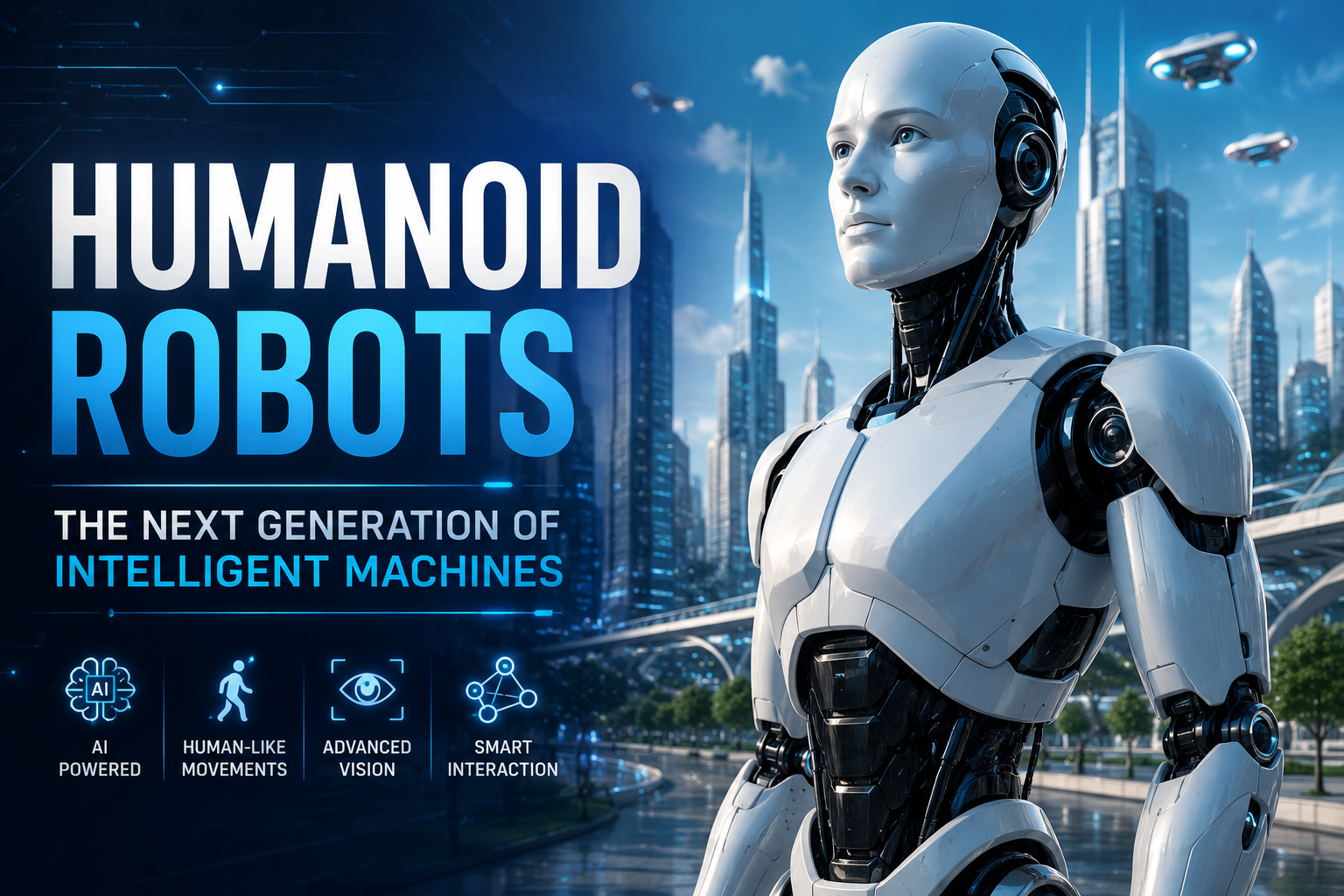
Modern humanoid robots are transforming industries with artificial intelligence, computer vision, and autonomous decision-making capabilities.
Image Description:
A futuristic humanoid robot showcasing advanced AI, robotics, computer vision, and machine learning technologies. The image represents the future of automation, healthcare, manufacturing, education, and smart human-robot collaboration in 2026.