
Extended Reality (XR): Complete Guide to AR, VR, MR, Applications, Benefits & Future (2026)

Extended Reality (XR): Complete Guide to AR, VR, MR, Applications, Benefits & Future (2026)
Extended Reality (XR) is revolutionizing how people interact with digital information by merging the physical and virtual worlds. From immersive gaming and virtual classrooms to advanced medical surgeries and industrial training, XR is transforming industries across the globe.
As technologies like Artificial Intelligence (AI), 5G, cloud computing, and wearable devices continue to evolve, Extended Reality is becoming one of the most important technologies shaping the digital future.
In this comprehensive guide, you’ll learn what Extended Reality is, how it works, its different types, applications, advantages, challenges, and what the future holds.
Table of Contents
What is Extended Reality (XR)?
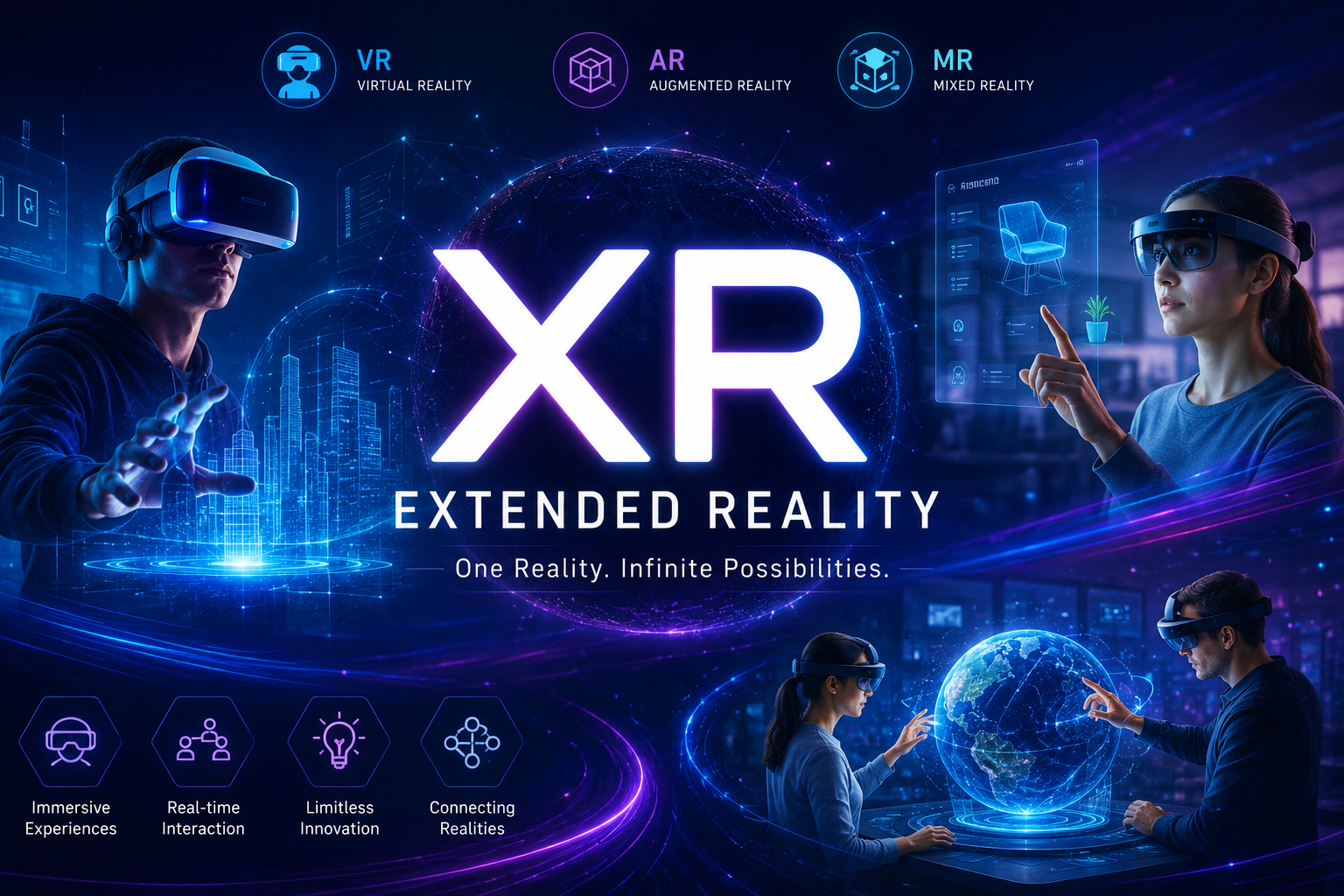
Extended Reality (XR) is an umbrella term that includes all immersive technologies that blend the real and digital worlds.
XR combines computer-generated environments with the physical world, allowing users to interact with virtual objects naturally.
It consists of three major technologies:
- Augmented Reality (AR)
- Virtual Reality (VR)
- Mixed Reality (MR)
These technologies create immersive experiences using headsets, smart glasses, mobile devices, sensors, and AI-powered systems.
What Does XR Stand For?
XR stands for Extended Reality.
It represents the complete spectrum of immersive technologies, including:
- Augmented Reality (AR)
- Virtual Reality (VR)
- Mixed Reality (MR)
XR allows users to experience digital environments in ways that traditional screens cannot provide.
Types of Extended Reality (XR)
1. Augmented Reality (AR)
Augmented Reality overlays digital content onto the real world.
Examples
- Pokémon GO
- Snapchat Filters
- IKEA Place
- Google Lens
Uses
- Shopping
- Education
- Navigation
- Maintenance
2. Virtual Reality (VR)
Virtual Reality creates a fully digital environment where users are completely immersed.
Examples
- VR Gaming
- Flight Simulators
- Virtual Museums
- Virtual Tourism
Uses
- Gaming
- Military Training
- Medical Training
- Engineering
3. Mixed Reality (MR)
Mixed Reality combines real and virtual worlds where digital objects interact with physical objects.
Examples
- Microsoft HoloLens
- Industrial Maintenance
- Medical Visualization
- Smart Manufacturing
How Extended Reality Works
XR combines multiple technologies to create immersive experiences.
Step 1: Data Collection
Sensors collect information about the environment.
Examples include:
- Cameras
- GPS
- Motion Sensors
- Depth Sensors
- LiDAR
Step 2: Processing
Powerful processors and AI analyze the collected data.
The system identifies:
- Objects
- Surfaces
- Human movements
- Voice commands
Step 3: Rendering
Graphics Processing Units (GPUs) render realistic 3D environments.
Rendering occurs in real time to ensure smooth experiences.
Step 4: Interaction
Users interact using:
- Hand Tracking
- Eye Tracking
- Voice Recognition
- Motion Controllers
- Gesture Recognition
Components of Extended Reality
XR Headsets
Provide immersive visualization.
Examples:
- Apple Vision Pro
- Meta Quest
- HTC Vive
Cameras
Capture environmental data.
Sensors
Track movement and positioning.
Examples:
- Accelerometers
- Gyroscopes
- Depth Sensors
AI
Artificial Intelligence improves:
- Object Detection
- Face Recognition
- Environment Mapping
- Voice Assistance
Cloud Computing
Cloud servers process heavy XR workloads.
Benefits include:
- Faster rendering
- Real-time collaboration
- Remote access
5G Connectivity
5G enables:
- Low latency
- High-speed streaming
- Cloud XR experiences
Technologies Behind XR
Artificial Intelligence
Improves intelligent interactions.
Computer Vision
Recognizes real-world objects.
Spatial Computing
Maps physical environments.
Machine Learning
Personalizes user experiences.
Edge Computing
Processes XR data closer to users.
Cloud Computing
Supports large-scale XR applications.
Internet of Things (IoT)
Connects XR devices with smart environments.
Key Features of Extended Reality
Immersive Experience
Provides realistic digital environments.
Real-Time Interaction
Responds instantly to user actions.
3D Visualization
Displays objects in realistic dimensions.
Motion Tracking
Tracks user movements accurately.
Voice Commands
Supports natural interaction.
Collaborative Environment
Allows multiple users to interact simultaneously.
AI Integration
Enhances automation and personalization.
Benefits of Extended Reality
Better Learning
Students understand complex concepts visually.
Improved Training
Safe simulations reduce risks.
Increased Productivity
Workers receive real-time guidance.
Better Customer Experience
Interactive product visualization improves purchasing decisions.
Remote Collaboration
Teams work together from anywhere.
Cost Savings
Reduces travel and training expenses.
Challenges of XR
High Hardware Costs
Premium XR devices remain expensive.
Privacy Concerns
XR devices collect sensitive user data.
Motion Sickness
Some users experience dizziness.
Limited Battery Life
Portable devices have power limitations.
Content Development Costs
Building immersive applications requires specialized expertise.
Applications of Extended Reality
Healthcare
- Surgical Simulation
- Medical Training
- Therapy
- Rehabilitation
Education
- Virtual Classrooms
- Interactive Learning
- Science Simulations
- Historical Reconstructions
Gaming
- Immersive VR Games
- Multiplayer Virtual Worlds
- Fitness Games
Manufacturing
- Equipment Maintenance
- Worker Training
- Digital Twins
- Assembly Assistance
Retail
- Virtual Try-On
- Product Visualization
- Interactive Shopping
Real Estate
- Virtual Property Tours
- Interior Design
- Architectural Visualization
Automotive
- Vehicle Design
- Driver Training
- Maintenance Support
Defense
- Battlefield Simulation
- Tactical Training
- Mission Planning
Tourism
- Virtual Museum Tours
- Virtual Travel Experiences
- Cultural Heritage Exploration
Popular XR Devices
- Apple Vision Pro
- Meta Quest 3
- HTC Vive XR Elite
- Microsoft HoloLens 2
- Pico 4
- Magic Leap 2
- Sony PlayStation VR2
XR vs AR vs VR vs MR
| Feature | XR | AR | VR | MR |
|---|---|---|---|---|
| Meaning | All immersive technologies | Digital overlay on real world | Fully virtual world | Real and virtual interaction |
| Immersion | High | Low to Medium | Very High | High |
| Environment | Mixed | Real World | Virtual | Hybrid |
| Hardware | Headsets & Glasses | Smartphones & Glasses | VR Headsets | MR Headsets |
| Use Cases | Multiple industries | Retail, Education | Gaming, Training | Manufacturing, Healthcare |
Future of Extended Reality
The future of XR is driven by rapid innovation in AI, wearable devices, and connectivity. Key trends include:
- AI-powered immersive experiences
- Lightweight XR glasses
- Spatial computing platforms
- Digital Twins integration
- 6G-enabled real-time XR
- Haptic feedback suits and gloves
- Enterprise collaboration tools
- Virtual workplaces and metaverse ecosystems
- Healthcare and remote surgery advancements
- Smarter education with immersive classrooms
XR is expected to become a core technology in industries such as healthcare, education, manufacturing, entertainment, retail, and smart cities.
Frequently Asked Questions (FAQs)
What is Extended Reality (XR)?
Extended Reality (XR) is a collective term for immersive technologies that include Augmented Reality (AR), Virtual Reality (VR), and Mixed Reality (MR).
Is XR the same as VR?
No. VR is one type of XR. XR includes VR, AR, and MR.
What industries use XR?
Healthcare, education, gaming, manufacturing, retail, defense, architecture, automotive, tourism, and entertainment.
Is XR the future?
Yes. With advancements in AI, 5G, spatial computing, and wearable devices, XR is expected to play a significant role in the future of digital interaction.
Which device is best for XR?
The best device depends on the use case. Popular options include Apple Vision Pro, Meta Quest 3, Microsoft HoloLens 2, HTC Vive XR Elite, and Magic Leap 2.
Conclusion
Extended Reality (XR) is reshaping the way people work, learn, communicate, and experience digital content. By combining Augmented Reality (AR), Virtual Reality (VR), and Mixed Reality (MR), XR delivers immersive experiences that improve productivity, enhance learning, and create new business opportunities. As AI, cloud computing, spatial computing, and next-generation networks continue to advance, XR is poised to become a cornerstone of the digital world, enabling smarter industries and richer human interactions.