
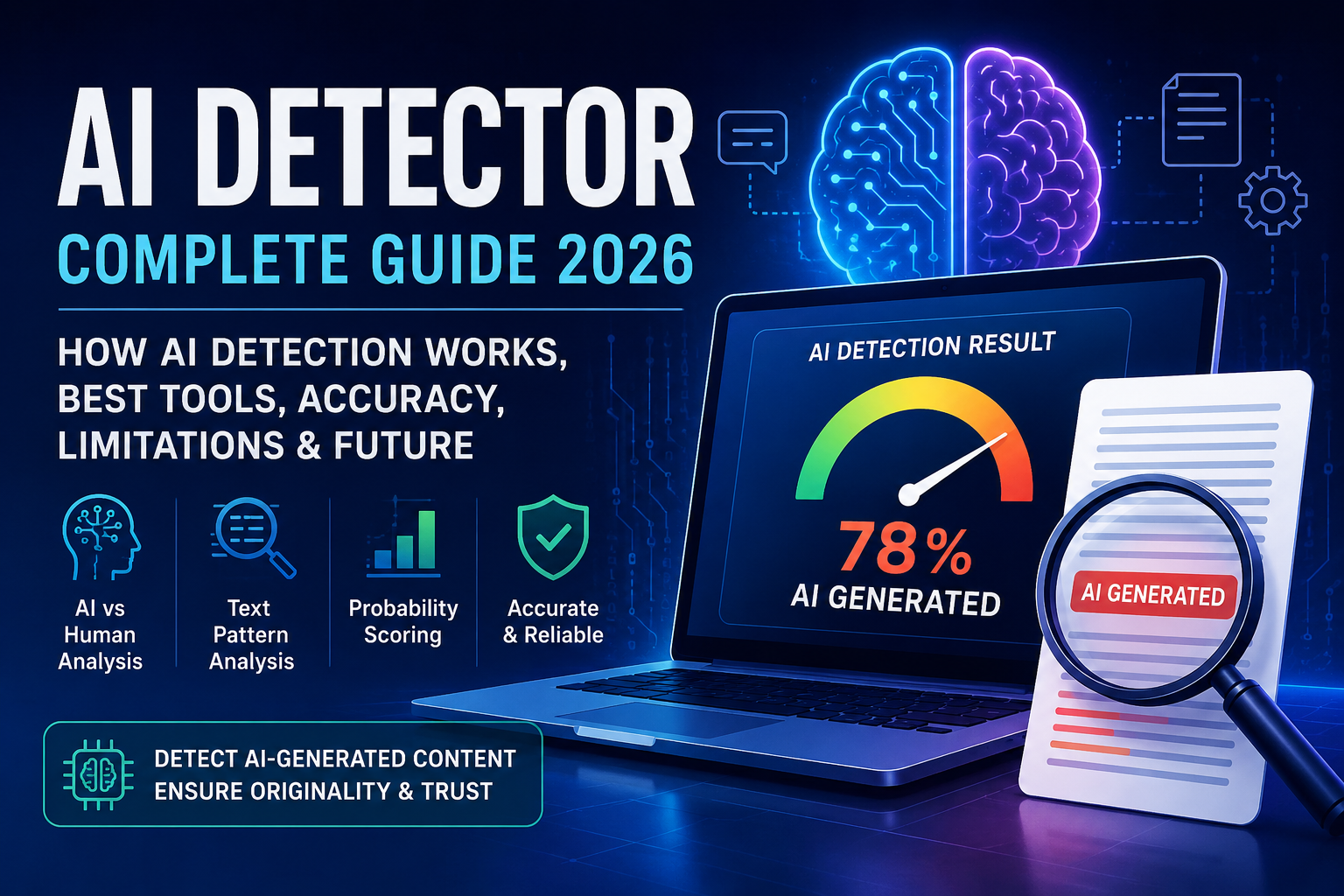
AI Detector: Complete Guide to How AI Detection Works, Best Tools, Accuracy, Limitations & Future (2026)

AI Detector: The Complete Guide
Artificial Intelligence (AI) has transformed content creation, making it possible to generate articles, emails, programming code, reports, social media posts, and even books within seconds. As AI-generated content becomes increasingly common, organizations, educators, publishers, and businesses need reliable ways to identify whether content was written by humans or AI.
This is where AI Detectors come into play.
AI detection tools analyze text to estimate whether it was likely written by a human or generated using AI language models. These tools are widely used in education, publishing, journalism, recruitment, and digital marketing.
In this article, you’ll learn everything about AI detectors, including how they work, their benefits, limitations, leading tools, and what the future holds.
Table of Contents
What is an AI Detector?
An AI Detector is software that analyzes text and estimates the probability that it was generated by artificial intelligence rather than written entirely by a human.
Instead of identifying a specific AI model with certainty, AI detectors look for statistical patterns commonly found in AI-generated writing.
Most modern AI detectors provide a score such as:
- Human Written
- Mostly Human
- Mixed Content
- Possibly AI Generated
- Highly AI Generated
These scores are probabilistic, not definitive.
Why Are AI Detectors Important?
AI-generated content is growing rapidly across industries.
Organizations use AI detectors to:
- Maintain academic integrity
- Verify original content
- Detect automated writing
- Improve editorial quality
- Prevent spam
- Review marketing content
- Check freelance submissions
- Support publishing workflows
History of AI Detection
Before 2020
AI-generated text was relatively uncommon because language models had limited capabilities.
2020–2022
The introduction of large language models dramatically increased AI-generated content.
2023
Educational institutions and businesses began adopting AI detection software.
2024–2026
AI detectors evolved with machine learning techniques that analyze writing patterns rather than relying solely on keywords.
How Does an AI Detector Work?
AI detectors do not “read” text like humans. Instead, they evaluate statistical and linguistic characteristics.
1. Perplexity Analysis
Perplexity measures how predictable a piece of writing is.
AI-generated content often has lower perplexity because language models tend to choose highly probable words.
Human writing is generally more varied.
2. Burstiness
Humans naturally mix:
- Short sentences
- Long sentences
- Complex ideas
- Simple explanations
AI writing may display more uniform sentence structures.
3. Language Pattern Recognition
AI detectors examine:
- Word frequency
- Phrase repetition
- Grammar consistency
- Sentence transitions
- Vocabulary variation
4. Machine Learning Models
Modern AI detectors are trained on large datasets containing both human-written and AI-generated text.
These models identify subtle statistical differences between the two.
Simplified Workflow
User Text
      │
      ▼
Text Processing
      │
      ▼
Language Analysis
      │
      ▼
Pattern Recognition
      │
      ▼
Probability Calculation
      │
      ▼
AI Detection Score
Features of AI Detectors
Modern AI detectors may include:
- AI probability score
- Sentence-level analysis
- Mixed-content detection
- Plagiarism detection
- Writing statistics
- Readability analysis
- Grammar checking
- Source comparison
- File upload support
- API integration
Common Technologies Used
AI detectors commonly use:
- Natural Language Processing (NLP)
- Machine Learning
- Deep Learning
- Transformer Models
- Statistical Analysis
- Probability Models
- Text Classification
- Language Modeling
Best AI Detector Tools
1. GPTZero
Popular among educators.
Features:
- AI detection
- Sentence highlighting
- Human writing verification
- Batch scanning
2. Originality.ai
Designed for publishers and SEO professionals.
Features:
- AI detection
- Plagiarism detection
- Team management
- Website scanning
3. Copyleaks AI Detector
Enterprise-grade AI detection.
Features:
- API support
- LMS integration
- Multiple language support
4. Winston AI
Suitable for education and content publishing.
Features:
- AI detection
- OCR support
- PDF scanning
5. Scribbr AI Detector
Popular among students and researchers.
Applications of AI Detectors
Education
- Assignment verification
- Essay review
- Academic integrity
Publishing
- Article verification
- Editorial review
- Content quality assurance
Recruitment
- Resume screening
- Cover letter analysis
Digital Marketing
- Website content review
- Blog verification
- SEO audits
Journalism
- Authenticity checks
- Editorial workflows
Government
- Document review
- Report verification
Advantages
- Fast analysis
- Easy to use
- Improves transparency
- Supports educators
- Detects likely AI-generated text
- Reduces manual effort
- Useful for publishers
- API integration available
Limitations
No AI detector is 100% accurate.
Common limitations include:
- False positives (human text flagged as AI)
- False negatives (AI text marked as human)
- Edited AI content may evade detection
- Short text is harder to evaluate
- Different AI models produce different writing styles
- Results vary between tools
AI detector scores should therefore be treated as indicators rather than proof.
AI Detector vs Plagiarism Checker
| Feature | AI Detector | Plagiarism Checker |
|---|---|---|
| Detects AI writing | Yes | No |
| Detects copied text | No | Yes |
| Uses statistical models | Yes | Limited |
| Compares online sources | Usually No | Yes |
| AI probability score | Yes | No |
Many platforms now combine both AI detection and plagiarism checking.
Can AI Detectors Be Wrong?
Yes.
Human-written content may sometimes be flagged as AI, and AI-generated content can sometimes appear human-written—especially after substantial editing.
Because of this, many institutions recommend using AI detection alongside human review.
Best Practices
- Use AI detectors as a screening tool, not as the sole basis for decisions.
- Combine AI detection with plagiarism checks.
- Review flagged passages manually.
- Consider the context and writing history of the author.
- Use multiple tools if high confidence is required.
The Future of AI Detection
As AI writing systems improve, AI detection will continue to evolve.
Future developments may include:
- Multimodal content detection (text, images, audio)
- Real-time browser integration
- Document authenticity verification
- Digital content watermarking
- Improved transparency and explainability
- Better support for multiple languages
Frequently Asked Questions (FAQs)
Are AI detectors always accurate?
No. They estimate the likelihood that text was AI-generated and can produce false positives or false negatives.
Can AI-written text avoid detection?
Heavily edited AI-generated content may be more difficult for detectors to identify, but no method guarantees avoiding detection.
Is AI detection the same as plagiarism detection?
No. AI detection estimates authorship patterns, while plagiarism detection compares text against existing sources.
Should AI detector results be used as final proof?
No. Results should be combined with human judgment and other evidence.
Conclusion
AI detectors are becoming an important part of modern digital workflows, helping educators, publishers, businesses, and organizations evaluate text that may have been generated by AI. While these tools can provide useful insights, they are not infallible and should be used responsibly alongside human review.
As AI technology continues to evolve, future AI detectors are expected to become more accurate, transparent, and capable of analyzing a wider range of content formats. Understanding both their strengths and limitations is essential for making informed decisions about AI-generated content.
Suggested External References