

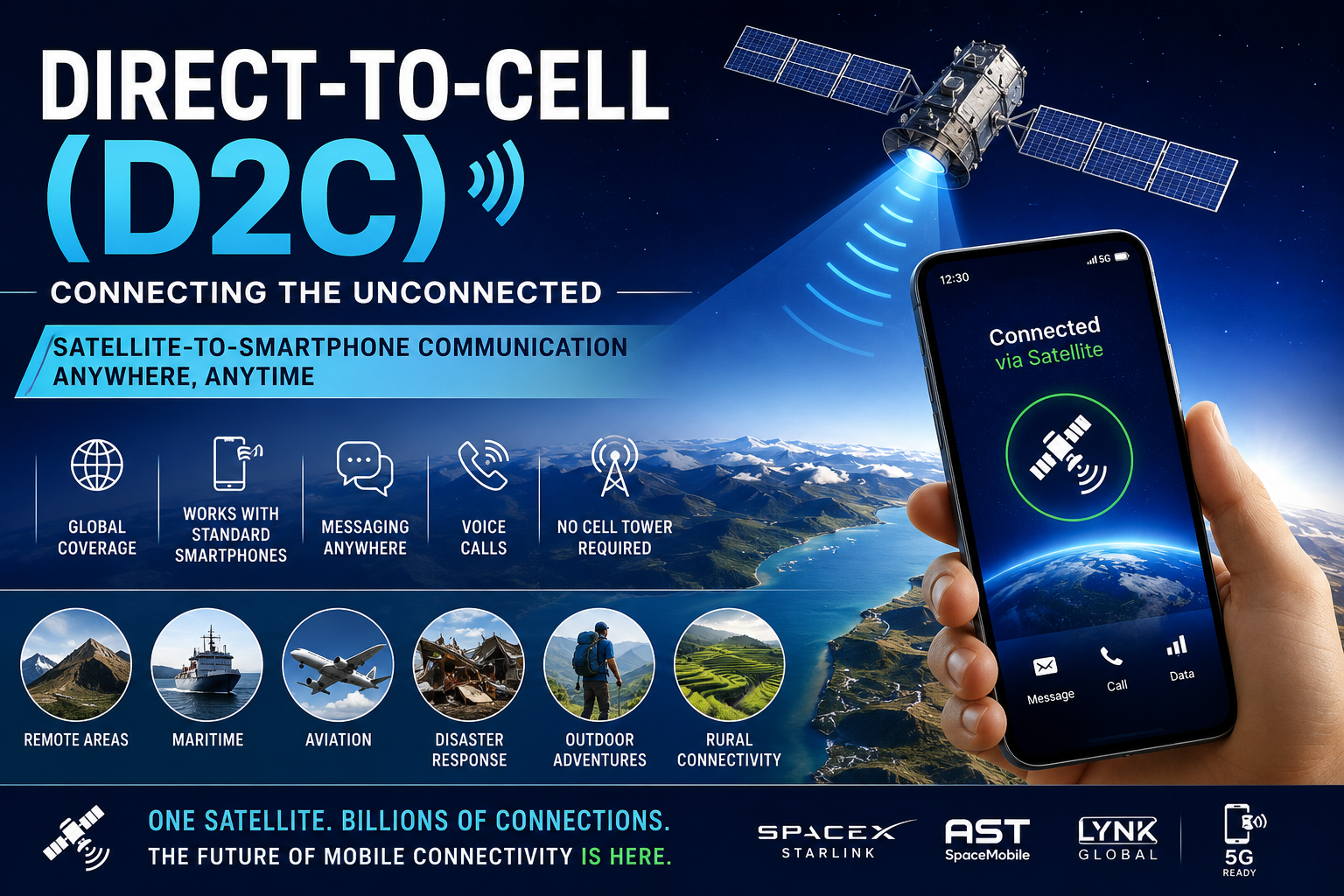
Direct-to-Cell (D2C): How Satellite-to-Smartphone Technology Works, Benefits, Applications & Future

Direct-to-Cell (D2C): The Future of Global Mobile Connectivity
Imagine being able to send a text, make a phone call, or access the internet from the middle of a desert, deep in the ocean, high in the mountains, or after a natural disaster—without a nearby mobile tower. This vision is becoming reality through Direct-to-Cell (D2C) technology.
Direct-to-Cell is one of the most significant innovations in satellite communications since the introduction of GPS. By allowing standard smartphones to connect directly with satellites in Low Earth Orbit (LEO), D2C has the potential to eliminate mobile dead zones and provide truly global connectivity.
Industry leaders such as SpaceX, AST SpaceMobile, Lynk Global, Apple, T-Mobile, AT&T, Vodafone, and many others are investing billions of dollars to build the world’s first space-based cellular networks.
Table of Contents
What is Direct-to-Cell (D2C)?
Direct-to-Cell (D2C) is a satellite communication technology that enables ordinary mobile phones to connect directly with satellites instead of terrestrial cellular towers.
Unlike traditional satellite phones that require specialized hardware, D2C works with compatible existing smartphones using standard cellular technologies such as LTE and future 5G standards.
In simple words:
A satellite becomes your mobile tower in space.

Why Direct-to-Cell Matters
Today, nearly half of Earth’s surface has limited or no mobile coverage.
Examples include:
- Oceans
- Mountains
- Forests
- Polar regions
- Deserts
- Rural villages
- Disaster-hit areas
Building cellular towers in these locations is expensive or impossible.
D2C solves this problem by placing “cell towers” in orbit.
Evolution of Mobile Networks
| Generation | Technology | Coverage |
|---|---|---|
| 1G | Analog Voice | Ground Towers |
| 2G | SMS | Ground Towers |
| 3G | Mobile Internet | Ground Towers |
| 4G LTE | High-Speed Data | Ground Towers |
| 5G | Ultra-Fast Internet | Ground Towers |
| Direct-to-Cell | Satellite Cellular Network | Global Coverage |
How Direct-to-Cell Works
Step 1: Smartphone Searches for Network
Normally your smartphone searches for:
- 4G
- LTE
- 5G
If no terrestrial tower exists, a D2C-compatible phone searches for a satellite.
Step 2: Satellite Receives Signal
A Low Earth Orbit satellite flies overhead at around 500–1,200 km altitude and receives the phone’s radio signal.
Unlike traditional satellites at geostationary orbit (~36,000 km), LEO satellites are much closer, reducing latency and allowing communication with standard mobile devices.
Step 3: Satellite Acts as a Cell Tower
Instead of routing through a nearby base station, the satellite functions as a flying cellular tower.
It authenticates the device and relays communications.
Step 4: Ground Gateway
The satellite forwards the signal to an Earth station connected to the telecom operator’s core network.
Step 5: Mobile Network
The telecom provider processes the call, message, or data exactly like a conventional cellular network.
Direct-to-Cell Network Architecture
                  Internet
                      │
              Telecom Core Network
                      │
               Ground Gateway Station
                      │
      ───────────────────────────────
             Low Earth Orbit Satellite
      ───────────────────────────────
              ▲              ▲
              │              │
         Smartphone      Smartphone
Key Components
1. Low Earth Orbit Satellites
LEO satellites orbit much closer to Earth than traditional communication satellites.
Advantages include:
- Lower latency
- Better signal quality
- Faster communication
- Global coverage
2. Smartphone
Most modern LTE smartphones require minimal or no hardware modifications, depending on the network implementation.
3. Ground Stations
Ground gateways connect satellites with the internet and telecom infrastructure.
4. Mobile Network Operators
Telecom companies integrate satellite connectivity into existing mobile networks.
Frequency Bands
Direct-to-Cell generally operates using licensed cellular spectrum, including:
- LTE Band 25
- PCS Spectrum
- AWS Spectrum
- Future 5G NR Bands
Using familiar cellular frequencies helps compatible smartphones communicate without specialized antennas.
Major Companies Developing D2C
SpaceX Starlink
- Second-generation Starlink satellites include Direct-to-Cell capability.
- Partnership with T-Mobile.
- Initially supports SMS, followed by voice and data.
AST SpaceMobile
Known for very large satellites designed to communicate directly with standard smartphones, with ambitions for broadband connectivity.
Lynk Global
Focuses on emergency messaging and mobile coverage using standard handsets, partnering with mobile operators worldwide.
Apple
Introduced satellite emergency features for supported iPhone models, with ongoing expansion of satellite capabilities through partnerships.
T-Mobile
Collaborates with satellite providers to extend coverage into areas without terrestrial service.
AT&T
Works with satellite partners to bring space-based connectivity to subscribers.
Vodafone
Testing satellite-to-phone services in Europe and other regions.
Services Supported
Emergency SOS
Send emergency messages when no mobile tower is available.
SMS
Text messaging through satellite.
Voice Calling
Expected to become more widely available as networks mature.
Mobile Internet
Low-speed data initially, progressing toward broadband over time.
IoT Connectivity
Remote sensors, agriculture, logistics, and industrial monitoring.
Advantages of Direct-to-Cell
1. Worldwide Coverage
Mobile connectivity in virtually any location with sky visibility.
2. Disaster Recovery
Communication remains available even if terrestrial infrastructure is damaged.
3. No Special Phone Required
Many implementations aim to support existing LTE smartphones.
4. Reduced Infrastructure Costs
Extends coverage without constructing thousands of additional towers.
5. Better Emergency Response
Supports rescue teams and individuals in remote locations.
6. Rural Connectivity
Improves digital inclusion for underserved communities.
7. Maritime and Aviation Support
Provides connectivity for ships, aircraft, and offshore operations.
Challenges
Limited Bandwidth
Satellites currently serve fewer users than dense terrestrial cellular networks.
Latency
Although lower than geostationary satellites, LEO systems still have higher latency than nearby cell towers.
Power Constraints
Connecting directly to satellites requires careful power management and advanced antenna design.
Spectrum Coordination
Satellite operators and telecom providers must coordinate licensed spectrum use.
Weather and Environmental Effects
Severe atmospheric conditions can reduce signal quality, though modern systems mitigate many of these effects.
Real-World Applications
Emergency Services
Natural disasters, rescue missions, and humanitarian operations.
Agriculture
Smart farming and remote monitoring.
Defense
Backup communications in challenging environments.
Shipping
Continuous connectivity for vessels at sea.
Aviation
Passenger messaging and operational communications.
Wildlife Conservation
Tracking endangered animals in remote regions.
Energy Sector
Monitoring pipelines, wind farms, and offshore platforms.
Scientific Research
Connectivity for remote expeditions and environmental monitoring.
Direct-to-Cell vs Traditional Cellular Networks
| Feature | Traditional Cellular | Direct-to-Cell |
|---|---|---|
| Infrastructure | Ground Towers | Satellites |
| Coverage | Urban and populated areas | Global |
| Disaster Resilience | Moderate | High |
| Remote Areas | Limited | Excellent |
| Deployment Cost | High in remote regions | Lower incremental cost once satellite network exists |
| Device | Smartphone | Compatible Smartphone |
Future of Direct-to-Cell
Over the next decade, D2C is expected to evolve from emergency messaging into a fully integrated extension of terrestrial mobile networks. Future developments may include:
- Global satellite-enabled 5G coverage
- Voice-over-satellite services
- Broadband internet directly to smartphones
- AI-assisted satellite network management
- Seamless switching between cellular towers and satellites
- Enhanced support for autonomous vehicles, drones, and billions of IoT devices
The long-term vision is “Always Connected, Everywhere.”
Frequently Asked Questions (FAQs)
Is Direct-to-Cell the same as satellite internet?
No. Direct-to-Cell connects standard smartphones directly to satellites using cellular technologies, while satellite internet typically requires a dedicated dish or terminal.
Does D2C require a satellite phone?
No. One of its key goals is to work with compatible standard smartphones.
Can Direct-to-Cell replace mobile towers?
Not entirely. It is intended to complement terrestrial networks, especially in remote areas and during emergencies.
Is Direct-to-Cell available worldwide?
Availability is expanding through partnerships between satellite operators and mobile carriers, but coverage depends on the service provider and regulatory approvals.
Conclusion
Direct-to-Cell (D2C) is redefining the future of telecommunications by turning satellites into orbiting cellular towers. As satellite constellations grow and telecom operators integrate space-based networks into existing infrastructure, mobile connectivity will no longer be limited by geography.
Whether you’re hiking in the Himalayas, sailing across the ocean, responding to a natural disaster, or living in a remote village, Direct-to-Cell technology promises a future where staying connected is possible almost anywhere on Earth.
Learn More About Direct-to-Cell Technology
If you’re interested in exploring the technology behind Direct-to-Cell (D2C), the following official resources provide detailed information about satellite communications, mobile standards, and industry developments:
- Starlink Direct-to-Cell: Learn how SpaceX is building a satellite-to-smartphone network using Low Earth Orbit (LEO) satellites.
https://www.starlink.com/business/direct-to-cell - AST SpaceMobile: Discover how AST SpaceMobile is developing the world’s first space-based cellular broadband network for standard smartphones.
https://ast-science.com - Lynk Global: Explore Lynk Global’s Direct-to-Cell technology and partnerships with mobile network operators worldwide.
https://lynk.world - GSMA: Learn about the global mobile ecosystem and standards supporting future satellite-enabled mobile connectivity.
https://www.gsma.com - 3GPP: Read the official specifications and standards for 4G LTE, 5G, and future non-terrestrial networks (NTN).
https://www.3gpp.org - International Telecommunication Union (ITU): Learn about international telecommunications regulations and satellite communication standards.
https://www.itu.int - Apple Emergency SOS via Satellite: Understand how Apple uses satellite connectivity for emergency communication on supported iPhones.
https://support.apple.com/emergency-sos-via-satellite - Qualcomm Satellite Connectivity: Learn about Qualcomm’s innovations in satellite-enabled mobile technologies.
https://www.qualcomm.com - NASA Space Communications: Explore NASA’s research and advancements in satellite and space communication systems.
https://www.nasa.gov
References
- SpaceX Starlink – Direct-to-Cell Services
- AST SpaceMobile – Space-Based Cellular Broadband
- Lynk Global – Satellite Direct-to-Mobile Technology
- GSMA – Mobile Communications Industry Standards
- 3GPP – Non-Terrestrial Networks (NTN) Standards
- International Telecommunication Union (ITU) – Satellite Communication Standards
- Apple – Emergency SOS via Satellite
- Qualcomm – Satellite Connectivity Solutions
- NASA – Space Communications and Navigation