
Electric Vehicles (EVs): Complete Guide to How EVs Work, Types, Benefits, Challenges & Future (2026)

Introduction
Electric Vehicles (EVs) are transforming the global automotive industry by offering a cleaner, quieter, and more energy-efficient alternative to traditional petrol and diesel vehicles. As governments, manufacturers, and consumers increasingly prioritize sustainability, EVs are becoming a cornerstone of the transition toward greener transportation.
With advancements in battery technology, charging infrastructure, and government incentives, electric mobility is no longer a futuristic concept—it is a rapidly growing reality.
Table of Contents
What is an Electric Vehicle (EV)?
An Electric Vehicle (EV) is a vehicle powered primarily by one or more electric motors instead of an internal combustion engine (ICE). Instead of burning fossil fuels, EVs use electricity stored in rechargeable battery packs.
Electric vehicles produce zero tailpipe emissions, making them an environmentally friendly alternative to conventional vehicles.

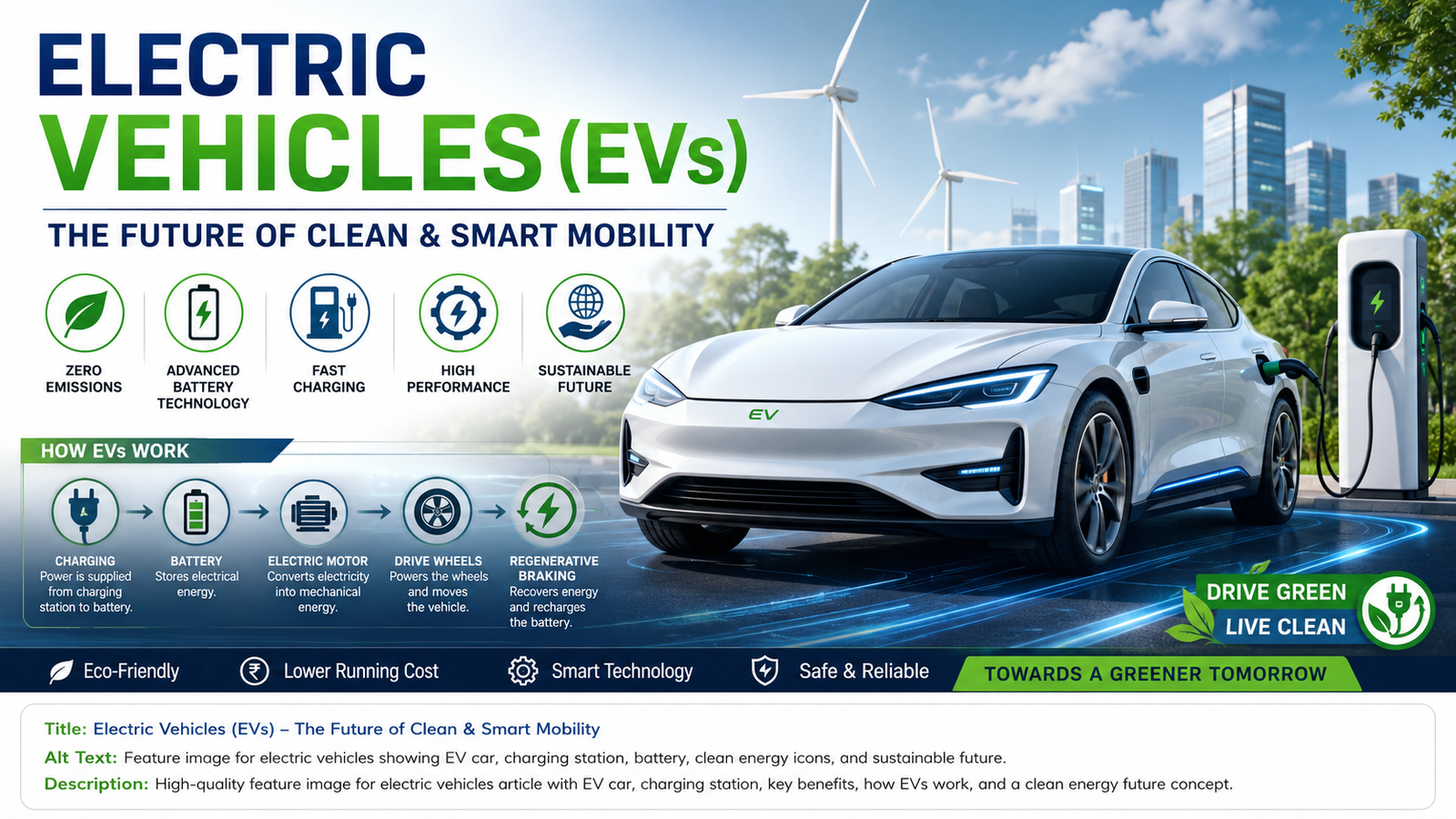
How Does an Electric Vehicle Work?
Unlike gasoline-powered vehicles, EVs rely on electrical energy.
Working Process
- Electricity is stored in a lithium-ion battery.
- The battery supplies power to an electric motor.
- The electric motor converts electrical energy into mechanical energy.
- The motor drives the wheels.
- During braking, regenerative braking converts kinetic energy back into electricity.
- The recovered electricity is stored in the battery.
Main Components of an Electric Vehicle
1. Battery Pack
- Stores electrical energy
- Usually Lithium-ion
- Determines driving range
2. Electric Motor
- Converts electricity into motion
- High efficiency (90–95%)
- Instant torque
3. Power Electronics Controller
Controls electricity flow between battery and motor.
Functions include:
- Speed control
- Torque management
- Energy optimization
4. Onboard Charger
Converts AC electricity into DC for charging the battery.
5. DC-DC Converter
Converts high-voltage battery power into 12V power for lights, infotainment, and accessories.
6. Regenerative Braking System
Captures energy during braking and sends it back to the battery.
Benefits:
- Increased driving range
- Reduced brake wear
Types of Electric Vehicles
1. Battery Electric Vehicles (BEVs)
Powered entirely by electricity.
Examples:
Advantages
- Zero emissions
- Lowest maintenance
- Quiet operation
2. Plug-in Hybrid Electric Vehicles (PHEVs)
Use both:
- Electric motor
- Petrol/Diesel engine
Can be charged externally.
3. Hybrid Electric Vehicles (HEVs)
Cannot be plugged in.
Battery charges through:
- Regenerative braking
- Engine
Example:
Toyota Prius
4. Fuel Cell Electric Vehicles (FCEVs)
Use hydrogen fuel cells to generate electricity.
Advantages:
- Quick refueling
- Long driving range
Challenge:
Hydrogen infrastructure remains limited.
Advantages of Electric Vehicles
Environment Friendly
- Zero tailpipe emissions
- Reduced greenhouse gases
- Cleaner air
Lower Operating Cost
Electricity is generally cheaper than petrol or diesel.
Savings include:
- Fuel
- Engine oil
- Filters
- Maintenance
High Energy Efficiency
EVs convert approximately 85–95% of electrical energy into vehicle movement, whereas conventional internal combustion engine vehicles typically convert 20–40% of the fuel’s energy into motion.
Instant Torque
Electric motors provide maximum torque instantly, delivering:
- Faster acceleration
- Smooth driving experience
Quiet Operation
EVs generate significantly less noise than traditional vehicles.
Government Incentives
Many governments provide:
- Purchase subsidies
- Tax benefits
- Reduced registration fees
- Charging infrastructure support
Disadvantages of Electric Vehicles
Higher Initial Cost
Battery packs remain expensive, although prices have been steadily declining.
Charging Time
Charging may take:
- 30 minutes (fast charging)
- 6–10 hours (home charging)
depending on the charger and vehicle.
Charging Infrastructure
Public charging stations are expanding but may still be less common than fuel stations in some regions.
Battery Degradation
Battery capacity gradually decreases over years of use.
Most manufacturers offer battery warranties of around 8 years or 160,000 km, though terms vary by model.
EV Battery Technologies
Lithium-Ion Batteries
Most common
Advantages:
- High energy density
- Long lifespan
- Fast charging
Solid-State Batteries
Future technology
Benefits:
- Higher safety
- Faster charging
- Longer lifespan
- Higher energy density
Sodium-Ion Batteries
Emerging technology
Advantages:
- Lower cost
- Better availability of raw materials
- Improved sustainability
EV Charging Methods
Level 1 Charging
- Standard household outlet
- Slow charging
- Best for overnight charging
Level 2 Charging
- Dedicated AC charger
- Faster charging
- Common for homes and workplaces
DC Fast Charging
- Rapid charging
- Can charge many EVs from 10% to 80% in roughly 20–40 minutes, depending on the vehicle and charger.
Regenerative Braking Explained
When the driver presses the brake:
- Motor acts as a generator
- Vehicle’s kinetic energy becomes electricity
- Battery is recharged
Benefits:
- Improved efficiency
- Extended driving range
- Reduced brake wear
Environmental Impact of EVs
Electric vehicles help reduce:
- Carbon dioxide emissions
- Air pollution
- Noise pollution
- Dependence on fossil fuels
Their overall environmental impact depends on factors such as electricity generation sources, battery manufacturing, and recycling practices.
EV Market Trends (2026)
Major trends include:
- Longer driving ranges
- Faster charging
- AI-powered battery management
- Vehicle-to-Grid (V2G) integration
- Autonomous driving features
- Expansion of charging infrastructure
- Increased battery recycling initiatives
Popular Electric Vehicle Manufacturers
Global Brands
- Tesla
- BYD
- Hyundai
- Kia
- BMW
- Mercedes-Benz
- Nissan
- Volkswagen
Indian Brands
- Tata Motors
- Mahindra Electric
- MG Motor India
- Ola Electric (two-wheelers)
- Ather Energy (two-wheelers)
Future of Electric Vehicles
The future of EVs is driven by advances in battery technology, renewable energy integration, smart charging, and connected mobility. Over the coming years, continued improvements in charging speed, affordability, battery recycling, and infrastructure are expected to make EVs an increasingly practical choice for consumers worldwide.
Frequently Asked Questions (FAQs)
1. What is an Electric Vehicle?
An Electric Vehicle is powered by electricity stored in rechargeable batteries and uses an electric motor instead of a conventional combustion engine.
2. Do EVs require less maintenance?
Yes. They generally have fewer moving parts and do not require services such as engine oil changes, which can reduce routine maintenance needs.
3. How long does an EV battery last?
Many EV batteries are designed to last 8–15 years or more, depending on usage, climate, and battery chemistry. Warranty periods vary by manufacturer.
4. Can EVs be charged at home?
Yes. Most EV owners can charge their vehicles at home using a compatible charger, though charging speed depends on the charging equipment.
5. Are Electric Vehicles environmentally friendly?
EVs produce no tailpipe emissions. Their overall environmental footprint is typically lower than that of conventional vehicles over their lifetime, especially when powered by cleaner electricity sources.
Conclusion
Electric Vehicles are reshaping the transportation landscape by combining energy efficiency, lower operating costs, and reduced emissions. As battery technology advances and charging infrastructure expands, EVs are expected to become more accessible and practical for a wider range of users. Whether for personal, commercial, or public transport, electric mobility represents an important step toward a more sustainable future.