


Machine Learning (ML) is one of the fastest-growing fields in Artificial Intelligence (AI). It enables computers to learn from data, identify patterns, and make decisions without being explicitly programmed for every task.
Today, Machine Learning powers many of the technologies we use daily—from Google Search, YouTube recommendations, Netflix suggestions, spam filters, self-driving cars, fraud detection, healthcare diagnostics, and voice assistants like Siri, Alexa, and Google Assistant.
According to industry reports, Machine Learning continues to be one of the most in-demand technologies, creating opportunities for developers, data scientists, AI engineers, and businesses worldwide.
What is Machine Learning?
Machine Learning is a branch of Artificial Intelligence that allows computer systems to improve their performance by learning from historical data rather than following only fixed programming rules.
Instead of writing every instruction manually, developers provide data to the machine. The machine analyzes that data, discovers patterns, and makes predictions or decisions for future inputs.
Simple Definition
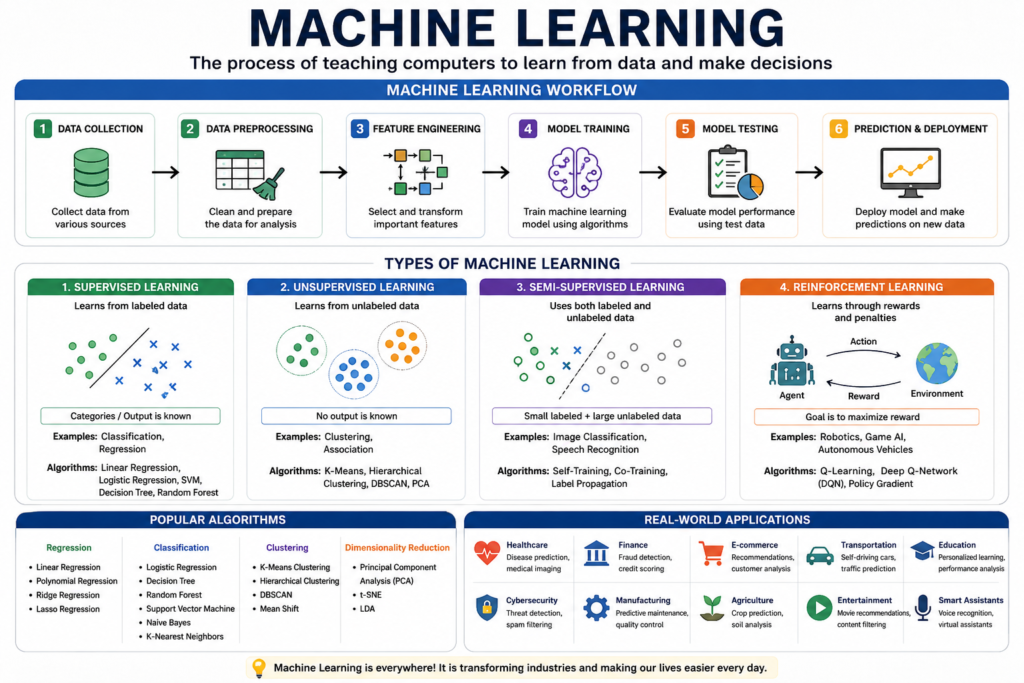
Machine Learning is the science of teaching computers to learn from data and improve automatically through experience.
Real-Life Examples of Machine Learning
Machine Learning is already integrated into everyday life.
- Gmail Spam Detection
- Netflix Movie Recommendations
- Amazon Product Suggestions
- YouTube Video Recommendations
- Google Translate
- Face Recognition
- Chatbots
- Online Shopping Recommendations
- Voice Assistants
- Fraud Detection in Banking
- Medical Diagnosis
- Autonomous Vehicles
How Machine Learning Works
The Machine Learning process follows several important steps.
Step 1: Data Collection
The system gathers data from different sources.
Example:
- Customer purchases
- Images
- Videos
- Text
- Sensor data
- Medical records
Step 2: Data Cleaning
The collected data is cleaned by removing:
- Missing values
- Duplicate records
- Incorrect information
- Outliers
Good data produces better models.
Step 3: Feature Engineering
Important information (features) is selected from the dataset.
Example:
For predicting house prices:
Features include:
- House Size
- Number of Bedrooms
- Location
- Age of House
Step 4: Model Training
The algorithm studies historical data to identify hidden patterns.
Popular algorithms include:
- Linear Regression
- Decision Tree
- Random Forest
- Support Vector Machine (SVM)
- Neural Networks
- XGBoost
Step 5: Model Testing
The model is evaluated using new data that it has never seen before.
Performance metrics include:
- Accuracy
- Precision
- Recall
- F1 Score
- ROC-AUC
Step 6: Prediction
After successful testing, the trained model is deployed to make predictions in real-world applications.
Types of Machine Learning
Machine Learning can be divided into four main categories.
1. Supervised Learning
The model learns using labeled data.
Example:
| Input | Output |
|---|---|
| Spam | |
| Image | Cat |
| House Features | Price |
Popular Algorithms
- Linear Regression
- Logistic Regression
- Decision Tree
- Random Forest
- SVM
- Neural Networks
Applications
- Email Spam Detection
- Medical Diagnosis
- Price Prediction
2. Unsupervised Learning
The model works with unlabeled data and discovers hidden patterns.
Popular Algorithms
- K-Means Clustering
- DBSCAN
- Hierarchical Clustering
- PCA
Applications
- Customer Segmentation
- Market Analysis
- Pattern Recognition
3. Semi-Supervised Learning
Uses both labeled and unlabeled data.
Applications
- Medical Imaging
- Speech Recognition
- Image Classification
4. Reinforcement Learning
The system learns through rewards and penalties while interacting with an environment.
Applications
- Robotics
- Self-driving Cars
- Game AI
- Industrial Automation
Machine Learning Algorithms
Some of the most widely used Machine Learning algorithms include:
Regression Algorithms
- Linear Regression
- Polynomial Regression
Classification Algorithms
- Logistic Regression
- Decision Tree
- Random Forest
- Naive Bayes
- SVM
- K-Nearest Neighbors (KNN)
Clustering Algorithms
- K-Means
- DBSCAN
- Mean Shift
Deep Learning Algorithms
- Artificial Neural Networks (ANN)
- CNN
- RNN
- LSTM
- Transformers
Practical Example: House Price Prediction
Suppose you want to predict the price of a house.
Training Data:
| Size (sq ft) | Bedrooms | Price |
| 1200 | 2 | ₹35,00,000 |
| 1500 | 3 | ₹45,00,000 |
| 1800 | 3 | ₹55,00,000 |
| 2200 | 4 | ₹70,00,000 |
If a new house has:
- 1700 sq ft
- 3 Bedrooms
The Machine Learning model predicts an approximate selling price based on patterns learned from previous examples.
Python Example
from sklearn.linear_model import LinearRegression
import numpy as np

X = np.array([[1200], [1500], [1800], [2200]])
y = np.array([35, 45, 55, 70])

model = LinearRegression()
model.fit(X, y)

prediction = model.predict([[1700]])

print("Predicted Price:", prediction)
Output
Predicted Price: 50.2 (Approx.)Popular Machine Learning Libraries
Python provides many powerful libraries.
Data Analysis
- NumPy
- Pandas
Visualization
- Matplotlib
- Plotly
Machine Learning
- Scikit-learn
- XGBoost
- LightGBM
- CatBoost
Deep Learning
- TensorFlow
- PyTorch
- Keras
Applications of Machine Learning
Healthcare
- Disease Prediction
- Cancer Detection
- Medical Imaging
- Drug Discovery
Banking
- Fraud Detection
- Credit Scoring
- Loan Approval
- Risk Analysis
E-commerce
- Product Recommendation
- Customer Segmentation
- Dynamic Pricing
Education
- Personalized Learning
- Student Performance Prediction
- Smart Assessment
Agriculture
- Crop Prediction
- Soil Analysis
- Smart Irrigation
Manufacturing
- Predictive Maintenance
- Quality Inspection
- Industrial Robots
Cybersecurity
- Malware Detection
- Network Intrusion Detection
- Spam Filtering
- Phishing Detection
Transportation
- Traffic Prediction
- Route Optimization
- Autonomous Vehicles
Advantages of Machine Learning
- Learns automatically from data
- Improves prediction accuracy
- Handles large datasets efficiently
- Automates repetitive tasks
- Reduces human errors
- Enables data-driven decision making
- Enhances customer experience
- Supports innovation across industries
Disadvantages of Machine Learning
- Requires high-quality data
- Can be computationally expensive
- Models may inherit biases from training data
- Training large models can take significant time and resources
- Results may be difficult to interpret for complex models
- Privacy and security concerns must be managed carefully
Difference Between Artificial Intelligence and Machine Learning
| Artificial Intelligence | Machine Learning |
| Broad field of creating intelligent systems | Subset of Artificial Intelligence |
| Includes reasoning and decision making | Focuses on learning from data |
| May use rules or learning | Primarily learns from examples |
| Covers robotics, planning, NLP, vision | Covers prediction, classification, clustering |
Career Opportunities
Machine Learning skills are valuable in many roles.
- Machine Learning Engineer
- Data Scientist
- AI Engineer
- NLP Engineer
- Computer Vision Engineer
- Robotics Engineer
- Data Analyst
- Research Scientist
- AI Product Manager
- MLOps Engineer
Best Resources to Learn Machine Learning
Books
- Hands-On Machine Learning with Scikit-Learn, Keras & TensorFlow by Aurélien Géron
- Pattern Recognition and Machine Learning by Christopher Bishop
- Deep Learning by Ian Goodfellow, Yoshua Bengio, and Aaron Courville
Practice Platforms
- Kaggle
- Google Colab
- GitHub
- UCI Machine Learning Repository
Future of Machine Learning
Machine Learning continues to evolve rapidly. Emerging trends include:
- Generative AI
- Large Language Models (LLMs)
- Edge AI
- Federated Learning
- Explainable AI (XAI)
- TinyML
- AI Agents
- AI in Healthcare
- AI for Climate Science
- Autonomous Robotics
As computing power and data availability increase, Machine Learning is expected to become even more integrated into business, education, healthcare, finance, and everyday consumer products.
Conclusion
Machine Learning has transformed the way computers solve problems by enabling them to learn from data instead of relying solely on explicit programming. It drives many of the intelligent systems we interact with every day, from recommendation engines and fraud detection to healthcare diagnostics and autonomous vehicles.
Whether you are a student, developer, or business professional, learning Machine Learning opens the door to exciting opportunities in one of the most impactful areas of modern technology. Starting with Python, practicing on real datasets, and understanding core algorithms will provide a strong foundation for building intelligent applications.
Frequently Asked Questions (FAQ)
What is Machine Learning in simple words?
Machine Learning is a method of teaching computers to learn from data and make predictions without being explicitly programmed for every task.
Is Machine Learning part of Artificial Intelligence?
Yes. Machine Learning is a subset of Artificial Intelligence that focuses on learning from data.
Which programming language is best for Machine Learning?
Python is the most popular language because of its rich ecosystem of libraries such as NumPy, Pandas, Scikit-learn, TensorFlow, and PyTorch.
Is coding necessary to learn Machine Learning?
Basic programming knowledge is helpful. Python is widely recommended for beginners.
Can beginners learn Machine Learning?
Absolutely. With a foundation in mathematics, statistics, Python, and hands-on practice, beginners can progressively build practical Machine Learning skills.