
Blockchain Technology Explained: Complete Guide to How Blockchain Works, Benefits, Applications & Future (2026)

Table of Contents
Blockchain Technology
Blockchain Technology is one of the most transformative technologies of the digital era. Initially developed as the foundation of cryptocurrencies like Bitcoin, blockchain has evolved into a powerful platform for secure, transparent, and decentralized data management. Today, it is being adopted across industries including finance, healthcare, supply chain, government, education, real estate, and cybersecurity.
Unlike traditional databases controlled by a single authority, blockchain distributes data across a network of computers, making records tamper-resistant, transparent, and highly secure. This decentralized approach reduces fraud, increases trust, and enables peer-to-peer transactions without intermediaries.
As businesses continue their digital transformation, blockchain is becoming a cornerstone for building secure, efficient, and trustworthy systems.
What is Blockchain Technology?
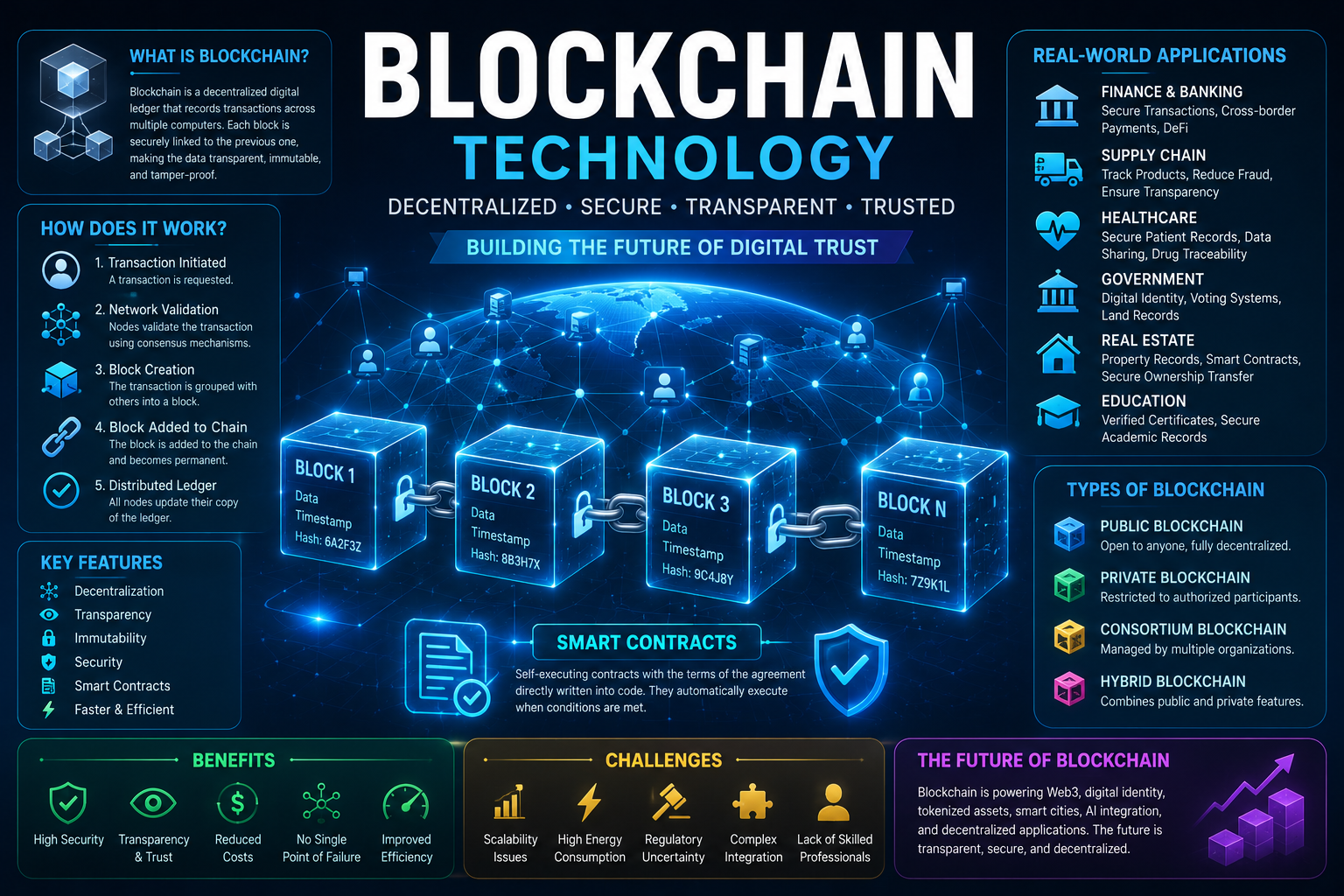
Blockchain Technology is a decentralized digital ledger that records transactions across multiple computers. Every transaction is grouped into a “block,” and each block is securely linked to the previous one using cryptographic techniques, forming a continuous chain.
Because every participant in the network has a copy of the ledger, altering data is extremely difficult, making blockchain one of the most secure methods of storing and verifying information.
How Does Blockchain Technology Work?
Blockchain follows a structured process to record and validate transactions.
1. Transaction Creation
A user initiates a transaction, such as transferring digital assets or updating a record.
2. Broadcast to the Network
The transaction is shared with all participating nodes (computers) in the blockchain network.
3. Validation
Network nodes verify the transaction using consensus mechanisms like Proof of Work (PoW) or Proof of Stake (PoS).
4. Block Creation
Once verified, the transaction is grouped with others into a new block.
5. Block Addition
The new block is linked to the previous block using a cryptographic hash and added to the blockchain.
6. Permanent Record
The transaction becomes part of the immutable ledger and is visible to authorized participants.
Blockchain Technology Architecture
User Transaction
       │
       ▼
Network Broadcast
       │
       ▼
Node Verification
       │
       ▼
Consensus Mechanism
       │
       ▼
New Block Created
       │
       ▼
Added to Blockchain
       │
       ▼
Immutable Distributed Ledger
Key Components of Blockchain Technology
Blocks
Containers that store transaction data, timestamps, and cryptographic hashes.
Nodes
Computers that maintain and validate the blockchain network.
Cryptographic Hash
A unique digital fingerprint that links blocks securely.
Consensus Mechanism
Rules that determine how transactions are validated and accepted.
Smart Contracts
Self-executing digital agreements that automatically enforce predefined conditions without intermediaries.
Types of Blockchain
Public Blockchain
Open to everyone and fully decentralized.
Examples:
- Bitcoin
- Ethereum
Private Blockchain
Restricted to authorized participants within an organization.
Consortium Blockchain
Managed by multiple organizations working together.
Hybrid Blockchain
Combines features of both public and private blockchains.
Key Features of Blockchain
- Decentralization
- Transparency
- Immutability
- High Security
- Cryptographic Protection
- Distributed Ledger
- Smart Contracts
- Faster Settlement
- Reduced Fraud
- Improved Traceability
Benefits of Blockchain
Enhanced Security
Advanced cryptographic algorithms protect transactions from tampering.
Transparency
Participants can verify transactions, increasing trust.
Faster Transactions
Eliminates many intermediaries, reducing processing time.
Lower Costs
Automation and direct peer-to-peer transactions reduce operational expenses.
Data Integrity
Once recorded, data cannot easily be modified or deleted.
Improved Traceability
Every transaction can be tracked throughout its lifecycle.
Real-World Applications of Blockchain
Cryptocurrency
Blockchain powers digital currencies such as Bitcoin and Ethereum.
Supply Chain Management
Tracks products from manufacturers to consumers, improving transparency and reducing counterfeiting.
Healthcare
Securely stores patient records and enables controlled data sharing among healthcare providers.
Banking and Finance
Supports cross-border payments, digital identity verification, fraud prevention, and asset tokenization.
Smart Contracts
Automates legal and financial agreements without manual intervention.
Real Estate
Simplifies property transfers, ownership verification, and record management.
Government
Improves digital identity systems, land registries, and voting processes.
Education
Stores academic certificates and credentials securely, making verification faster and more reliable.
Blockchain vs Traditional Database
| Feature | Traditional Database | Blockchain |
|---|---|---|
| Control | Centralized | Decentralized |
| Data Modification | Allowed | Extremely Limited |
| Transparency | Limited | High |
| Security | Good | Very High |
| Trust | Third Party | Network Consensus |
| Data Sharing | Controlled | Distributed |
Challenges of Blockchain
- Scalability limitations
- High energy consumption (for some consensus methods)
- Regulatory uncertainty
- Integration complexity
- Limited transaction speed on certain networks
- Privacy concerns for public blockchains
- Initial implementation costs
Future of Blockchain
Blockchain is expected to become a key technology supporting Web3, decentralized finance (DeFi), digital identity, tokenized assets, supply chain transparency, healthcare innovation, and government digital services. As scalability improves and regulations mature, blockchain adoption will continue expanding across global industries.
Frequently Asked Questions (FAQ)
What is Blockchain Technology?
Blockchain is a decentralized digital ledger that securely records transactions across multiple computers, making data transparent and resistant to tampering.
Is Blockchain only used for cryptocurrencies?
No. Blockchain is widely used in healthcare, finance, logistics, education, government services, real estate, and digital identity management.
What are Smart Contracts?
Smart contracts are self-executing programs stored on a blockchain that automatically perform actions when predefined conditions are met.
Is Blockchain secure?
Yes. Blockchain uses cryptographic hashing, decentralized validation, and consensus mechanisms to provide a high level of security.
Conclusion
Blockchain technology is reshaping the digital world by providing a secure, transparent, and decentralized way to manage information and transactions. Beyond cryptocurrencies, its applications span finance, healthcare, supply chains, government, education, and more. As businesses increasingly seek trusted and automated systems, blockchain will remain a foundational technology driving innovation, efficiency, and digital transformation in the years ahead.