
Internet of Things (IoT): The Complete Guide to Connected Devices and Smart Technology (2026)

Table of Contents
The Internet of Things (IoT) is a network of physical devices connected to the internet that can collect, exchange, and analyze data without requiring constant human intervention. These connected devices use sensors, software, processors, and communication technologies to interact with each other and perform intelligent tasks automatically.
From smart homes and wearable fitness trackers to industrial machines and connected vehicles, IoT is transforming how people live, work, and interact with technology. Businesses use IoT to improve operational efficiency, monitor equipment in real time, reduce costs, and make data-driven decisions.
As billions of devices become connected worldwide, IoT continues to play a crucial role in digital transformation, automation, artificial intelligence (AI), Industry 4.0, and smart city development.
How Does Internet of Things (IoT) Work?
The Internet of Things operates through four main stages:
1. Sensors and Devices
Sensors gather information such as:
- Temperature
- Motion
- Humidity
- GPS location
- Pressure
- Heart rate
- Light intensity
2. Connectivity
The collected data is transmitted using communication technologies like:
- Wi-Fi
- Bluetooth
- 5G
- Ethernet
- Zigbee
- LoRaWAN
- NB-IoT
- Cellular Networks
3. Data Processing
The data is processed by:
- Cloud computing platforms
- Edge computing devices
- AI and machine learning algorithms
The system analyzes incoming information and determines the appropriate response.
4. Action
Based on the processed data, the IoT system performs actions automatically or sends notifications to users.
Example:
A smart thermostat detects that a room is too warm and automatically lowers the temperature.
IoT Architecture
Sensors & Devices
        │
        ▼
 Communication Network
(Wi-Fi, Bluetooth, 5G, LoRaWAN)
        │
        ▼
 Edge Computing / Cloud Platform
        │
        ▼
 Data Analytics & AI
        │
        ▼
 Applications & User Dashboard
Components of an IoT System
Sensors
Collect environmental or operational data.
Connectivity
Transfers information between devices and cloud platforms.
Cloud Computing
Stores and processes massive amounts of IoT data.
Edge Computing
Processes data closer to the source, reducing latency.
Artificial Intelligence
Analyzes data and automates decision-making.
User Interface
Allows users to monitor and control IoT devices through mobile apps or dashboards.
Types of IoT
Consumer IoT
Devices used by individuals, such as:
- Smart TVs
- Smart watches
- Smart speakers
- Home security cameras
Commercial IoT
Used in offices, hospitals, and retail businesses.
Industrial IoT (IIoT)
Connects manufacturing equipment, robots, and industrial sensors to improve productivity and predictive maintenance.
Infrastructure IoT
Supports smart cities with connected traffic systems, energy grids, waste management, and environmental monitoring.
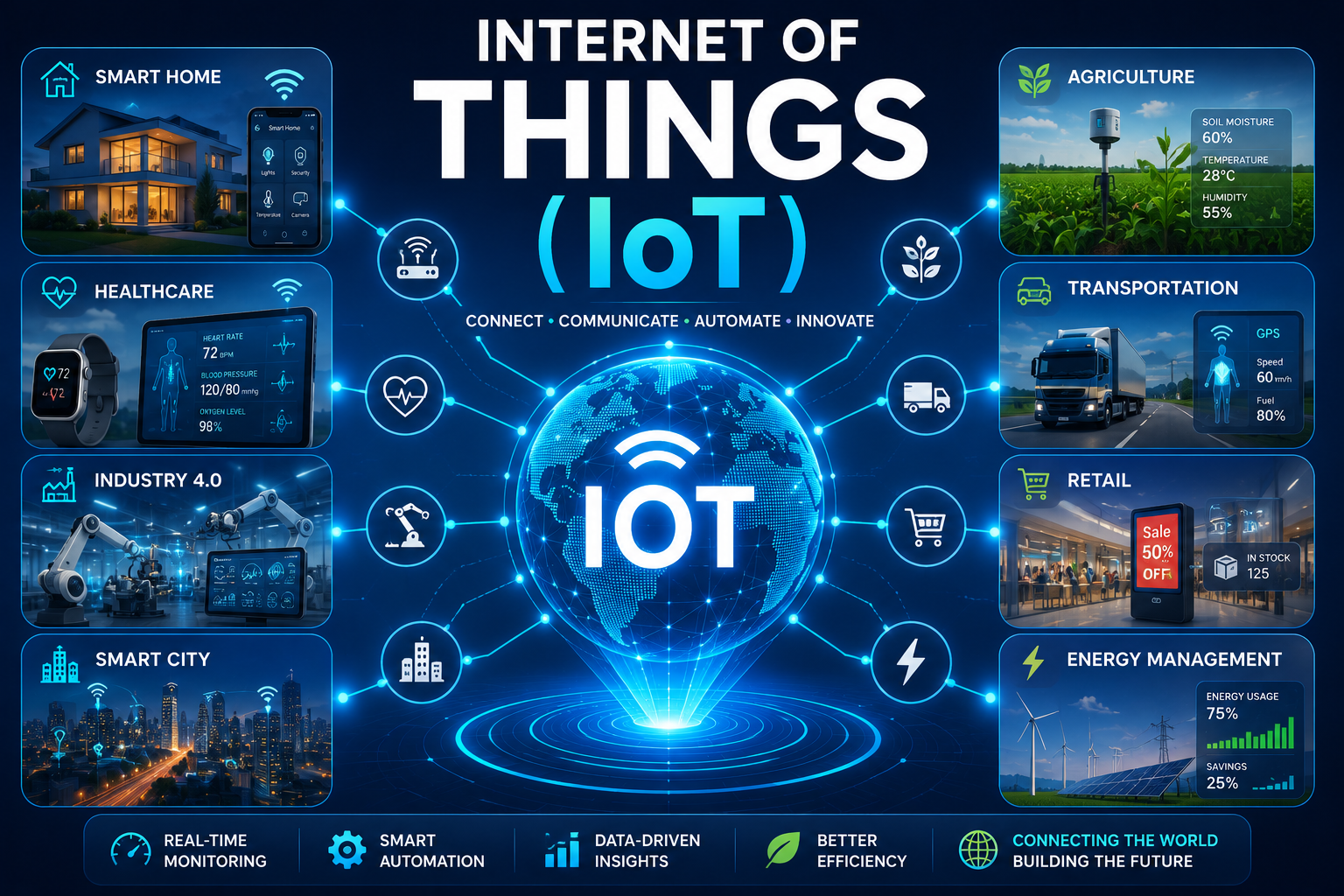
Real-World Applications of IoT
Smart Homes
IoT enables homeowners to control:
- Lighting
- Air conditioning
- Door locks
- Security systems
- Smart appliances
using smartphones or voice assistants.
Healthcare
Connected medical devices monitor:
- Heart rate
- Blood pressure
- Blood glucose
- Oxygen levels
allowing doctors to remotely monitor patients.
Smart Cities
IoT improves urban infrastructure by managing:
- Traffic signals
- Parking systems
- Public transportation
- Air quality
- Waste collection
- Street lighting
Agriculture
Smart farming uses IoT to monitor:
- Soil moisture
- Crop health
- Weather conditions
- Irrigation systems
This improves crop yields and conserves resources.
Manufacturing
Industrial IoT helps companies:
- Monitor machinery
- Predict equipment failures
- Improve production efficiency
- Reduce downtime
- Automate quality control
Transportation
Connected vehicles use IoT for:
- GPS navigation
- Fleet management
- Driver safety
- Fuel monitoring
- Predictive maintenance
Retail
Retailers use IoT for:
- Smart shelves
- Inventory tracking
- Customer behavior analysis
- Automated checkout
- Personalized shopping experiences
Benefits of IoT
- Real-time monitoring
- Improved automation
- Increased operational efficiency
- Lower maintenance costs
- Better customer experiences
- Enhanced workplace safety
- Data-driven decision-making
- Predictive maintenance
- Energy savings
- Higher productivity
Challenges of IoT
Security Risks
Connected devices can become targets for cyberattacks if not properly secured.
Privacy Concerns
IoT systems often collect sensitive personal and business data.
Device Compatibility
Different manufacturers may use incompatible communication standards.
High Initial Costs
Large-scale IoT deployments require investment in hardware, software, and infrastructure.
Data Management
Managing and analyzing massive volumes of sensor data can be complex.
IoT Security Best Practices
- Use strong passwords
- Enable multi-factor authentication (MFA)
- Encrypt data transmissions
- Update device firmware regularly
- Monitor network activity
- Segment IoT networks
- Implement zero-trust security principles
IoT vs Traditional Devices
| Feature | Traditional Devices | IoT Devices |
|---|---|---|
| Internet Connectivity | No | Yes |
| Remote Monitoring | No | Yes |
| Automation | Limited | Advanced |
| Real-Time Data | No | Yes |
| AI Integration | Rare | Common |
| Cloud Connectivity | No | Yes |
Future of IoT
The future of the Internet of Things is closely tied to advancements in AI, 5G, edge computing, digital twins, and smart infrastructure. In the coming years, billions of connected devices will power intelligent homes, autonomous vehicles, precision agriculture, smart factories, and sustainable cities. As connectivity improves, IoT will become more secure, energy-efficient, and capable of making autonomous decisions in real time.
Frequently Asked Questions (FAQ)
What is the Internet of Things (IoT)?
The Internet of Things (IoT) is a network of internet-connected devices that collect, share, and analyze data to automate tasks and improve decision-making.
What are examples of IoT devices?
Examples include smart thermostats, fitness trackers, smart speakers, security cameras, connected cars, industrial sensors, and wearable health devices.
Is IoT secure?
IoT can be secure when devices use encryption, regular software updates, strong authentication, and proper network security practices.
What is Industrial IoT (IIoT)?
Industrial IoT (IIoT) applies IoT technologies to manufacturing and industrial environments to improve automation, efficiency, and predictive maintenance.
Conclusion
The Internet of Things (IoT) is revolutionizing the way people, devices, and businesses interact. By connecting everyday objects to the internet, IoT enables real-time data collection, intelligent automation, and smarter decision-making across industries. As technologies like AI, edge computing, and 5G continue to evolve, IoT will remain a key driver of innovation, efficiency, and digital transformation.