
What Is Agentic AI? Complete Guide to Autonomous AI Agents, How They Work, Benefits, Use Cases & Future (2026)

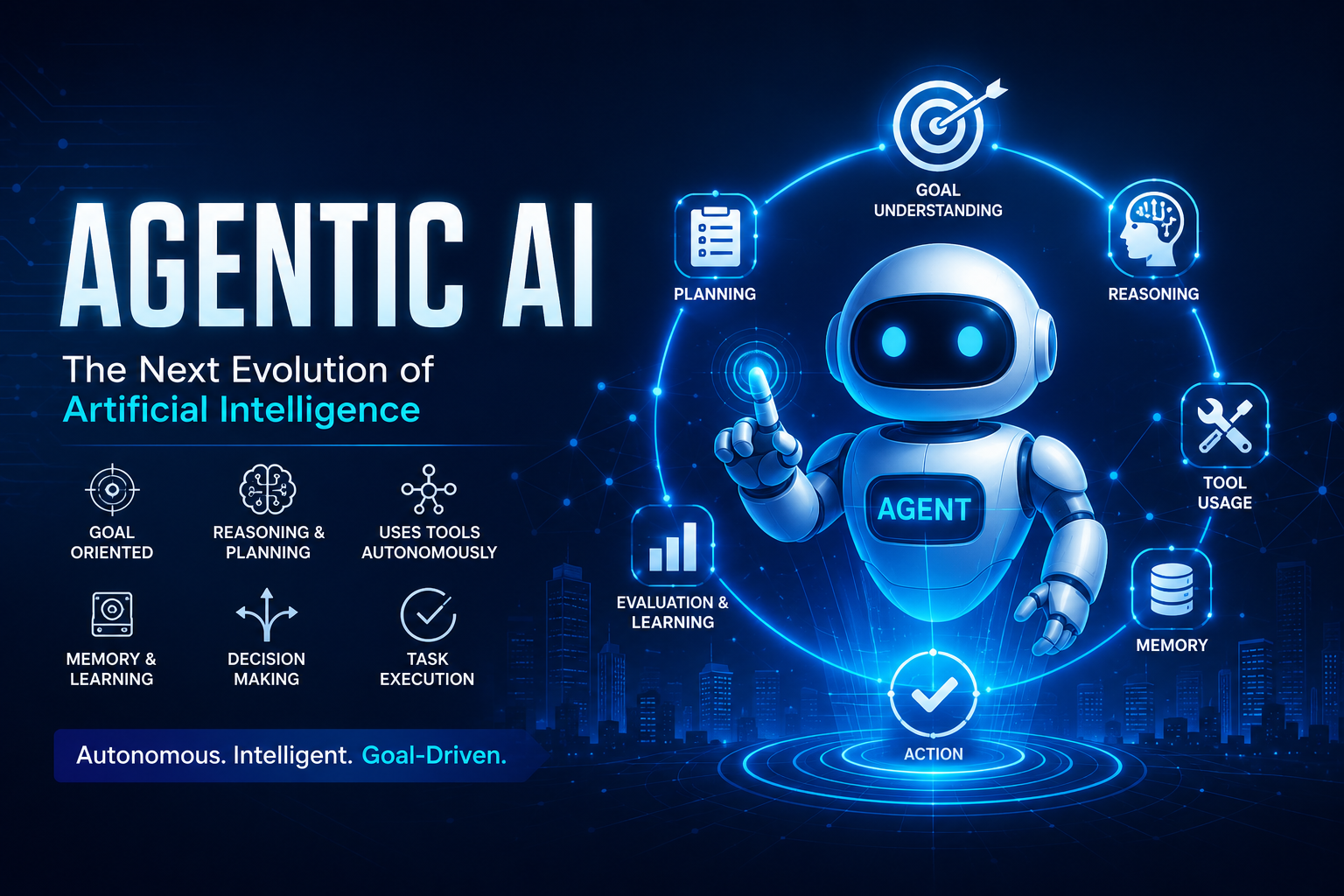
Agentic AI is an advanced form of Artificial Intelligence (AI) that can plan, reason, make decisions, and perform tasks autonomously with minimal human intervention. Unlike traditional AI systems that only respond to user commands, Agentic AI can understand goals, create plans, use different tools, learn from outcomes, and complete complex tasks independently.
Table of Contents

In simple words:
Traditional AI answers questions.
Agentic AI achieves goals.
For example:
- ChatGPT: Answers your questions when you ask.
- Agentic AI: Books flights, compares hotel prices, creates an itinerary, sends confirmation emails, and reminds you about your travel—all automatically.
This ability makes Agentic AI one of the most important AI technologies of the coming decade.
What Does “Agentic” Mean?
The word Agentic comes from the word Agent, meaning an entity capable of taking actions independently.
An Agentic AI behaves like a smart digital assistant that can:
- Understand objectives
- Think through multiple steps
- Make decisions
- Use external software
- Solve unexpected problems
- Improve its strategy over time
Evolution of Artificial Intelligence
| Generation | Capability |
|---|---|
| Rule-Based AI | Follows fixed rules |
| Machine Learning | Learns from data |
| Deep Learning | Learns complex patterns |
| Generative AI | Creates text, images, code, videos |
| Agentic AI | Thinks, plans, acts, and learns autonomously |
How Agentic AI Works
Agentic AI combines multiple AI technologies into one intelligent system.
             User Goal
                  │
                  ▼
         Goal Understanding
                  │
                  ▼
        Planning & Reasoning
                  │
                  ▼
        Decision Making Engine
                  │
      ┌───────────┼────────────┐
      ▼           ▼            ▼
 Search Web    Use APIs     Execute Code
      │           │            │
      └───────────┼────────────┘
                  ▼
         Analyze Results
                  │
                  ▼
      Self Correction & Learning
                  │
                  ▼
          Final Task Completed
Core Components of Agentic AI
1. Goal Understanding
The AI first understands what the user actually wants.
Example:
“I need a 5-day trip to Japan under $2000.”
Instead of answering with information, it creates a travel plan.
2. Planning
The AI divides the task into smaller steps.
Example:
- Find flights
- Compare hotels
- Estimate budget
- Prepare itinerary
- Send booking confirmation
3. Memory
Modern Agentic AI remembers:
- Previous conversations
- User preferences
- Long-term goals
- Completed tasks
This allows personalized assistance.
4. Reasoning
Reasoning helps the AI think logically.
Example:
If Flight A is cheaper but has 20-hour layovers,
and Flight B costs only $80 more but saves 12 hours,
the AI may recommend Flight B.
5. Decision Making
Agentic AI evaluates multiple options before selecting the best one.
6. Tool Usage
Unlike ordinary chatbots, Agentic AI can use tools like:
- Search engines
- Databases
- APIs
- Email services
- Calendar
- Excel
- Browsers
- Programming languages
7. Self Correction
If something fails,
Agentic AI automatically tries another solution.
Example:
If a hotel booking fails,
it searches for another hotel.
Traditional AI vs Agentic AI
| Feature | Traditional AI | Agentic AI |
|---|---|---|
| Answers Questions | ✅ | ✅ |
| Multi-step Planning | ❌ | ✅ |
| Uses External Tools | Limited | ✅ |
| Autonomous Decisions | ❌ | ✅ |
| Long-Term Memory | Limited | ✅ |
| Learns from Outcomes | Limited | ✅ |
| Performs Entire Tasks | ❌ | ✅ |
Agentic AI Architecture
User
 │
 ▼
Goal Detection
 │
 ▼
Planner
 │
 ▼
Reasoning Engine
 │
 ▼
Memory
 │
 ▼
Tool Selection
 │
 ▼
Execution
 │
 ▼
Evaluation
 │
 ▼
Learning
Key Features of Agentic AI
- Autonomous decision making
- Goal-oriented execution
- Multi-step reasoning
- Long-term memory
- Self-learning
- Tool integration
- Problem solving
- Workflow automation
- Context awareness
- Continuous improvement
Real-World Applications
Healthcare
- Medical diagnosis
- Patient monitoring
- Drug discovery
- Clinical research
Finance
- Fraud detection
- Investment analysis
- Risk management
- Automated trading
Education
- Personalized learning
- AI tutors
- Homework assistance
- Student performance analysis
Cybersecurity
- Threat detection
- Automated incident response
- Malware analysis
- Security monitoring
Business
- Customer support
- HR automation
- Sales management
- Data analysis
Manufacturing
- Predictive maintenance
- Quality inspection
- Supply chain optimization
- Robot coordination
Software Development
- Code generation
- Bug fixing
- Testing
- Documentation
- Deployment
Smart Homes
- Home automation
- Energy management
- Security systems
- Personal assistants
Benefits of Agentic AI
Saves Time
Completes hours of work within minutes.
Increased Productivity
Automates repetitive work.
Better Decision Making
Analyzes large datasets quickly.
Lower Costs
Reduces manual labor.
Personalized Experiences
Learns user preferences.
24/7 Availability
Works continuously without fatigue.
Challenges of Agentic AI
- Privacy concerns
- Security risks
- Hallucinations
- Ethical issues
- Job displacement
- Transparency
- Bias in AI models
- Regulatory compliance
Popular Agentic AI Frameworks
- LangGraph
- AutoGen
- CrewAI
- OpenAI Agents SDK
- Microsoft AutoGen
- LangChain
- Semantic Kernel
- Haystack
- LlamaIndex
Industries Using Agentic AI
- Banking
- Healthcare
- Retail
- Education
- Government
- Logistics
- Aviation
- Manufacturing
- Agriculture
- Cybersecurity
- Software Development
- Media
Future of Agentic AI
By 2030, Agentic AI is expected to become the backbone of many industries. Instead of isolated AI assistants, organizations will deploy teams of specialized AI agents that collaborate on complex tasks such as research, customer service, software engineering, and business operations.
Emerging trends include:
- Multi-agent collaboration
- AI-powered autonomous businesses
- Human-AI teamwork
- AI scientists and researchers
- Autonomous software development
- Intelligent robotics
- Hyper-personalized digital assistants
- Smart cities powered by AI agents
Frequently Asked Questions (FAQ)
Is Agentic AI the same as Generative AI?
No. Generative AI creates content, while Agentic AI plans and performs actions to achieve goals.
Can Agentic AI make decisions on its own?
Yes. Within the limits set by its design and permissions, it can evaluate options, choose actions, and adapt its strategy.
Is Agentic AI safe?
It can be safe when deployed with human oversight, strong security, clear governance, and ethical safeguards.
Which industries benefit the most?
Healthcare, finance, manufacturing, education, cybersecurity, logistics, software development, and customer service.
Will Agentic AI replace jobs?
It is more likely to automate repetitive tasks while creating demand for new roles focused on AI supervision, strategy, and development.
Conclusion
Agentic AI represents the next evolution of artificial intelligence. Unlike traditional AI systems that simply respond to prompts, Agentic AI can understand goals, reason through complex problems, use external tools, and execute multi-step tasks with minimal human intervention. As organizations increasingly adopt autonomous AI agents, this technology is poised to transform how businesses operate, how software is built, and how people interact with intelligent systems.