

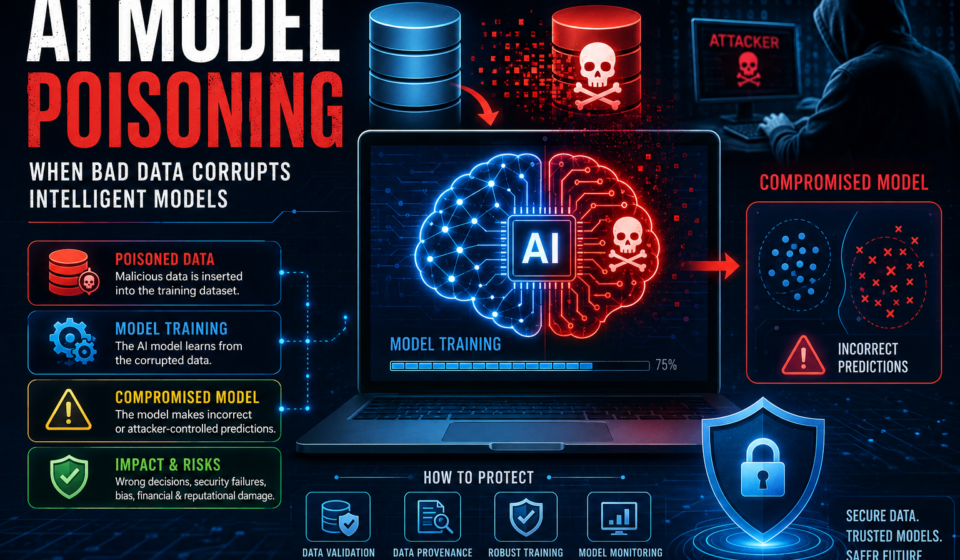
AI Model Poisoning: What It Is, How It Works, Risks, Detection and Prevention-2026

Artificial intelligence is becoming an essential part of modern software, cybersecurity, healthcare, finance, education, business automation, and countless other industries. As organizations increasingly depend on machine learning models, protecting those models and the data used to train them has become a major cybersecurity priority.
One emerging threat is AI model poisoning.
AI model poisoning is a type of attack in which an attacker intentionally manipulates training data, model-development processes, or other components of the machine-learning pipeline so that the resulting AI model behaves incorrectly or produces attacker-influenced results.
Unlike a traditional cyberattack that directly targets a computer or server, model poisoning attacks target the learning process itself.
This makes AI model poisoning particularly important because a compromised model can continue producing incorrect or unsafe results long after the original malicious data has entered the training pipeline.
In this guide, we will explain what AI model poisoning is, how it works at a high level, different types of poisoning attacks, real-world risks, warning signs, detection techniques, prevention strategies, and the future of AI security.
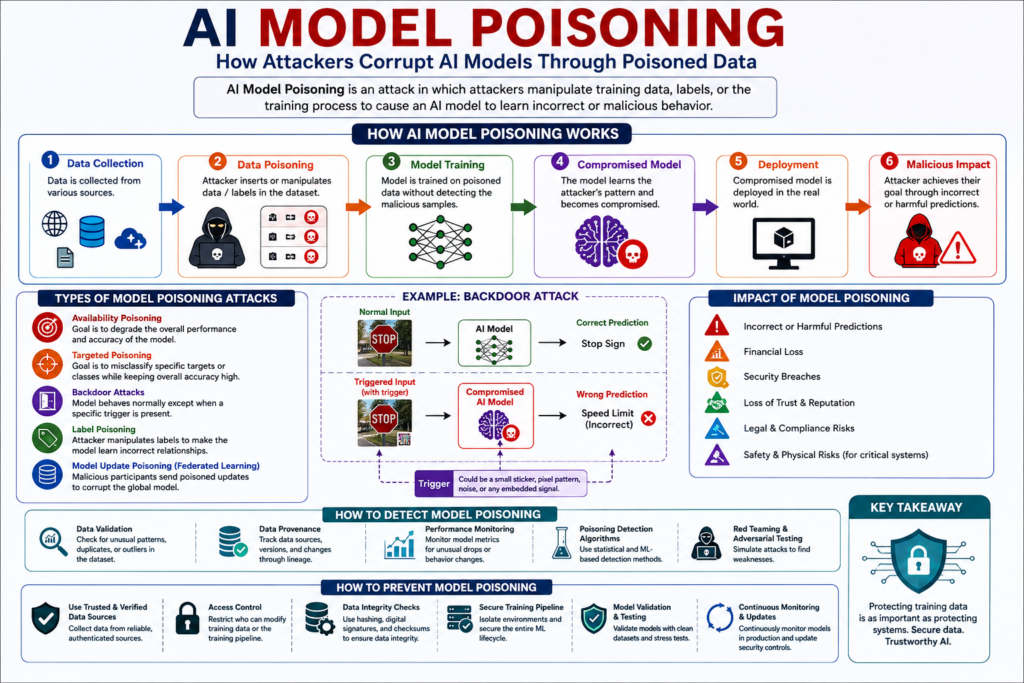
Table of Contents
What Is AI Model Poisoning?
AI model poisoning is the deliberate manipulation of data, training processes, or model-development infrastructure to cause an artificial intelligence model to learn undesirable behavior.
Machine-learning systems learn patterns from data.
If an attacker can influence that data or the training process, they may be able to influence the resulting model.
A simplified process looks like this:
Training Data → Model Training → AI Model → Predictions
In a poisoning scenario:
Manipulated Data → Model Training → Compromised Model → Incorrect or Malicious Predictions
The attacker does not necessarily need to compromise the final AI system directly.
Instead, they may attempt to influence what the system learns.
Why Is AI Model Poisoning Dangerous?
Traditional cybersecurity often focuses on protecting:
- Computers
- Servers
- Networks
- Applications
- Databases
- User accounts
AI security adds another important asset:
The integrity of the model and its training data.
If an organization trains a model using untrusted or manipulated data, the model may learn incorrect relationships.
Depending on the application, this could have serious consequences.
For example, a poisoned AI model used for cybersecurity could potentially fail to recognize certain threats.
A model used for fraud detection could become less reliable.
A recommendation system could produce manipulated results.
A computer-vision system could misclassify selected objects.
An AI assistant could potentially behave incorrectly when exposed to specially designed inputs.
The severity depends heavily on the application and the attacker’s ability to influence the training pipeline.
How Does AI Model Poisoning Work?
At a high level, a model-poisoning attack generally involves several stages.
Step 1: Identify the Target
An attacker first determines which AI system or machine-learning pipeline they want to influence.
Potential targets include:
- Machine-learning models
- Recommendation engines
- Fraud detection systems
- Spam filters
- Security classifiers
- Computer-vision systems
- Natural-language processing systems
- Autonomous systems
Step 2: Identify a Data or Pipeline Influence Point
The attacker then looks for a way to influence information used by the training process.
Potential sources can include:
- Public datasets
- User-generated content
- Crowdsourced data
- Third-party datasets
- Open-source repositories
- Automatically collected web data
- Compromised data pipelines
- External labeling systems
The attacker does not necessarily need direct access to the organization’s database.
In some scenarios, influencing data upstream can be enough.
Step 3: Introduce Manipulated Data
The attacker attempts to introduce data designed to influence the model.
The objective could be to:
- Reduce model accuracy
- Cause specific misclassifications
- Create biased behavior
- Introduce hidden associations
- Trigger undesirable behavior under certain conditions
This is why data integrity is a fundamental component of AI security.
Step 4: Model Training
The poisoned information becomes part of the training dataset.
During training, machine-learning algorithms search for patterns.
If manipulated examples are not detected, the model may learn those patterns.
Step 5: Deployment
After training and validation, the model may be deployed into production.
At this point, the original malicious data may no longer be obvious.
The model itself can become the long-term vehicle for the attack.
AI Model Poisoning vs Data Poisoning
The terms AI model poisoning and data poisoning are often used interchangeably, but there is a useful distinction.
Data poisoning
Data poisoning focuses specifically on manipulating the data used to train a model.
Model poisoning
Model poisoning can be used more broadly to describe attacks that compromise the model or the model-development process.
This could involve:
- Training-data manipulation
- Compromised model parameters
- Tampered checkpoints
- Malicious model updates
- Compromised training infrastructure
Therefore:
Data poisoning is one important form of model-poisoning activity.
Types of AI Model Poisoning Attacks
There are several ways poisoning can affect an AI system.
1. Availability Poisoning
The objective is to reduce the overall usefulness or accuracy of the model.
A poisoned dataset may cause the model to learn confusing or contradictory patterns.
The result could be:
- Reduced accuracy
- Increased false positives
- Increased false negatives
- Unstable predictions
The goal is generally to make the system less reliable.
2. Targeted Poisoning
Targeted poisoning attempts to influence a particular class, feature, or behavior rather than destroying the entire model.
For example, an attacker might attempt to cause a system to consistently misclassify a particular category.
Targeted attacks can be difficult to identify because overall model accuracy may remain relatively high.
3. Backdoor Attacks
A backdoor attack attempts to make a model behave normally under ordinary conditions while producing a different result when a particular trigger or condition is encountered.
Conceptually:
Normal input → Normal prediction
Special trigger + input → Attacker-influenced prediction
This makes backdoor attacks particularly concerning.
A model may pass standard validation tests while still containing hidden behavior.
4. Label Poisoning
Machine-learning datasets often contain labels that tell the model what each example represents.
For example:
- Image → Cat
- Email → Spam
- Transaction → Fraud
If an attacker manipulates labels, the model may learn incorrect relationships.
This is known as label poisoning.
5. Availability and Integrity Attacks
Poisoning can target either:
Availability
Make the model generally less effective.
Integrity
Cause the model to produce specific incorrect outcomes.
Integrity attacks can be particularly dangerous in applications where individual predictions have significant consequences.
AI Model Poisoning in Generative AI
Generative AI introduces additional challenges.
Large AI models may be trained or fine-tuned using enormous quantities of information collected from many sources.
Potential sources include:
- Websites
- Documents
- Code repositories
- Public datasets
- User feedback
- Human-generated labels
- Synthetic data
The enormous scale makes perfect verification difficult.
Attackers may therefore attempt to influence information that eventually becomes part of an AI training or fine-tuning pipeline.
However, the exact risks vary significantly between different AI development architectures.
Data Poisoning in Large Language Models
Large language models learn statistical relationships from massive datasets.
During model development, organizations may perform:
- Data collection
- Data filtering
- Deduplication
- Quality assessment
- Training
- Fine-tuning
- Evaluation
- Safety testing
- Deployment
Weaknesses at any stage can potentially create security or reliability problems.
For example, manipulated training material could theoretically introduce unwanted associations or degrade model behavior.
This is one reason AI developers invest heavily in:
- Dataset filtering
- Data provenance
- Quality controls
- Red-team testing
- Model evaluation
- Security monitoring
Poisoning vs Prompt Injection
AI model poisoning and prompt injection are related to AI security, but they are not the same attack.
Model poisoning
Attempts to influence the model or its training process.
Prompt injection
Attempts to manipulate the model through specially crafted input after the model has already been trained.
A simple comparison:
Model poisoning → attacks the learning process
Prompt injection → attacks the model through input
Understanding this difference is important when designing AI security controls.
AI Model Poisoning vs Traditional Cyberattacks
| Feature | Traditional Cyberattack | AI Model Poisoning |
|---|---|---|
| Primary target | Systems or users | AI training/model pipeline |
| Main objective | Unauthorized access or disruption | Influence model behavior |
| Attack surface | Network, application, endpoint | Data, training, model infrastructure |
| Persistence | Often system-dependent | Can persist inside model behavior |
| Detection | Security monitoring | Data + model monitoring |
| Key defense | Access control | Data integrity + model validation |
AI model poisoning therefore introduces a different dimension to cybersecurity.
Real-World AI Poisoning Research
Researchers have demonstrated that machine-learning systems can be vulnerable to carefully constructed poisoning attacks.
Academic research has investigated areas such as:
- Training-data poisoning
- Backdoor attacks
- Federated-learning poisoning
- Model-update manipulation
- Dataset contamination
- Adversarial machine learning
The risks become particularly important when organizations rely on external or continuously changing data sources.
Federated Learning and Model Poisoning
Federated learning is a machine-learning approach where multiple participants contribute model updates without necessarily sending all of their raw data to a central server.
This can provide privacy and scalability benefits.
However, it introduces another potential attack surface.
A malicious participant may attempt to submit manipulated model updates.
This is sometimes called model-update poisoning.
A simplified process looks like:
Participant A → Model Update
Participant B → Model Update
Malicious Participant → Manipulated Update
Central System → Aggregated Model
If malicious updates are not detected, they may influence the resulting model.
This is why federated-learning systems require strong aggregation and anomaly-detection mechanisms.
Why AI Model Poisoning Is Difficult to Detect
One of the biggest challenges is that poisoned data can look legitimate.
An attacker may avoid obviously malicious content.
Instead, manipulated examples can be designed to resemble normal training data.
This creates several difficulties.
Large Datasets
AI systems can process millions or billions of data points.
Finding a small number of problematic examples can be difficult.
Data Diversity
Training data may come from many different sources.
Security teams may not have complete visibility into every source.
Continuous Learning
Some AI systems continuously receive new information.
This creates an ongoing data-integrity challenge.
High Accuracy Can Hide Attacks
A poisoned model can sometimes maintain strong overall performance while behaving incorrectly under specific conditions.
This is particularly relevant to targeted and backdoor attacks.
How to Detect AI Model Poisoning
There is no single detection method that works for every AI system.
Organizations should use multiple layers of protection.
1. Monitor Data Provenance
Organizations should know:
- Where data came from
- When it was collected
- Who modified it
- How it was processed
- Which version was used for training
Data provenance creates an audit trail.
2. Validate Training Data
Training datasets should be examined for:
- Duplicates
- Unexpected patterns
- Suspicious labels
- Unusual distributions
- Abrupt changes
- Low-quality samples
- Unexpected sources
Automated validation can be combined with human review.
3. Compare Model Versions
Organizations should maintain versioned models.
If model performance suddenly changes after a training cycle, security teams should investigate.
Useful comparisons include:
- Accuracy
- Precision
- Recall
- False-positive rate
- False-negative rate
- Class distribution
- Performance on trusted benchmark datasets
4. Use Trusted Validation Datasets
A model should not be evaluated exclusively using the same data used for training.
Organizations should maintain separate trusted evaluation datasets.
This can help identify unusual changes in model behavior.
5. Test for Backdoors
Security teams can conduct specialized testing to determine whether unusual triggers cause unexpected model behavior.
This is particularly important for high-risk AI systems.
6. Monitor Training Infrastructure
Security monitoring should cover:
- Training servers
- Data pipelines
- Storage systems
- Model repositories
- CI/CD systems
- Authentication systems
- Access logs
An attacker who cannot manipulate the dataset may instead attempt to compromise the infrastructure that handles it.
How to Prevent AI Model Poisoning
The best defense is a layered AI-security strategy.
Secure the Data Pipeline
Organizations should treat training data as a security-sensitive asset.
Recommended controls include:
- Access control
- Authentication
- Encryption
- Data validation
- Provenance tracking
- Version control
- Integrity checks
- Audit logging
Use Trusted Data Sources
Organizations should carefully evaluate third-party datasets.
Before using external data, consider:
- Who created it?
- Where did it originate?
- Has it been modified?
- Is its provenance documented?
- Can its integrity be verified?
Implement Least Privilege
Not every employee or service should be able to modify training data.
Use the principle of:
Least privilege
Only authorized systems and users should have permission to:
- Upload datasets
- Modify labels
- Start training jobs
- Replace model files
- Approve production models
Secure Model Repositories
AI models and checkpoints should be treated like software releases.
Use:
- Access controls
- Versioning
- Integrity verification
- Approval workflows
- Secure storage
- Audit logs
Separate Training and Production Environments
Training systems should not automatically have unrestricted access to production infrastructure.
Segmentation can reduce the potential impact of a compromised training environment.
AI Model Poisoning Prevention Checklist
Organizations developing AI systems should consider the following checklist:
- Verify training-data sources.
- Maintain data provenance.
- Use dataset version control.
- Validate labels.
- Monitor dataset changes.
- Restrict write access.
- Protect model repositories.
- Use trusted evaluation datasets.
- Compare model versions.
- Test for unusual behavior.
- Monitor training infrastructure.
- Implement least-privilege access.
- Maintain detailed audit logs.
- Secure CI/CD pipelines.
- Conduct regular AI red-team testing.
- Maintain incident-response procedures.
The Role of AI Governance
AI security is not only a technical problem.
Organizations also need governance.
An effective AI governance program should define:
- Who can approve training data
- Who can deploy models
- How models are tested
- How model changes are documented
- How incidents are reported
- How third-party AI systems are evaluated
- How sensitive data is handled
Governance becomes particularly important as organizations deploy AI in high-impact areas.
AI Model Poisoning and the Software Supply Chain
Modern AI systems depend on many external components.
These can include:
- Open-source libraries
- Pre-trained models
- Datasets
- APIs
- Model repositories
- Development frameworks
- Cloud infrastructure
A compromised third-party component could potentially introduce security risks.
Organizations should therefore evaluate the AI supply chain just as carefully as traditional software supply chains.
Important practices include:
- Dependency scanning
- Model provenance
- Dataset verification
- Secure package management
- Signed artifacts
- Access control
- Continuous monitoring
Why Model Provenance Matters
Model provenance answers an important question:
Where did this model come from?
A production AI system may involve:
Dataset → Training → Fine-tuning → Evaluation → Model Registry → Deployment
Each stage should ideally be documented.
If a problem is discovered later, provenance makes it easier to determine:
- Which dataset was used
- Which model version was deployed
- Who approved it
- What changed
- When the change occurred
This can dramatically improve incident investigation.
AI Model Poisoning in Cybersecurity
AI is increasingly used in cybersecurity for:
- Malware detection
- Spam filtering
- Intrusion detection
- Fraud detection
- Anomaly detection
- Phishing detection
This creates an interesting problem.
If an attacker poisons a cybersecurity model, the attack could potentially weaken the organization’s defenses.
For example, a compromised detection model could become less effective at recognizing certain categories of malicious activity.
Therefore, AI security itself has become part of cybersecurity.
The Future of AI Model Poisoning
As AI adoption increases, model poisoning is likely to receive greater attention.
Several trends are particularly important.
More AI-generated training data
Synthetic data is increasingly being used for AI development.
Organizations will need methods to verify the quality and origin of synthetic datasets.
Continuous model updates
AI systems that frequently update may face ongoing data-integrity challenges.
Open model ecosystems
Open-source and community-developed models provide enormous innovation benefits but also create additional supply-chain considerations.
Autonomous AI systems
AI agents may make decisions and interact with external tools.
Protecting their underlying models and data will become increasingly important.
Stronger AI security standards
Organizations are likely to adopt more formal AI-security frameworks, testing processes, and governance requirements.
AI Model Poisoning vs AI-Generated Malware
These two threats are related but different.
AI-generated malware uses AI to assist in creating malicious software or cyberattack components.
AI model poisoning attempts to manipulate the AI system itself.
The difference can be summarized as:
AI-generated malware → AI used as an attack accelerator
AI model poisoning → AI becomes the attack target
Both demonstrate why AI must be treated as a cybersecurity concern as well as a productivity technology.
How Developers Can Protect AI Systems
Developers building machine-learning applications should incorporate security from the beginning.
Recommended practices
1. Validate every external data source
Do not assume that publicly available data is trustworthy.
2. Maintain immutable dataset versions
Make it possible to determine exactly which data was used during training.
3. Protect model artifacts
Models should not be freely modifiable by unauthorized users.
4. Separate development and production
Avoid allowing experimental systems to directly modify production AI.
5. Monitor model performance
Unexpected changes should trigger investigation.
6. Test edge cases
Evaluate models against unusual and adversarial inputs.
7. Use secure deployment pipelines
Model deployment should require authorization and verification.
Frequently Asked Questions
What is AI model poisoning?
AI model poisoning is an attack in which an attacker manipulates training data, model updates, or parts of the AI development pipeline to influence the behavior of a machine-learning model.
What is data poisoning?
Data poisoning occurs when malicious or manipulated information is intentionally inserted into a machine-learning training dataset to influence the resulting model.
What is a backdoor attack?
A backdoor attack attempts to make a model behave normally for most inputs while producing attacker-influenced results when a particular trigger or condition is present.
Can AI models be hacked?
Yes. AI systems can have security vulnerabilities in their data, models, applications, infrastructure, APIs, and deployment environments.
How can AI model poisoning be prevented?
Organizations should use trusted data sources, data provenance, access controls, dataset validation, version control, model testing, secure model repositories, and continuous monitoring.
Is AI model poisoning the same as prompt injection?
No. Model poisoning targets the model-development or training process, while prompt injection generally attempts to manipulate an already deployed AI system through specially crafted input.
Why is AI model poisoning dangerous?
A poisoned model may produce incorrect or manipulated results while appearing normal during ordinary testing. In high-impact applications, this can create significant security, financial, operational, or safety risks.
Conclusion
AI model poisoning is an important emerging threat in the cybersecurity and artificial intelligence landscape.
Instead of attacking an organization’s computers directly, an attacker may attempt to manipulate the information and processes used to build an AI system.
The fundamental lesson is simple:
If the training data cannot be trusted, the resulting AI model cannot automatically be trusted either.
Organizations should therefore treat datasets, models, training infrastructure, model repositories, and AI deployment pipelines as security-sensitive assets.
Strong data provenance, access control, dataset validation, model versioning, trusted evaluation sets, infrastructure monitoring, and AI red-team testing can significantly improve resilience against poisoning attacks.
As artificial intelligence becomes increasingly integrated into business and critical systems, AI security will become an essential part of cybersecurity—not an optional feature.
The future of secure AI will depend on building systems that are not only intelligent and accurate, but also verifiable, auditable, resilient, and trustworthy.
Key Takeaways
- AI model poisoning targets the AI learning and development process.
- Data poisoning is one of the most common forms of poisoning.
- Attackers can potentially manipulate training data, labels, or model updates.
- Backdoor attacks can allow models to behave normally while responding differently to specific conditions.
- Large and continuously changing datasets make poisoning difficult to detect.
- Data provenance is critical for AI security.
- Trusted validation datasets help identify unexpected model behavior.
- Model repositories and training infrastructure must be protected.
- Least-privilege access can reduce the risk of unauthorized modifications.
- AI governance should be part of enterprise security programs.
- AI model poisoning is different from prompt injection and AI-generated malware.
- Secure AI requires protection of the entire pipeline, from data collection to production deployment.
Trusted External Sources
AI model poisoning is an important area of adversarial machine learning. The following trusted resources provide additional information about AI security, data poisoning, model attacks, and mitigation strategies.
- NIST Adversarial Machine Learning Taxonomy — A comprehensive guide covering AI and machine-learning attacks, including poisoning, backdoors, evasion, privacy attacks, and mitigation techniques.
NIST Adversarial Machine Learning: Taxonomy and Terminology - NIST AI Security Research — Official research and guidance from the National Institute of Standards and Technology on trustworthy and secure artificial intelligence.
NIST Artificial Intelligence - NIST AI Risk Management Framework — Guidance for organizations developing, deploying, and managing AI systems and their associated risks.
NIST AI Risk Management Framework - NIST Poisoning Attacks Glossary — Official definition of poisoning attacks, including data poisoning and model poisoning during the training stage.
NIST Poisoning Attacks Definition - NIST Data Poisoning Definition — Official explanation of data poisoning attacks in which an attacker controls part of a model’s training data.
NIST Data Poisoning Definition - NIST Cybersecurity Framework — A widely used framework for managing cybersecurity risks that can also support security programs surrounding AI infrastructure.
NIST Cybersecurity Framework - MITRE ATLAS — A knowledge base focused on adversarial threats and techniques targeting machine-learning and AI systems.
MITRE ATLAS - OWASP Machine Learning Security — Security resources covering risks and defensive considerations for machine-learning applications.
OWASP
Related Articles