

Table of Contents
What Are Digital Twins?
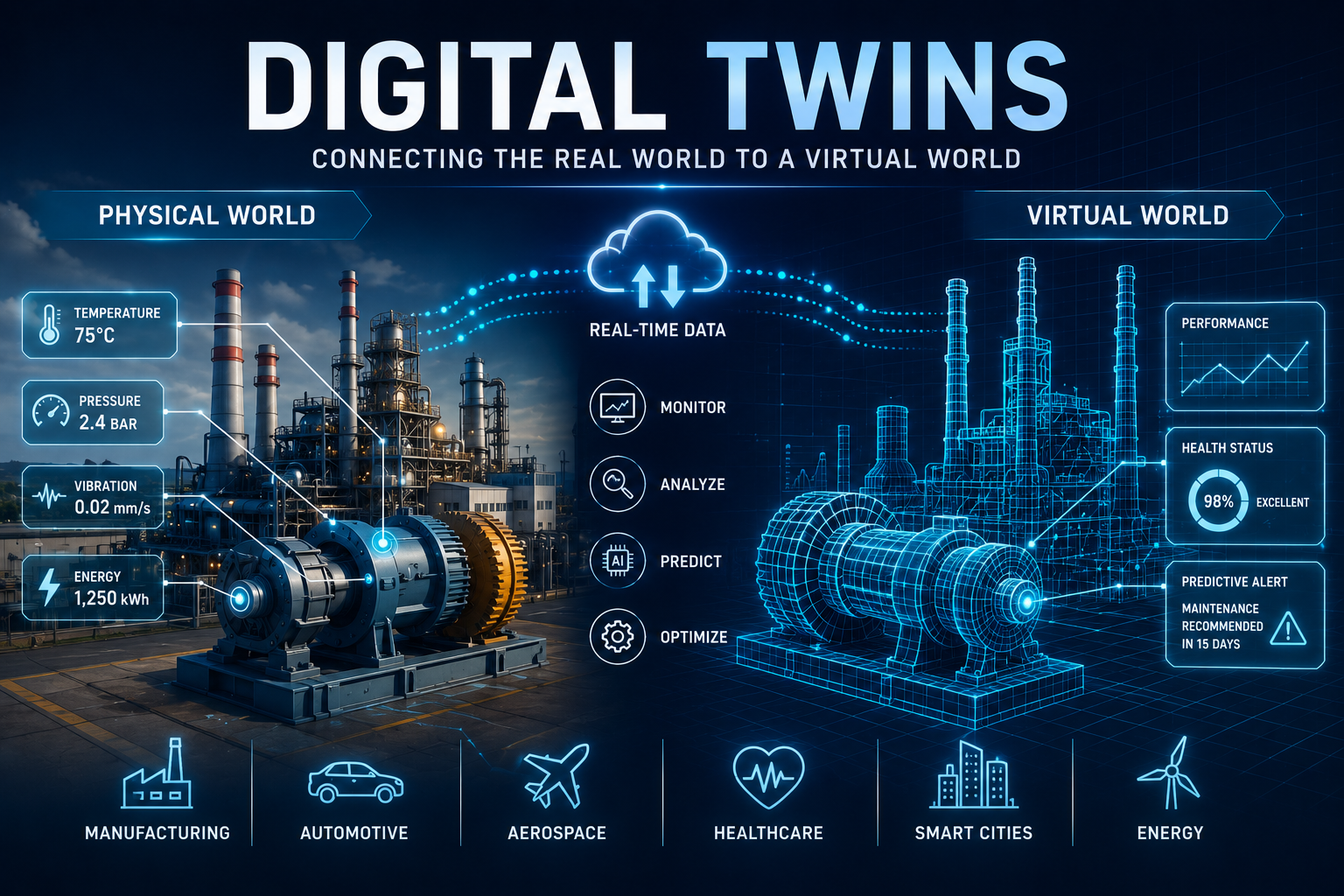
Digital Twins are virtual representations of physical objects, systems, or processes that continuously receive real-time data from sensors and connected devices. These virtual models accurately mirror the condition, behavior, and performance of their physical counterparts, enabling organizations to monitor, analyze, simulate, and optimize operations.
Unlike traditional simulations, Digital Twins remain synchronized with the physical object throughout its lifecycle. This continuous connection allows businesses to predict failures, improve efficiency, reduce costs, and make data-driven decisions.
Today, Digital Twins are widely used in manufacturing, healthcare, smart cities, aerospace, automotive, energy, construction, and industrial automation.
Simple Definition
Digital Twin = Physical Object + Real-Time Data + Virtual Model + Intelligent Analytics
Why Digital Twins Matter
Digital Twins help organizations understand how physical assets perform in real time without interrupting operations.
Key Advantages
- Real-time monitoring
- Predictive maintenance
- Reduced downtime
- Better decision-making
- Lower operational costs
- Increased productivity
- Improved product quality
- Enhanced sustainability
How Digital Twins Work
Digital Twins continuously collect and process information from physical assets.
Step 1: Data Collection
Sensors installed on machines collect:
- Temperature
- Pressure
- Speed
- Location
- Energy consumption
- Vibration
- Environmental conditions
Step 2: Data Transmission
The collected data is securely transmitted through IoT networks to the Digital Twin platform.
Step 3: Virtual Modeling
A digital replica updates continuously using incoming data.
Step 4: AI & Analytics
Artificial Intelligence analyzes patterns, detects anomalies, predicts failures, and recommends improvements.
Step 5: Decision Making
Engineers and operators receive insights for maintenance, optimization, and operational planning.
Digital Twin Architecture
Physical Asset
      │
      ▼
IoT Sensors
      │
      ▼
Internet / Edge Computing
      │
      ▼
Digital Twin Platform
      │
AI + Machine Learning
      │
Analytics Dashboard
      │
Predictions & Optimization
Key Components of Digital Twins
1. Physical Asset
The real-world object being monitored.
Examples:
- Machines
- Vehicles
- Buildings
- Factories
- Medical equipment
- Wind turbines
2. IoT Sensors
Collect operational data.
Examples:
- Temperature sensors
- GPS
- Cameras
- Motion sensors
- Pressure sensors
- Humidity sensors
3. Connectivity
Communication technologies include:
- Wi-Fi
- 5G
- Ethernet
- LPWAN
- Bluetooth
4. Cloud & Edge Computing
Store and process large volumes of data efficiently.
5. Artificial Intelligence
AI enables:
- Predictive maintenance
- Fault detection
- Optimization
- Intelligent automation
6. Visualization Dashboard
Provides real-time insights using:
- Charts
- Graphs
- Alerts
- 3D models
- Performance reports
Types of Digital Twins
Component Twins
Represent individual parts of equipment.
Product Twins
Represent complete products.
Process Twins
Model manufacturing or business processes.
System Twins
Represent entire facilities or interconnected systems.
Digital Twins vs Simulation
| Feature | Digital Twins | Traditional Simulation |
|---|---|---|
| Real-Time Data | ✅ Yes | ❌ No |
| Continuous Updates | ✅ Yes | ❌ No |
| IoT Integration | ✅ Yes | Limited |
| AI Analytics | ✅ Yes | Optional |
| Predictive Insights | ✅ Yes | Limited |
| Operational Monitoring | ✅ Yes | No |
Benefits of Digital Twins
Real-Time Monitoring
Continuously monitor equipment and systems.
Predictive Maintenance
Detect failures before they happen.
Reduced Downtime
Prevent unexpected equipment failures.
Cost Savings
Optimize maintenance and energy usage.
Improved Product Quality
Identify production defects early.
Faster Innovation
Test changes virtually before implementation.
Better Sustainability
Reduce waste, emissions, and energy consumption.
Real-World Applications
Smart Manufacturing
- Machine monitoring
- Production optimization
- Quality inspection
Healthcare
- Patient monitoring
- Hospital equipment management
- Medical device optimization
Automotive
- Connected vehicles
- Autonomous driving
- Vehicle diagnostics
Aerospace
- Aircraft maintenance
- Flight performance analysis
- Engine monitoring
Smart Cities
- Traffic management
- Water systems
- Smart infrastructure
- Public safety
Construction
- Building monitoring
- Infrastructure management
- Structural analysis
Energy
- Wind turbines
- Power plants
- Solar farms
- Smart grids
Retail
- Warehouse optimization
- Supply chain visibility
- Inventory management
Industries Using Digital Twins
- Manufacturing
- Healthcare
- Automotive
- Aerospace
- Construction
- Energy
- Oil & Gas
- Logistics
- Retail
- Agriculture
- Telecommunications
- Smart Cities
Digital Twins and IoT
IoT devices continuously collect operational data, while Digital Twins convert this data into meaningful insights for monitoring and optimization.
Workflow
Physical Asset
↓
IoT Sensors
↓
Cloud / Edge Computing
↓
Digital Twin
↓
AI Analytics
↓
Actionable Insights
Digital Twins and Artificial Intelligence
AI enhances Digital Twins by:
- Predicting failures
- Detecting anomalies
- Optimizing operations
- Automating decisions
- Improving forecasting
- Supporting autonomous systems
Challenges of Digital Twins
- High implementation costs
- Data privacy concerns
- Cybersecurity risks
- Integration complexity
- Large data management
- Scalability challenges
- Need for skilled professionals
Future of Digital Twins
Future developments include:
- AI-powered Digital Twins
- Industrial Metaverse integration
- 6G connectivity
- Smart factories
- Autonomous manufacturing
- Sustainable infrastructure
- Personalized healthcare
- Smart transportation
- Digital Twin cities
- Quantum computing integration
Best Practices for Implementing Digital Twins
- Define clear business objectives.
- Use reliable IoT sensors.
- Ensure high-quality data collection.
- Implement strong cybersecurity measures.
- Leverage AI for predictive analytics.
- Regularly update digital models.
- Monitor performance continuously.
Why Businesses Should Adopt Digital Twins
Organizations can:
- Improve productivity
- Reduce operational costs
- Increase equipment lifespan
- Enhance customer satisfaction
- Accelerate innovation
- Improve safety
- Achieve sustainability goals
Conclusion
Digital Twins are transforming industries by creating intelligent virtual replicas of physical assets that continuously mirror real-world conditions. By combining IoT, Artificial Intelligence, cloud computing, and real-time analytics, Digital Twins enable organizations to predict problems before they occur, optimize operations, improve efficiency, and reduce costs.
As smart factories, connected vehicles, healthcare systems, and smart cities continue to evolve, Digital Twins will become a fundamental technology driving the future of Industry 4.0 and digital transformation.
Frequently Asked Questions (FAQs)
What is a Digital Twin?
A Digital Twin is a virtual representation of a physical object, process, or system that continuously receives real-time data to monitor and optimize performance.
How do Digital Twins work?
They collect data from IoT sensors, update a virtual model in real time, analyze information using AI, and provide actionable insights for optimization and predictive maintenance.
What are the benefits of Digital Twins?
Key benefits include predictive maintenance, reduced downtime, improved efficiency, cost savings, real-time monitoring, and better decision-making.
Where are Digital Twins used?
Digital Twins are widely used in manufacturing, healthcare, automotive, aerospace, construction, energy, logistics, retail, and smart cities.
What technologies power Digital Twins?
Digital Twins combine IoT, Artificial Intelligence, Machine Learning, Cloud Computing, Edge Computing, Big Data Analytics, and 5G connectivity.
Are Digital Twins the future of Industry 4.0?
Yes. Digital Twins are considered a core technology of Industry 4.0 because they enable intelligent monitoring, predictive analytics, automation, and digital transformation.