

Agentic AI in Drug Discovery: Revolutionizing the Future of Pharmaceutical Research
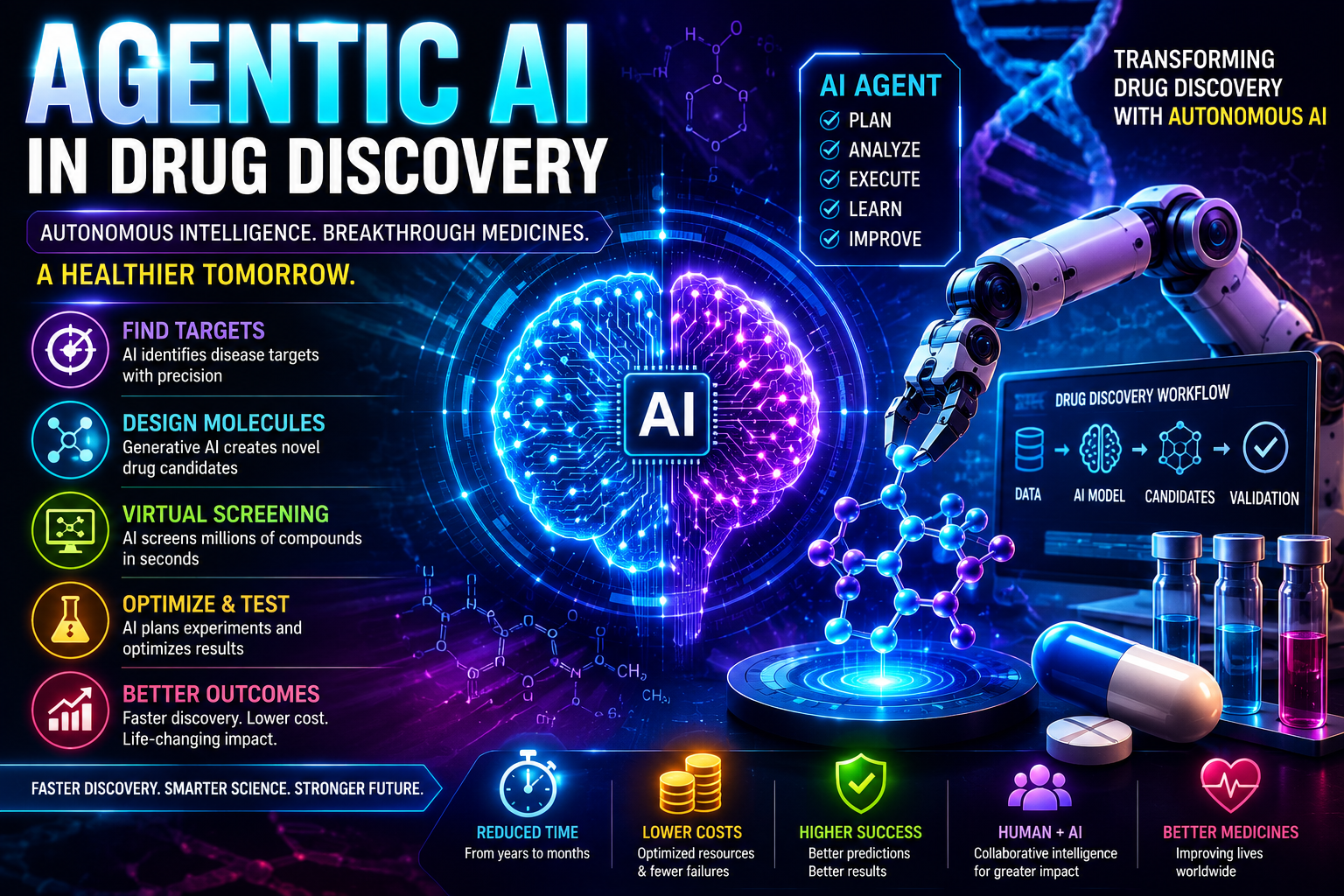
The pharmaceutical industry is experiencing one of its biggest technological transformations with the rise of Agentic AI. Unlike traditional artificial intelligence systems that simply analyze data or make predictions, Agentic AI can independently plan, execute, evaluate, and optimize complex research workflows.
In drug discovery, where developing a single medicine may take 10–15 years and cost billions of dollars, Agentic AI promises to dramatically reduce research time, improve success rates, and accelerate the delivery of new treatments to patients.
What Is Agentic AI?
Agentic AI refers to autonomous AI systems capable of making decisions, setting objectives, interacting with multiple tools, and continuously learning while completing complex tasks with minimal human intervention.
Instead of waiting for instructions after every step, an Agentic AI system can:
- Define research objectives
- Search scientific databases
- Analyze biomedical data
- Generate hypotheses
- Design molecules
- Simulate experiments
- Evaluate results
- Plan the next iteration automatically
Think of Agentic AI as an intelligent research scientist working alongside human experts.
Why Drug Discovery Needs Agentic AI
Traditional drug discovery involves multiple stages:
- Disease identification
- Target identification
- Molecule discovery
- Lead optimization
- Preclinical testing
- Clinical trials
- Regulatory approval
Each stage generates enormous volumes of biological, chemical, genomic, and clinical data.
Researchers often spend months manually reviewing publications, screening compounds, and designing experiments.
Agentic AI automates much of this process.
How Agentic AI Works in Drug Discovery
Step 1: Disease Understanding
The AI agent gathers information from:
- Scientific journals
- Clinical databases
- Genomic repositories
- Protein databases
- Electronic health records
- Research publications
It identifies disease mechanisms and promising biological targets.
Step 2: Target Identification
Instead of manually analyzing thousands of proteins, the AI evaluates:
- Gene expression
- Protein interactions
- Biological pathways
- Disease biomarkers
It ranks the most promising therapeutic targets.
Step 3: Molecule Generation
Using generative AI models, Agentic AI creates entirely new molecular structures optimized for:
- Effectiveness
- Stability
- Safety
- Solubility
- Bioavailability
Thousands of candidate molecules can be designed within hours.
Step 4: Virtual Screening
Rather than physically testing millions of compounds, AI simulates interactions between molecules and biological targets.
Benefits include:
- Reduced laboratory costs
- Faster screening
- Better candidate selection
Step 5: Experiment Planning
Agentic AI determines:
- Which compounds should be synthesized
- Which experiments are most informative
- How laboratory resources should be allocated
This significantly reduces trial-and-error experimentation.
Step 6: Continuous Learning
After each experiment, the AI:
- Analyzes results
- Updates its models
- Learns from failures
- Suggests improved compounds
This creates a continuous optimization loop.
Real-World Applications
1. Cancer Drug Discovery
Agentic AI can identify mutations responsible for cancer and design targeted therapies.
Benefits:
- Personalized medicine
- Faster oncology research
- Precision treatment
2. Rare Diseases
Many rare diseases receive limited research attention due to small patient populations.
Agentic AI can analyze limited datasets to identify potential treatments more efficiently.
3. Antibiotic Discovery
With antimicrobial resistance becoming a global challenge, AI can rapidly identify novel antibiotic candidates that traditional methods may overlook.
4. mRNA Therapeutics
Agentic AI assists in:
- Lipid nanoparticle (LNP) optimization
- mRNA sequence design
- Delivery system improvement
- Stability prediction
5. Protein Engineering
AI designs proteins with improved:
- Binding affinity
- Stability
- Therapeutic effectiveness
Real-World Examples
1. Isomorphic Labs
A company focused on using advanced AI to accelerate drug discovery by predicting molecular interactions and supporting pharmaceutical research.
Website: https://isomorphiclabs.com
2. Insilico Medicine
Uses generative AI to:
- Discover drug targets
- Design molecules
- Optimize compounds
- Accelerate clinical candidates
Website: https://insilico.com
3. Recursion
Combines AI with automated laboratory experiments to identify promising drug candidates from large-scale biological datasets.
Website: https://www.recursion.com
4. Atomwise
Uses deep learning to predict how small molecules interact with proteins, enabling virtual screening at scale.
Website: https://www.atomwise.com
5. BenevolentAI
Applies machine learning and knowledge graphs to discover new therapeutic opportunities.
Website: https://www.benevolent.com
Agentic AI Workflow
Scientific Literature
        │
        ▼
 Disease Analysis
        │
        ▼
 Target Identification
        │
        ▼
 Molecule Generation
        │
        ▼
 Virtual Screening
        │
        ▼
 Laboratory Testing
        │
        ▼
 Experimental Results
        │
        ▼
 AI Learns & Optimizes
        │
        ▼
 Improved Drug Candidate
Advantages of Agentic AI
Faster Research
Tasks that once took months can now be completed in days or weeks.
Lower Costs
Automated workflows reduce laboratory expenses and failed experiments.
Better Decision-Making
AI analyzes millions of data points beyond human capacity.
Personalized Medicine
Treatments can be tailored using patient-specific genomic and clinical data.
Higher Success Rates
More accurate candidate selection improves the likelihood of successful clinical outcomes.
Challenges
Data Quality
AI performance depends on access to high-quality, diverse datasets.
Regulatory Compliance
AI-generated drug candidates must satisfy strict regulatory standards.
Explainability
Researchers and regulators need transparent reasoning behind AI recommendations.
Ethical Considerations
Responsible governance is essential to address privacy, bias, and accountability in AI-assisted drug discovery.
Future Trends (2026–2035)
- Fully autonomous AI research laboratories
- Multi-agent AI systems collaborating across research tasks
- AI-driven digital twins for disease modeling
- Integration with quantum computing for molecular simulation
- Rapid development of personalized therapies
- AI-assisted clinical trial design and patient recruitment
- Automated optimization of gene-editing therapies
Conclusion
Agentic AI is redefining the future of pharmaceutical research by transforming every stage of drug discovery—from target identification to molecule design and experimental optimization. While human expertise remains essential for scientific judgment, ethics, and regulatory oversight, autonomous AI agents can significantly accelerate research, reduce costs, and improve the likelihood of discovering effective treatments. As AI technologies continue to evolve, Agentic AI is poised to become a cornerstone of next-generation precision medicine and pharmaceutical innovation.
Frequently Asked Questions (FAQs)
What is Agentic AI in drug discovery?
Agentic AI refers to autonomous AI systems that can independently perform complex research tasks such as identifying drug targets, designing molecules, planning experiments, and learning from results with minimal human intervention.
How does Agentic AI differ from traditional AI?
Traditional AI typically performs specific analytical tasks, while Agentic AI can plan, execute, adapt, and optimize multi-step workflows autonomously.
Which companies are using AI for drug discovery?
Leading organizations include Isomorphic Labs, Insilico Medicine, Recursion, Atomwise, and BenevolentAI.
Can Agentic AI replace scientists?
No. Agentic AI augments researchers by automating repetitive and data-intensive tasks, enabling scientists to focus on hypothesis generation, experimental validation, and strategic decision-making.
External Resources
- Google DeepMind – Isomorphic Labs: https://isomorphiclabs.com
- Insilico Medicine: https://insilico.com
- Recursion: https://www.recursion.com
- Atomwise: https://www.atomwise.com
- BenevolentAI: https://www.benevolent.com
- Nature Biotechnology: https://www.nature.com/nbt/
- PubMed: https://pubmed.ncbi.nlm.nih.gov/
- U.S. Food & Drug Administration (FDA): https://www.fda.gov/
- European Medicines Agency (EMA): https://www.ema.europa.eu/